The 9 Best Chess Clocks for 2026, Ranked by a Club Player
Nine clocks ranked by mode list, lever feel and whether the display survives a time scramble.
| Image | Pick | Product | Buy |
|---|---|---|---|
 | Best overall | DGT 2500 Official FIDE Chess Clock with Clear Display | Price |
 | Best for club night | DGT North American Chess Clock and Game Timer | Price |
 | Best preset library | LEAP Digital Chess Clock Fide Approved Chess Timer | Price |
 | Best for byo-yomi | LEAP Chess Clock Digital Chess Timer Advanced for Board Gam… | Price |
 | Best looking | A&A Chess Clock | Price |
 | Best for beginners | VINJOE Digital Chess Clock Timer | Price |
 | Best for Go players | Feiyasi Chess Clock | Price |
 | Best battery bundle | Feiyasi Digital Chess Clock Timer | Price |
 | Best analog | BETTERLINE Analog Chess Clock Timer Professional Grade Wood… | Price |
The DGT 2500 is the best chess clock here, and it is the only one on this list whose listing says FIDE approved and recommended it. It measures 198 x 110 x 60 mm, weighs 320 grams, and its display runs 174 mm wide. Nine clocks are ranked below, from that one down to a wind-up wooden analog.
I have set a lot of clocks on club tables, and I read the one-star reviews before the five-star ones. I have not unboxed any of these nine, so everything below comes from the spec sheets, the mode lists and the pattern in what owners report. Where a listing gives no size and no weight, I say so rather than guess. If you want a wider sweep of tournament timers, my guide to the best digital chess clocks covers the same ground from a different angle.
How I picked these
I set five thresholds and dropped anything that missed two of them. Then I ranked what survived by how much of a hurry you would be in if it failed mid-game.
- Modes. The preset list has to cover sudden death, bonus (Fischer increment), delay and byo-yomi. That is four modes, and every digital clock here clears it. The analog stays on the list on purpose.
- Readability. Digits you can read from about two feet away while seated. The DGT 2500 lists a display at 174 x 32 mm. Several clocks here list no display size at all, and I count that against them.
- Footprint. Around 200 mm wide or less, so the clock sits next to a board with 2 to 2.5 inch squares without invading the pieces. US Chess guidance puts king height at 3.375 to 4.5 inches with a king base near 75 to 80 percent of the square, and a clock that overhangs into that strip gets clipped by a rook.
- Weight and lever. 320 grams is the number I like. Most of the ABS-shell clocks here publish no weight, which usually means a light body that walks across the table when you hit it during a scramble.
- Power. One or two AA or AAA cells, plus memory for your settings so you are not re-entering 90 minutes with a 30-second increment every Tuesday. Two of these ship with batteries and the rest do not.
The rest of the kit matters too. Clocks, scoresheets, bags and the small stuff all live in my chess accessories roundup.
This is DGT's FIDE-approved tournament box, with a flag bar across the top, optional automatic period transition and a quick time penalty button an arbiter can use without stopping the game. The part I care about is the lever. DGT made it more visible on this model, and at 320 grams with a 198 mm body it stays where you put it when you slap it at 11:58 pm in a league match.
My concession: it is the deepest menu on this list. If all you play is five-minute skittles at the kitchen table, you are carrying a settings tree and an approval stamp you will never use, and 198 mm is alot of table next to a small board.
What owners say: the display gets mentioned first, then the flag bar. The recurring gripe is the manual, which assumes you already know what a period is and why you would want one to transition automatically.
- Good for: FIDE-rated events and anyone who wants the clock the arbiter expects to see on the table.
- Skip it if: you want two buttons and a five-minute preset, nothing else.
2. DGT North American Chess Clock and Game Timer
- Quick and easy to set and program!
- Choose quick-set options for the most popular controls
- DGT North American Chess Clock and Game timer
The North American is the plainest good clock DGT makes: 22 preset timing modes, quick-set options for the popular controls, delay functions and a large display. There is no menu archaeology here. You scroll to 90 minutes with a five-second delay, press go, and get on with the game. If you have played an evening league in the US, you have probably pressed one of these.
The catch is that the listing says nothing about FIDE approval, and it gives no dimensions and no weight. That silence is why it sits behind the 2500 rather than beside it. It also lacks the flag bar and penalty button, so an arbiter running a rated event has less to work with.
What owners say: owners describe it as the clock they never think about, which is the compliment that matters. The complaint that shows up is about the beep, which some clubs want and some tournament halls do not.
- Good for: weekly club chess and anyone who sets a clock in the dark and wants it to beep once and start.
- Skip it if: you play FIDE-rated chess or you want the modern display.
3. LEAP Digital Chess Clock Fide Approved Chess Timer
- Available for Chinese Chess, International Chess,I-GO and Other 2 Players Board Game
- Alarm as the time Runing out. Can Turn up/off the Alarm;1 x AA battery (Not Included )
- Bouns and Delay functions with Easy Setting, Light Weight, Setting Memoried.
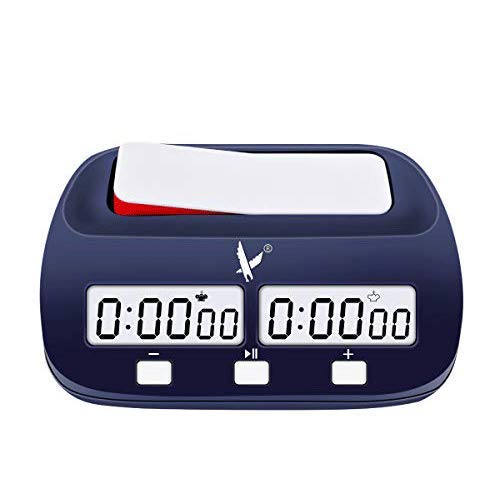
LEAP's FIDE-approved timer carries 37 preset programs, a countdown that runs to 10 hours, count up and down, byo-yomi, bonus, delay, an on/off alarm and setting memory. It handles international chess, Chinese chess, Go and any other two-player game you point it at. One AA battery runs it.
Here is the concession. The shell is ABS, the listing gives no weight, and light plastic clocks creep across the table when you hit them hard. The alarm is also a beep you cannot soften, only silence, which is fine at home and awkward in a quiet hall.
What owners say: the preset count is the thing owners brag about, and the memory function comes up often from people who play the same control every week. The recurring complaint is the manual's translation, which takes a second read.
- Good for: players who move between chess, Go and Chinese chess and want one clock for all three.
- Skip it if: you want a heavy body that sits still under a hard press.
4. LEAP Chess Clock Digital Chess Timer Advanced for Board Game and Ches…
LEAP's updated 2021 model adds move counts and lets you set two different base times, one per side, which is handy for teaching games where a beginner gets more time. You get 37 presets, bonus, delay (Fischer), byo-yomi, alarm on/off and setting memory in an ABS shell.
The limitation is printed right in the listing: no counting up. If you run a club session on a count-up clock, or you like to see elapsed time after a game, this model will not do it. It is also one of several here with no published dimensions or weight.
What owners say: owners point to the move counter and the two-base-time trick as the reasons they bought it. The gripe that recurs is the button feel, which is softer than a DGT lever.
- Good for: byo-yomi players, Go clubs and coaches running unequal-time teaching games.
- Skip it if: you need count-up timing or a firm, clicky lever.
The A&A is the best-looking clock on this list, and I do not say that often about plastic. Matte finish, smooth curves, a rocker bar that looks like it belongs on a piece of furniture, and a choice of black or white. Under the surface: 38 preset modes, a quick reset on a double-press of the on/off button, arbiter mode, a forced move counter, and sound you can toggle off.
The concession is the battery situation. It runs on two AAA cells and they are not in the box, and the listing gives no dimensions or weight. It also does not claim FIDE approval, so if an arbiter at a rated event is picky, this is not the one to bring.
What owners say: the 4,000-plus hours of claimed battery life is the headline owners repeat, along with the rocker feel. The complaint that shows up is the reset gesture, which a few people trigger by accident when they mean to pause.
- Good for: a clock that lives on a coffee table or a streamed board and gets admired between games.
- Skip it if: you need FIDE approval or you want batteries included.
VINJOE's timer claims millisecond-precision timing, ships with bonus, delay and positive time modes, one-touch start, pause and reset, an alarm, setting memory and a dedicated restart button so you cannot wipe a game by fumbling. Two AA batteries run it, and they are not included.
The problem with the listing is that it is all adjectives and almost no numbers. No dimensions, no weight, no mode count, no display size. I can tell you what it does, not how big it is, and for a clock that has to fit beside a board that matters. Treat the "scratch-resistant casing" claim as marketing until you have it in hand.
What owners say: the restart button and the large digits are the two features owners mention, mostly from people playing casual games with kids. The recurring note is that the buttons need a firm press, which slows down blitz.
- Good for: family game nights, beginners and anyone who has accidentally reset a clock mid-game.
- Skip it if: you play fast blitz or you want published specs before you buy.
Feiyasi's wood grain model is the Go-friendly pick on this list. Five modes (basic, delay, bonus, byo-yomi and positive timing), a 10-hour maximum, volume adjustment with a mute setting, and one AA battery. The finish is a wood grain color rather than actual wood, so do not expect the feel of a wooden clock.
The concession is documentation. No dimensions, no weight, no preset count and no FIDE approval are listed. You are buying on the mode list and the price band, and you will be learning the menus from the product page video rather than from a printed manual.
What owners say: owners describe the setup as quicker than they expected, and the mute switch gets praise from people playing in the same room as a sleeping child. The note that recurs is that the plastic finish photographs warmer than it looks in person.
- Good for: Go and byo-yomi players who want a quiet clock with a five-mode menu.
- Skip it if: you want real wood or a published spec sheet.
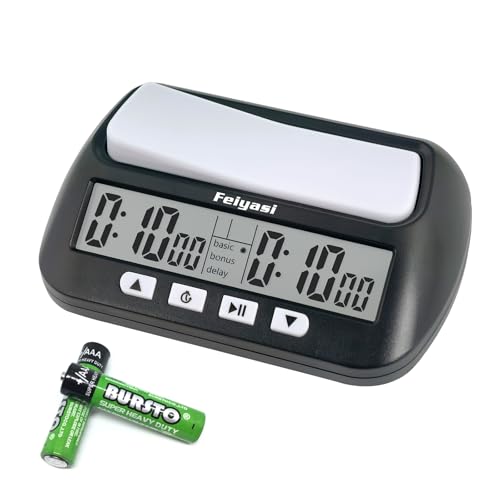
This is the value version of the Feiyasi: four modes (basic, reward, delay, forward timing), simple settings, adjustable volume with mute, a power-off switch and two AA batteries in the box. For a first clock or a spare that lives in a bag, that bundle is the whole argument.
The concession is byo-yomi. It is not on the mode list here, so if you play Go or any event with a byo-yomi period, step up to the wood grain model above. There is also no preset count and no FIDE approval listed.
What owners say: the included batteries and the simple menu are what owners bring up, usually from people who bought it as a second clock. The complaint that recurs is the lack of a byo-yomi mode once they started playing Go.
- Good for: a first digital clock, a spare for the club bag, or a gift for a kid starting out.
- Skip it if: you play Go or anything with byo-yomi periods.
9. BETTERLINE Analog Chess Clock Timer Professional Grade Wooden Clock W…
- INCREDIBLY ACCURATE Second-hand improves the accuracy of this 6.3-inch by 4-inch chess clock
- NO BATTERY NEEDED Wind-up mechanism ensures that you'll never have to interrupt a game to replace a battery
- SO SIMPLE TO USE Just wind it up and set the hands before the game begins
The BETTERLINE is a wind-up wooden analog clock, 6.3 by 4 inches, with a second hand and no battery anywhere. You wind it, set the hands, and play. For sudden death games and skittles it is completely dependable, and it looks like it belongs on a wooden board rather than next to one.
The concession is arithmetic. Analog means no increment, no delay, no byo-yomi and no move counter, so 3+2 blitz is out of the question and a 30-second add-on is something you do by hand with the knob. If your club runs any modern control, this is a display piece that also tells time.
What owners say: owners talk about the wood and the winding mechanism, and about it still working after years in a bag. The recurring gripe is the tick, which is audible in a quiet room.
- Good for: casual games, historical sets and anyone who refuses to think about batteries.
- Skip it if: you play blitz, increment controls or anything an arbiter has to verify.
What actually matters when you buy chess clocks
The mode list, not the mode count. Thirty-seven presets sounds better than 22 untill you notice both cover the four things you need: sudden death, bonus, delay and byo-yomi. Check for those four by name before you get excited about the number. A clock that does 90 minutes with a 30-second increment and a 3+2 blitz game covers 95 percent of what most players ever touch.
Display size and digit height. The DGT 2500 lists a 174 x 32 mm display. Most of the others list nothing, which tells you something. You need to read the digits from about two feet away, seated, in a hall with bad lighting, while your opponent is pressing the lever.
Weight and lever travel. 320 grams is a good target. Below that, the clock slides when you hit it, and you spend the game nudging it back. The lever or rocker also has to register a light press, because in a time scramble you are not pressing gently.
Where it sits. A 198 mm clock next to a board with 2.25 inch squares is fine. Next to a 1.75 inch travel board it is half the table. If you play on a vinyl roll-up mat at home, measure the gap before you buy a wide clock.
Power and memory. One AA cell is the sweet spot for weight and cost. Two AAA is fine. What matters more is whether the clock remembers your settings, because re-entering 90+30 every week is the fastest way to stop using a good clock. If you are setting up a permanent board, my picks for chess tables have room beside them for a full-size timer.
Side by side
| Clock | Key spec | Best for |
|---|---|---|
| DGT 2500 | 198 x 110 x 60 mm, 320 g, FIDE approved | Best overall |
| DGT North American | 22 preset modes, delay functions | Best for club night |
| LEAP FIDE Approved | 37 presets, 10 hour max, 1 AA | Best preset library |
| LEAP 9921 | 37 presets, byo-yomi, move counts, no count-up | Best for byo-yomi |
| A&A | 38 modes, 2 AAA, 4,000+ hour claim | Best looking |
| VINJOE | 2 AA, bonus, delay, positive time | Best for beginners |
| Feiyasi Wood Grain | 5 modes, 1 AA, 10 hour max | Best for Go players |
| Feiyasi Digital | 4 modes, 2 AA included | Best battery bundle |
| BETTERLINE | Wood, wind-up, 6.3 x 4 inches | Best analog |
Which one I'd buy
If you play rated chess, buy the DGT 2500 and stop reading. The FIDE approval, the flag bar and the 320 gram body are the three things an arbiter and a time scramble will both test, and it passes all three.
If you play club chess once a week and nothing else, the DGT North American does the job with 22 presets and less menus to get lost in. And if you are buying for someone else, a beginner or a kid, the Feiyasi with two AA batteries in the box is the low-risk pick, and it sits nicely alongside the other ideas in my gifts for chess lovers guide. Whichever you choose, press the lever once before the game starts. Half of all clock disputes are a lever that was never tested.
Questions people ask me
How does a chess timer work?
Two clocks, one per player, and only one runs at a time. You press your side of the lever after you move, which stops your clock and starts your opponent's. Run out and you lose on time unless your opponent cannot possibly mate you.
Do I need a FIDE-approved chess clock?
Only for FIDE-rated events, where an arbiter may insist on an approved model. Club nights, scholastic events and kitchen blitz do not care. A clock with bonus and delay modes covers almost everything else.
Is an analog chess clock still usable?
For sudden death and casual games, yes, and a wind-up clock never needs a battery. It cannot do increment or delay, so it is a poor fit for 3+2 blitz or any event with a 30-second add-on.