Travel and Giant Chess Sets: Pick the Size Class First (2026)
Small enough for a carry-on or big enough for a schoolyard, both ends of this category turn on the same four numbers.
The size class comes before anything else
Travel sets and giant sets are two purchases wearing one category label. One rides in a backpack next to a paperback, the other gets staked to a lawn. So start with king height, because that single number sorts the whole page. On the small end, travel sets run 1.5 to 3 inches; the pocket magnetic ones sit around 1.5 to 2 inches with squares near 0.8 inch. On the big end, "giant" gets used for everything from a 12-inch king to a 48-inch monster chained to a resort patio. The 25-inch class is the sane middle for schools and club fundraisers. If you want the standard sizes for comparison, the chess sets guides cover king heights from 3.375 up to 4.5 inches.
Travel sets: weigh the packed box, not the king
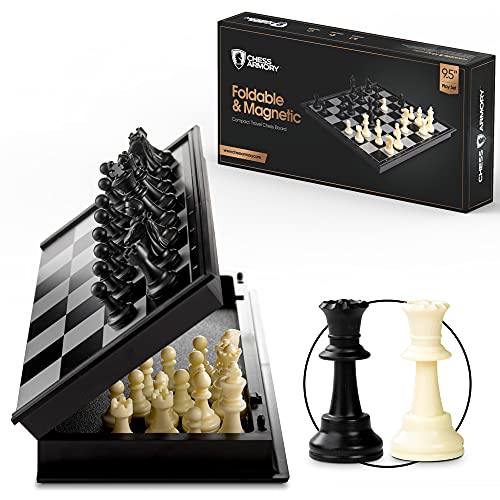
US Chess puts tournament squares at 2 to 2.5 inches, with the king base around 75 to 80 percent of the square. Travel sets cheat that ratio and mostly get away with it. What they don't get away with is a hollow 2-inch king on a roll-up vinyl board, which goes over every time the bus hits a pothole. Owners keep mentioning magnets and latches, in that order. Weigh the whole package. Under a pound disappears into a daypack. Two pounds with a hard case still fits and plays better, and I'd take the heavier one. My concession: if you're hiking the thing in, ounces win and you live with the wobble.
Giant sets: the wind is the real opponent
A hollow 25-inch king weighs a few pounds and tips in a decent gust. Sand-filled or water-weighted bases fix that and cost more. Square size sets your playing distance: 5-inch squares for kids indoors, 8-inch squares on a patio, 12-inch squares outdoors where people need to stand back to move. Pieces that big get stored rather than left out, so the carry bag matters as much as the plastic. Price runs about $150 for a basic 12-inch set and $400 to $900 for the 25-inch weighted class, based on what I see listed. And a second concession: giant sets are a hassle. Level ground, a hose, and somewhere to dry 32 pieces the size of bowling pins. The chess boards section covers surface and base choices in more detail.
Check the specs before the sunset photos
Six lines on a listing tell you what you need: king height, square size, piece count, material, base type, and what's in the box. If square size isn't listed, that's your answer. Contrast matters more outdoors than any color scheme, and a printed mat beats painted concrete every time. If you want personality rather than portability, themed chess sets get you there without wrecking the proportions.
What the guides below cover
The pages under this intro split the work by size class. One covers travel-size folding and magnetic sets by packed weight. Another handles outdoor boards and bases. If you need clocks, bags or scorebooks to go with either, the chess accessories guides sort the small stuff. Match a 2.25-inch square with a king base near 1.75 inches and nothing looks wrong on the table.
Questions people ask me
What size counts as a giant chess set?
Most giant sets run from a 12-inch king up to 48 inches, with squares from about 5 inches to 12 inches. The 25-inch king on 8-inch squares is the usual pick for schools and patios. Anything under 12 inches is really an oversized garden set.
Are magnetic travel chess sets good enough for a real game?
Yes, if the pieces have some weight and the magnets hold through a jostle. Look for a king base near 75 percent of the square and a case with a proper latch. The 1.5-inch sets are for planes and waiting rooms, not tournament prep.
How much do giant chess sets cost?
Expect around $150 for a basic 12-inch plastic set and $400 to $900 for the 25-inch weighted class. Wood and custom builds go higher. Storage bags and bases are often sold separately, so read the contents list.
Buying guides