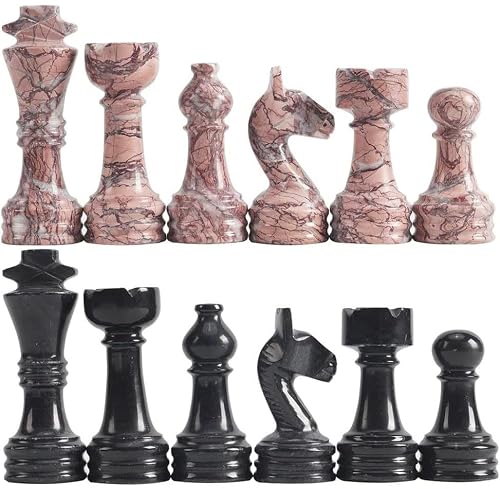
Chess Pieces for Sale: What to Check Before You Buy in 2026
Four decisions separate a set you'll keep for twenty years from one you'll pass on by spring.
I've bought chess pieces three ways. As a full set in a box, as a coffee can of loose plastic men from a club clearing out a closet, and once as a single black rook to replace one that went home in a kid's pocket. All three taught me the same thing. Pieces are the part of the game you actually touch, and most people pick them last, after the board. That's backwards.
Here's how I'd narrow the field. Four decisions matter, and three of them are numbers.
Start with the king height, then work backward to your board
US Chess guidance puts tournament-sized kings at 3.375 to 4.5 inches tall, with squares between 2 and 2.5 inches, and a king base around 75 to 80 percent of the square. That last figure is the one people skip. A king whose base crowds the square looks wrong and knocks into its neighbors during a scramble of captures. Measure your board's squares before you do anything else. If the board is still an open question, my chess boards section covers square sizes and surfaces in more depth than I can here.
Decide the material, because it sets the weight and the price
Wood is warm and repairable. Plastic is cheap and close to indestructible. Resin and metal look heavy and often feel top-heavy in the hand. On paper, a weighted plastic club set runs $30 to $60, a boxwood set lands around $150 to $400 depending on the turning, and carved decorative pieces pass $1,000 without much effort. Price isn't playing quality. I keep a $25 plastic set on the kitchen table and it gets more use than the wooden one in the study. What matters is the base. A piece that rattles when you shake it isn't filled, and a piece that isn't filled slides instead of staying put.
Choose pieces alone or the whole matched set
Buying pieces by themselves makes sense when you already own a board you like, when you want a particular style on a particular surface, or when you're replacing damage. Buying everything together removes the guessing. If you're starting from nothing, the chess sets guide walks through what a matched pairing looks like and where the money actually goes. One concession: a set from a single maker usually fits together better than pieces you assembled separately, because that maker sized the king base to their own squares.
Check the count, the extras, and the storage
A regulation set is 32 pieces plus spare queens, and most tournaments expect two extras. Count them in the listing instead of assuming. Felt pads on the bases aren't cosmetic; they protect the board and cut the clatter that gets you glared at in a quiet hall. A cloth bag or a slotted box matters more than it sounds, because loose pieces in a drawer lose their kings. My chess accessories section covers bags, clocks, and the small gear that keeps a set playable for years.
Which guide to open next
Buying for a club or a tournament hall? Size and weight first, styling a distant third. Buying a gift, or a first set for a kid who's just learning? Then styling is half the fun, and the themed chess sets guide is the better entry point. Travelers and anyone furnishing a patio should look at folding and garden sizes before ordering anything full size, since the jump between a table set and a lawn set is bigger than most people expect.
Every listing on this page follows the same rules: pieces clearly described, sizes and materials spelled out, and no guessing about specs the seller didn't print. Start with your square measurement. Everything else follows.
Questions people ask me
How tall should chess pieces be for a 20 inch board?
A 20 inch board usually has squares somewhere between 2 and 2.25 inches once you account for the border. That points to a king between roughly 3.75 and 4.25 inches tall. Check the king base as well, since it should sit around 75 to 80 percent of the square.
Are plastic chess pieces acceptable for tournament play?
Yes. US Chess doesn't require wood or any specific material, so a weighted plastic set with felted bases is normal at club and scholastic events. What gets noticed is a set that slides, tips, or arrives missing a piece.
What's a reasonable price for a set of chess pieces on their own?
Weighted plastic pieces usually run $20 to $60, boxwood pieces land around $100 to $400, and hand-carved decorative sets go well past that. You're paying for material, turning time, and how the base is weighted. None of that changes how well the set plays.
Buying guides