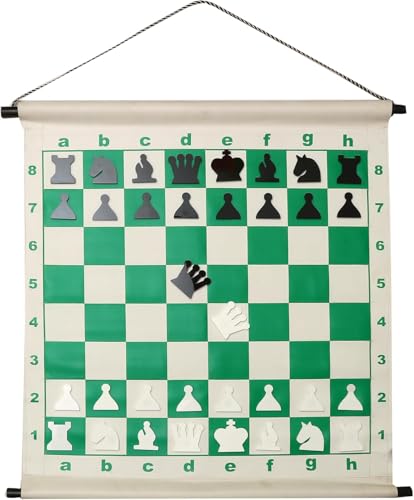
Chess Boards: How to Pick Squares, Wood, and Size for 2026
Four numbers decide whether a board lasts thirty years or holds a plant.
Chess boards are a sizing decision before they're a shopping decision
I've played on a board that cost more than a used car and on a $12 roll-up that came free with a magazine subscription. The cheap one wasn't the worse of the two. Four decisions separate a board you keep for thirty years from one that ends up holding a plant, and every one of them runs on numbers.
Square size gets set by the king's base
This is the decision people get backwards. They buy a board that fits the furniture, then discover their kings look like they're standing in different zip codes. US Chess guidance puts king height at 3.375 to 4.5 inches and squares at 2 to 2.5 inches, with the king's base covering roughly 75 to 80 percent of a square. A standard 3.75-inch club king on a 1.75-inch base wants 2.25-inch squares.
Measure the base of the pieces you already own before you shop. If you don't own any yet, buy board and men as a pair, which is why I point people to the chess sets guides first.
Solid wood, veneer, vinyl, or silicone
Every listing photographs well. The differences show up in thickness and in what happens during an August humidity spell. A solid wood board three-quarters of an inch thick sits on a table like furniture and weighs a few pounds. A vinyl roll-up at an eighth of an inch rolls into a tube and survives being stepped on. Veneer over MDF sits between them and takes more abuse than people admit, though edges fail when somebody drags the board across a table.
Solid wood isn't automatically the better buy. It moves with moisture, and a thin solid board can warp faster than decent veneer. If the board lives out on a table, buy thickness. If it rides in a backpack, buy vinyl.
A 20-inch board and a 15-inch board are for different lives
The tournament footprint is 20 inches with 2.25-inch squares, matching a standard club set on a folding table. A 15-inch board with 1.75-inch squares is for coffee tables, small apartments, and teaching a seven-year-old where the pieces start. Measure the table, measure the shelf, then measure the table again. I've met more people who regret size than regret material.
Pieces are half the purchase
A board with no men on it is tabletop decoration. Matching a set means checking base diameter on every piece, not just the king, because pawns are usually the ones that look lost on a wide square. The chess pieces section covers base diameters and per-piece weights if you're assembling the pair yourself.
Analog, or a board with a battery inside
Smart boards record moves and hand them to an app. On paper that's a good deal for solo study, and owners keep mentioning app updates and setup steps as the tax attached to it. The smart chess boards comparison is where I'd start reading. My rule: buy the board you'd still enjoy with the electronics switched off.
What shipping and local buying change
Buying in person has one real advantage, which is setting your own pieces on the board before money changes hands. Weight is the other thing. A 21-inch wooden board in a box is a different parcel from a rolled vinyl mat, and cross-border shipping prices that difference. If you're teaching a kid the moves or running a classroom, the printable chess board route costs nothing and works fine.
What the guides below cover
The rest of this page breaks the category out by material, size, and whether the board has a brain in it. Start with the size guidance if you already own pieces and just need squares to match. Start with the sets if you're buying everything at once.
Questions people ask me
What size chess board do I need for standard pieces?
US Chess guidance puts king height between 3.375 and 4.5 inches and squares between 2 and 2.5 inches. The king's base should cover about 75 to 80 percent of a square, so a 3.75-inch club king on a 1.75-inch base wants 2.25-inch squares. Measure the base of the pieces you already own before you order anything.
Is a solid wood chess board worth the extra cost?
It is if the board stays out on a table, because thickness and weight are what make it feel like furniture instead of a mat. Solid wood moves with humidity, though, and a thin solid board can warp faster than good veneer over MDF. Vinyl is the better call for anything that travels.
Do I need a smart chess board?
Only if you study or play online alone often enough to actually use the move tracking. Owners keep mentioning app dependence and setup steps as the trade-off, and the electronics age faster than the wood does. Buy a board you'd still enjoy with it switched off.
Buying guides