9 Best Chess Move Boards in 2026: What Lights Up, What Moves, What Coaches
Light-up move guidance, talking coaches, and boards that push the pieces for you, sorted by what's actually worth owning.
| Image | Pick | Product | Buy |
|---|---|---|---|
 | Best overall | ChessUp 2 | Price |
 | Best all-in-one computer | Chessnut Evo AI Chess Computer — Built | Price |
 | Best self-moving board | Chessnut Move | Price |
 | Best wooden self-moving | Miko Chess Grand: Your Ultimate AI Chess | Price |
 | Best robotic arm coach | SenseRobot AI Chess Robot with Robotic Arm | Price |
 | Best light-up trainer | Light Up Electronic Chess Board | Price |
 | Best for stronger players | Advanced Electronic Chess Board | Price |
 | Best for travel | GoChess Mini Smart Chess Board AI Electronic Chess Game Set… | Price |
 | Best gift for a fan | Harry Potter Chess Set Smart Electronic Board Game. Wizards… | Price |
Nine chess move boards made the final cut, and my top pick is the ChessUp 2. Touch a piece and it lights every legal square, flagging the moves that drop material before you commit to them. Then it plays ranked games on Chess.com and Lichess over its own WiFi, with no phone on the table.
That phone-free part is the whole argument. Most "smart" boards are a tablet accessory with a wooden frame around it. These nine split into four real approaches: light-up squares, a built-in screen, self-moving pieces, and one robotic arm. They do not do the same job, and two of them cost more than a decent used car payment.
How I picked these
I start with size, because size is where these boards quietly fail. US Chess guidance puts tournament kings at roughly 3.375 to 4.5 inches with 2 to 2.5 inch squares and a king base around 75 to 80 percent of a square. Most of this list runs 1.22 to 1.38 inch squares, which is travel-set territory, and I say so in every entry. My own club set is a 3.75-inch king on 2.25-inch squares. If you want the regulation numbers, I laid them out in my guide to the best chess boards for tournament play.
Second, sensing. I want to know whether the board sees a piece by RFID chip, by magnet, or by making you press a square. Chip and magnet systems track a whole move with no input from you. Press-a-square systems turn you into the sensor, and that gets old around move 30.
Third, base and material. Felt-padded bases, magnets strong enough to hold pieces upside down (one listing demonstrates exactly that), and a named wood species all tell you the maker thought about a Tuesday club night. When a listing doesn't name the wood or publish a weight, I say it isn't listed instead of guessing. A plastic-and-wood electronic board will never feel like a solid wood set, and if that's what you want, start with plain chess boards and skip the electronics.
Fourth, return friction. A board that needs three taps, a WiFi login and a firmware update before move one gets left in the closet by February. I weight setup time as heavily as engine strength. Nobody improves at chess by troubleshooting an app.
Touch a piece and ChessUp 2 lights the legal destinations. Touch it toward a bad square and it warns you before the move lands. The AI help is set per player, so a beginner can play with glowing hints while the stronger player at the other end gets nothing. The TouchSense pieces come in the box and need no pairing of their own.
Built-in WiFi is the quiet win here. The board connects straight to Chess.com and Lichess, so you're not handing a phone to a nine-year-old so they can play another nine-year-old. The app handles lessons and lets you set up any position and mirror it on the board. My concession: the pieces don't move themselves, so a full game is still 40 reaches across the table. And with compact squares, it isn't a tournament board. It's a teaching board that also plays online, and it's very good at both.
What owners say: the light guidance is the reason people keep it. The app is where the friction lives, with pairing trouble and the odd update mentioned more than board faults.
Good for: families and self-learners who want move-by-move feedback without a phone on the table. Skip it if: you want pieces that glide themselves around or a board that looks like furniture between games.
2. Chessnut Evo AI Chess Computer — Built
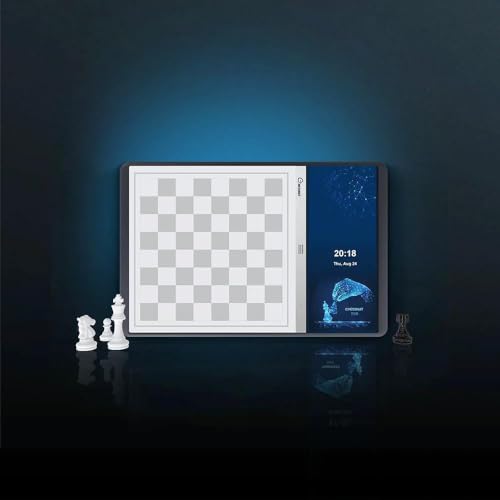
A 12.3-inch touchscreen built into the board, full RFID piece recognition, and two engines to choose from. Stockfish runs 600 to 3190 Elo and Maia runs 1100 to 1900. Maia is the interesting one: it's tuned to play like a person, so it punishes you the way a 1500-rated club player does rather than the way a machine does.
The package includes 34 chip pieces with two extra queens and a USB-C cable. Standalone online play on Chess.com and Lichess means no phone or tablet in the loop. My concession: the pieces are piano-finish plastic and the board is plastic-and-wood, so it will never feel like a Jaques set under your fingers. A 12.3-inch screen in the middle of the playing surface also changes the room. Some people want exactly that. Some want quiet wood.
What owners say: the no-phone online play and the screen get praised. The board is not a lap board and nobody claims otherwise.
Good for: the player who wants one device to do lessons, engines and online games. Skip it if: a screen in the middle of your chess board sounds like a distraction.
This is the one that stops people mid-sentence at the club. The pieces are self-moving, and the board can reposition several at once, so a reset or a study position takes seconds instead of a minute of plucking. The listing claims 1mm piece recognition, a 10 Hz refresh rate and a 0.1-second response, with automated moves averaging under three seconds.
Stockfish is built in with adjustable Elo, voice control handles hands-free commands, and the Chessnut app pushes a Chess.com or Lichess opponent's move onto the physical board automatically. You also get 34 pieces, a charging pad, two cables and two spare bases. My concession: plastic pieces on a wooden board is an odd pairing at this price, and anything with motors will eventually need service. Mechanical things make noise, too, and you'll hear every capture.
What owners say: the auto-reset and the game import get the most attention. The whir of moving pieces comes up regularly, usually as an observation rather than a complaint.
Good for: the player who wants online opponents to appear on a real board with no screen and no typing. Skip it if: you like the silence of a wooden set and the feel of moving your own pieces.
4. Miko Chess Grand: Your Ultimate AI Chess
Self-moving pieces on a handcrafted wooden board, plus an auto-reset that sends everything home at the tap of a button. The app adds live commentary on each move, puzzles, and a livestream mode that replays a grandmaster game on your board as it happens. That last feature is a genuinely good use of a machine that can move pieces by itself, and it's the one I'd show a skeptical friend first.
My concession: the good features live behind the app, so the board alone is a handsome opponent rather than a coach. You're paying for the mechanism and the timber together, and the timber is doing a lot of the persuading.
What owners say: the wood finish and the auto-reset are what people mention first. App reliance is the usual gripe.
Good for: someone who wants self-moving pieces in something that looks like a chess set, not a gadget. Skip it if: you'd rather not depend on a phone app to use the features you paid for.
5. SenseRobot AI Chess Robot with Robotic Arm
A robotic arm that picks up real pieces and puts them down again. Twenty-five AI levels, 1200+ exercises, endgame drills, classic game replay, hints and undos, all with voice coaching. The arm's physical pace is part of the appeal: you watch a piece travel and land, which is not the same sensation as a highlighted square appearing.
Lichess integration, PGN export, multi-profile support and WiFi OTA updates round it out. The listing is also refreshingly blunt that an arm moves pieces naturally rather than at screen speed. My concession: one piece at a time means a full reset is not instant, and connected features need WiFi plus app setup before any of it works. This is a teaching machine first, an opponent second.
What owners say: kids stay engaged with the arm in a way they don't with a screen. Setup and the deliberate pace get mentioned in the same breath.
Good for: parents who want a chess tutor that physically moves pieces and talks a child through it. Skip it if: you want fast resets and blitz-speed play.
The simplest version of the idea, done well. Lift a piece and a small LED at the bottom right of the square shows where it can go. The engine is rated above 2300 Elo, National Master territory, and a TUTOR button switches on voice feedback. It carries 256 puzzles, 256 classic games and a 5-MINI chess mode for short sessions.
The physical package is a 2.36-inch king on 1.22-inch squares with a 14.6-inch diagonal, magnets that hold pieces when the board is inverted, felt-padded bases, two extra queens and a 2000mAh battery. My concession: those squares are small next to the 2 to 2.5 inches US Chess suggests, and the listing warns that sliding a piece across the board causes a misread. You have to lift and place like a tournament player. Good habit, less relaxing evening.
What owners say: the lift-and-light flow is the reason people recomend it. The sliding warning is real; drag a rook and the board gets confused.
Good for: a beginner who wants to see legal moves on the board instead of on a screen. Skip it if: you have large hands or you're used to a 2.25-inch square club board.
Same shell as its light-up sibling, different brain. This one runs to 2200+ Elo, shows move coordinates on a 4-digit LCD instead of lighting squares, and carries 128 tactical puzzles plus 256 classic games. Voice coaching, unlimited takebacks, magnets that hold pieces when inverted, EVA foam storage and AA batteries with auto-shutoff.
The physical numbers match the other JWSCHESSUN: a 2.36-inch king, 1.22-inch squares, a 14.6-inch diagonal. My concession: with no LED move guidance, a total beginner gets coordinates and a voice rather than a glowing square, which is a slower way to learn. AA batteries also mean you're buying batteries; the listing doesn't name a rechargeable cell here.
What owners say: the LCD coordinates are easy to read and the voice coaching gets used more than expected. Battery changes come up.
Good for: a improving player who wants a strong engine and a talking board without paying for lights. Skip it if: you're buying for a child who needs the squares to light up.
8. GoChess Mini Smart Chess Board AI Electronic Chess Game Set for All L…
Thirty-five millimeter squares, a coaching light under each one, and 32 difficulty levels. The assist level is set per player, so a grandparent and a grandchild can sit down and both get a fair game out of the same board. It connects to Lichess and Chess.com when you want a human on the other end.
My concession: 35mm works out to about 1.38 inches, which is a small target, and the Mini name is honest. This is a board you carry in a bag rather than leave on a table. The pieces are small, the lights are not, and that's the trade.
What owners say: portability and the colored coaching lights are the highlights. Small squares for adult fingers is the recurring note.
Good for: travel, a commute, or a small apartment where a full set won't fit. Skip it if: you want a board that stays out on a table and looks the part.
9. Harry Potter Chess Set Smart Electronic Board Game. Wizards Chess wit…
Wizard's Chess pieces, light coaching, 32 difficulty levels, and online play on Lichess and Chess.com. The pieces do not move by themselves, and the listing says that twice, which tells you everything about the questions buyers send before ordering.
My concession: you're paying for the theme as much as the electronics, and the coaching is the same GoChess light system you can get without the wizard pieces. The sculpted pieces are not Staunton, so a purist will twitch. But if the person on your list has never finished a game, the theme might be the thing that gets them to push a pawn.
What owners say: gift buyers love it and report that non-players actualy ask to try it. Serious players note the non-standard pieces.
Good for: a Harry Potter fan who is chess-curious, or a gift where the wrapping matters. Skip it if: the recipient already plays seriously and wants proper Staunton proportions.
What actually matters when you buy chess move boards
Sensing method. RFID chip pieces (Chessnut Evo, Chessnut Move) track a full move with no input from you. Magnet-and-LED systems (both JWSCHESSUN boards, GoChess Mini) need you to lift and place cleanly. Touch systems (ChessUp 2) read the piece itself. All three beat pressing squares.
Square size and king height. Compare every listing to the 2 to 2.5 inch square and 3.375 to 4.5 inch king range. The JWSCHESSUN boards run 1.22-inch squares with a 2.36-inch king, and the GoChess Mini runs 35mm. Compact, not regulation.
Phone or no phone. Built-in WiFi (ChessUp 2, Chessnut Evo) means the board is the computer. App-tethered boards add a step to every session, and that step is where habits die.
How the board talks to you. LEDs on the squares, a 12.3-inch screen, a 4-digit LCD with coordinates, or a voice. Pick the one that matches how you actualy absorb information, because you'll be reading it for an hour.
Setup and storage. Felt-padded bases, magnets for inverted carrying, EVA foam trays and a 2000mAh internal battery all reduce friction. If storage is your sticking point, my roundup of the best chess board with storage covers the non-electronic options.
Side by side
| Board | Key spec | Best for |
|---|---|---|
| ChessUp 2 | Built-in WiFi, TouchSense pieces, per-player AI help | Best overall |
| Chessnut Evo | 12.3-inch screen, Stockfish 600-3190 Elo, RFID pieces | Best all-in-one computer |
| Chessnut Move | Self-moving plastic pieces, 1mm recognition, wooden board | Best self-moving board |
| Miko Chess Grand | Handcrafted wood, self-moving pieces, app auto-reset | Best wooden self-moving |
| SenseRobot | Robotic arm, 25 levels, 1200+ exercises | Best robotic arm coach |
| JWSCHESSUN Light Up | 2.36-inch king, 1.22-inch squares, 2300+ Elo, LED guidance | Best light-up trainer |
| JWSCHESSUN Advanced | 2200+ Elo, 4-digit LCD, AA power | Best for stronger players |
| GoChess Mini | 35mm squares, 32 difficulty levels, coaching lights | Best for travel |
| Harry Potter Smart Board | Wizard's Chess pieces, 32 levels, online play | Best gift for a fan |
Which one I'd buy
If you want one board that teaches during the game and doesn't need your phone, buy the ChessUp 2. It's the cleanest answer to the whole category, and the per-player hint setting means it stays useful after you've outgrown the hints.
If you're shopping for a strong player who wants resistance rather than lessons, the JWSCHESSUN Advanced at 2200+ Elo is the value pick. If money is not the conversation and you want pieces that move on their own, the Chessnut Move is the one I'd point at. And if you're buying a gift for someone who has never played, skip the electronics entirely and look at the best chess boards for men for something they'll actually leave on a shelf.
Questions people ask me
What counts as a chess move board?
It's an electronic board that does something a wooden set can't: light up the legal squares for a piece, call out a blunder, or physically move pieces for you. The category runs from a $ battery-powered trainer to a wooden board with self-moving pieces. The thing they share is feedback during the game, not after it.
Do any of these boards move the pieces for me?
Three of them do. The Chessnut Move uses self-moving plastic pieces, the Miko Chess Grand does the same on a wooden board, and the SenseRobot uses a robotic arm. The ChessUp 2, GoChess Mini and both JWSCHESSUN boards light up squares but leave the lifting to you.
Can I use an electronic board in a tournament?
No. US Chess guidance puts tournament kings around 3.375 to 4.5 inches with 2 to 2.5 inch squares, and most of these run 1.22 to 1.38 inch squares. They're training tools and home opponents. Keep a regulation set for the club and use the electronic board for practice.