Chess Pieces Cartoon Printables: What to Print and How to Scale It
A cartoon chess set you can print, cut and play tonight, sized to fit a paper board with 2 inch squares.
Free downloads
PDFs, 0.9 inch squares. Print at 100% (actual size), not “fit to page”.
- Blank board with coordinates: US Letter · A4
- Blank board, no coordinates: US Letter · A4
- Board with pieces in the starting position: US Letter · A4
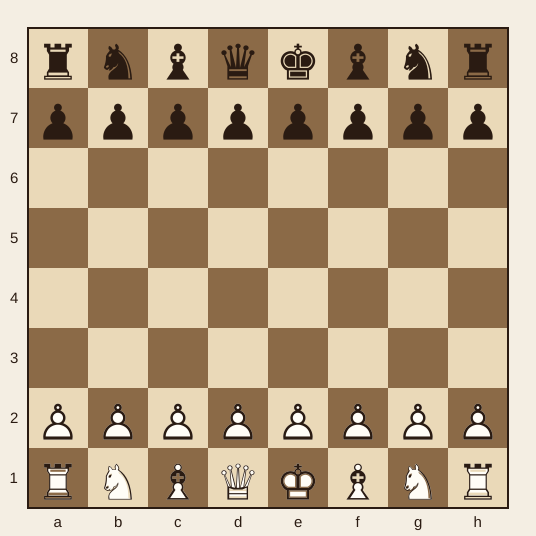
Short answer: a chess pieces cartoon printable is a PDF you print at home, cut out, and play with on a paper or vinyl board. The free files are linked on this page, all six piece types in both colors, 32 pieces per set. Print, cut, play. That's the whole job, and it runs you a few dollars in paper.
What a cartoon chess printable actually is
A flat set, not a 3D one. Each piece is a printed silhouette with thick outlines and simple shapes, and the whole set fits on a handful of letter sheets. You cut them out, give them a base, and set them on a board.
The look is deliberate. A cartoon pawn with a big round head reads at arm's length in a way a Staunton silhouette doesn't, which matters when a seven-year-old is hunting for a bishop on the far rank. The shapes also cut cleanly with kitchen scissors. No craft knife, no cutting mat.
If you've priced school sets lately, you know the gap. A decent plastic club set runs $20 to $35. Paper costs pennies, and you can reprint the pawn somebody crumpled.
Print settings that decide whether the pieces stand up
Use 65 lb cardstock, about 176 gsm. A 50-sheet pack is roughly $12 and it's the one upgrade that matters. Plain 20 lb copy paper curls off the roller, and a curled knight falls over every time a hand crosses the board.
Paper size: US Letter at 8.5 by 11 inches is the default. On A4 (210 by 297 mm), print at 100 percent and skip "fit to page," which shrinks the art by around 4 percent and throws off your square matching. Set quality to normal or high. Draft mode saves ink and fades the heavy black outlines that make the cartoon style readable from across a table.
Check the preview before you commit 30 sheets. I've watched a teacher print a whole class set at 94 percent and then wonder why the pawns looked stunted.
Scaling pieces to a 2 to 2.25 inch square
Work backward from the square, not the piece. US Chess guidance puts tournament squares at 2 to 2.25 inches, with a king base around 75 to 80 percent of the square. On a 2.25 inch square that means a base near 1.7 inches wide.
Start at 100 percent, cut one pawn, and set it on your board. If the base leaves more than half the square empty, reprint that page at 110 percent. Two rounds of that and you're dialed in.
The numbers below are my working reference for a 2.25 inch square, not measurements printed anywhere on the file.
| Piece | Per side | Base width I aim for | Printed height |
|---|---|---|---|
| King | 1 | 1.6 to 1.7 in | 2.5 in |
| Queen | 1 | 1.6 to 1.7 in | 2.3 in |
| Bishop | 2 | 1.4 in | 2.1 in |
| Knight | 2 | 1.4 in | 2.1 in |
| Rook | 2 | 1.4 in | 1.9 in |
| Pawn | 8 | 1.2 in | 1.5 in |
Print two copies of the light set page and two of the dark set page. Pawns go missing first, then knights.
Setting the pieces on the board correctly
A printed set still has to start in the right places, and cartoon pieces don't always have obvious crowns. Use the rank order below and put the queen on her own color: white queen on d1, a light square, black queen on d8, a dark one.
| File | Rank 1 piece (White) | Rank 8 piece (Black) |
|---|---|---|
| a, h | rook | rook |
| b, g | knight | knight |
| c, f | bishop | bishop |
| d | queen | queen |
| e | king | king |
Pawns fill rank 2 for White and rank 7 for Black. Eight of them, one per file.
Laminating, washers and the base question
A 3 mil laminating pouch through a home machine gives you a piece that bends instead of tearing. A 100-pack costs around $15. Copy shops charge roughly 50 cents to $1 per letter sheet, so a full set runs a few dollars and an hour of your evening.
Or skip the laminator. Tape each piece to a 1 inch steel washer, a penny, or a square of foam board. Low weight, wide footprint, and a bumped piece slides rather than launches across the room. That's the version I'd build for a classroom every time.
And the honest part: laminated paper is not a real chess set. Pieces skate, the board creases, a gust on a picnic table ends the game. It's a bridge, not a destination. If you want the chunky, click-together end of the market instead, this Lego chess set review covers what holds up to actual handling.
A class set of 24 in about an hour
Do the math first. 12 boards at 32 pieces each is 384 pieces, which is a lot of scissor work. Print everything, stack three sheets, cut the outer block, then trim the individual shapes. Fourth grade and up can cut their own. Younger kids will hand you ragged pawns.
Bag each set in a quart zip bag with the folded board inside and write "32" on the bag in marker. Cleanup goes fast when a missing piece is obvious.
If paper won't survive your room, the themed chess sets I've written up give you a feel for what stands up to a room full of kids.
Where cartoon pieces genuinely help a beginner
Three places. Knight movement, because a cartoon horse head is easier to track through an L than an abstract shape. Recognition speed, since bold outlines carry across a table. And the drop in intimidation, which applies to adults too.
Kids outgrow the look faster than you'd expect, usually inside 6 to 8 weeks. The pieces that coax a five-year-old to the board are often the ones a nine-year-old is embarrassed by. That's fine. Print the paper version now and let them ask for wood later.
When they do ask, and they want characters rather than plain shapes, the best Star Wars chess sets do the licensed thing without turning into a $300 display object.
Printing a board that matches the pieces
A board with 2.25 inch squares is 18 inches across before you add a border, so it won't fit on one letter sheet. Print two halves on 8.5 by 11, trim the inner margins, and tape along the center line with clear tape on both faces. You end up with roughly 17 by 22 inches of usable paper, which is plenty.
Label the files a through h along the bottom and the ranks 1 through 8 up the side. New players read coordinates far quicker when the labels are printed rather than scribbled. If you're buying rather than printing, the best Harry Potter chess sets show what a themed board looks like when the whole thing is designed as one object.
Storage, reprints and the moment to spend money
Keep flat pieces in a manila envelope between sessions, not a shoebox. Weighted bases on 32 pieces crush cardstock edges and you'll be reprinting bishops by November.
Set a rule: one reprint per year, and only the pages you actualy need. Most households burn through the pawn page and nothing else.
And when a kid is still playing after two months, stop printing. That's the signal to buy something with weight and a felt base. If the history angle hooks them instead of the cartoon one, the best Lewis chessmen sets are a fine place to end up.
Questions people ask me
Can you actually play a real game with cartoon chess printables?
Yes. The pieces move exactly like any other chess set, so a printed set plays a legal game. The one thing to watch is base width against square size, because an oversized paper piece slides over the grid lines and makes the board hard to read.
What paper should I print chess pieces on?
65 lb cardstock, roughly 176 gsm. Standard 20 lb copy paper curls as it leaves the printer, and a curled knight tips over every time someone reaches across the board. Set the print dialog to 100 percent, never fit to page.
What size squares should my printable board have?
US Chess guidance puts squares at 2 to 2.25 inches with a king base around 75 to 80 percent of the square. For flat paper pieces, match the base width first and let height follow, since a wide tip-prone shape needs more footprint than a weighted wooden piece.