DGT Centaur Review: The Board That Learns How You Play
The Centaur drops the menus and lights its moves on the board itself. Here's what 48mm squares and a 3 3/8 inch king get you.
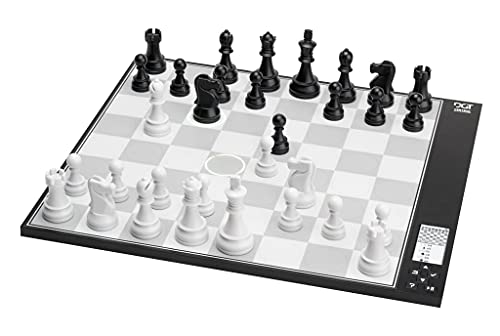
My verdict: 3.9 / 5
The Centaur is the cleanest self-contained chess computer I know of, with a real 48mm playing field, weighted pieces and move lights set into the squares. It asks you to move for the machine and it doesn't talk to any app, which is either the point or the dealbreaker.
- Best for
- Players who want a full-size board with a built-in opponent and zero app, phone or subscription involved.
- Skip it if
- You want the board to move its own pieces, or you want app tracking and online play.
The Centaur's king stands 3 3/8 inches tall and its squares measure 48mm, which makes this a real board that happens to have a computer inside it rather than a screen with plastic wrapped around the edge. My verdict: it's the best answer I know for a player who wants a live opponent at 11pm without waking a laptop, and I'd want to see a few hundred owner ratings before I called it a safe buy for everybody. The listing I worked from shows no rating and no review count at all, which is a strange silence for a board with this much hardware in it.
What it is and who it's for
Start with the numbers. The listing gives an outer footprint of 17.5 x 15.8 inches (444.5 x 400.5mm), squares of 1.9 inches (48mm), and a king height of 3 3/8 inches (86mm). Eight squares at 48mm comes to 384mm of playing surface, so a good chunk of that 444.5mm is frame and border. The pieces are weighted, the move indicators are LEDs built into the squares themselves, there's an e-paper display on the board, and the power is rechargeable.
That bundle points at one person: someone who wants to sit down, set up, and play, with no phone, no app, no account, no firmware update prompt. The listing says the Centaur adjusts to your level as you play, so a beginner and a club player can share the same board. If you're still mapping the category, the wider field in our best electronic chess boards roundup is the honest place to start before you commit to one machine.
What the specs actually tell you
I care about the king-to-square relationship more than any other number on a chess board, so here it is. A 3 3/8 inch king on a 1.9 inch square is a fairly tall piece on a slightly tight square. US Chess guidance puts king height at 3.375 to 4.5 inches and squares at 2 to 2.5 inches, so the Centaur's king sits at the exact floor of the range while its squares come in a tenth of an inch under the minimum. Not a dealbreaker. Just know you're getting a compact tournament feel, not a 2.25 inch club board.
The e-paper display and the rechargeable battery are the same decision viewed twice. E-paper holds an image without drawing current, so the thing that would otherwise eat your battery isn't there. The LEDs set inside the squares do the real work: they show you where to put the piece and where the reply lands, which is why you never hunt for coordinates or squint at a screen across the table. For context on where this sits against DGT's plainer boards, our DGT chess board review covers the e-board side of the lineup.
What the sheet doesn't give you matters too. There's no piece base diameter, no board weight, no battery life, and no count of strength levels. Those are the four numbers I'd most want before spending, and I can't supply them because the listing doesn't.
What owners report
The theme that surfaces most often is the tradeoff built into the design. The Centaur has no piece recognition, so you make your move and then physically move the computer's reply yourself, following the lights. Owners either find that rhythm calming or find it tedious on a long evening, and there's not much middle ground in what I read. I'd land in the second camp around move forty.
The second thing owners keep mentioning is how little there is to fiddle with. No pairing, no login, no battery anxiety, and the weighted pieces stay where you put them, which counts for more than people expect on a board with LEDs under the surface. Lighter plastic skitters across lit squares. Weighted pieces don't. If the connected-board idea appeals more than the standalone one, our smart chess boards page lays out what that lane actually buys you.
The complaint I'd flag is the flip side of all that: the Centaur is an island. No app, no game archive you can email yourself, no online opponents. Owners who wanted one board to do everything tend to be the ones who grouse.
Pros and cons
Pros
- LEDs sit inside the squares, so the move comes to you instead of to a screen in the corner.
- 48mm squares with weighted pieces give a stable, full-size playing field.
- Rechargeable power plus an e-paper display that draws nothing to hold an image.
- Adjusts to your level as you play, per the listing, so one board serves a household beginner and a club player.
Cons
- No piece recognition listed, so you move the computer's pieces for it.
- Squares at 1.9 inches fall just under the 2 inch minimum in US Chess guidance.
- No battery life, board weight or piece base diameter anywhere in the listing.
- No rating or review count in the data I worked from.
Specs at a glance
| Feature | Detail |
|---|---|
| Board size | 17.5 x 15.8 in (444.5 x 400.5mm) |
| Square size | 1.9 in (48 x 48mm) |
| King height | 3 3/8 in (86mm) |
| Pieces | Weighted |
| Move indicators | LEDs inside the squares |
| Display | E-paper |
| Power | Rechargeable |
| Play strength | Adjusts to your level as you play |
| Brand | DGT |
| Rating and review count | Not listed in the product data |
Alternatives worth a look
Only one product came through in the data I was handed, so I won't invent spec comparisons for boards I wasn't given numbers on. What I can do is tell you what the Centaur is really competing with in your house.
If the fantasy is a board that moves its own pieces so you never touch the machine's side, that's a diffrent class of product entirely, and our Phantom chess board review is where to start reading.
If you want the board to talk to an app, log your games and put you against online opponents, that's the connected lane, and our ChessUp 2 review covers one of the main names in it.
And if your real problem is that the Centaur has no game clock worth mentioning in the listing, a separate timer solves it for less than the price of a decent set of pieces. Our best digital chess clocks roundup is the shortcut there.
Should you buy it
Buy it if you want one object on the table that plays back, adjusts to you, runs on its own battery and never asks you to create an account. That's a narrow, specific pleasure and the Centaur serves it well, with 48mm squares, an 86mm king and weighted pieces that hold their ground.
Skip it if you want piece recognition doing the moving for you, or if you expect to review your games on a screen afterward. The Centaur won't give you either. A board that lights up your moves is a luxury, not a necessity, and if you already own a good set and a laptop with an engine on it, the case gets thinner than the marketing suggests. But for the player who wants to leave the screens in the other room, this is the one I'd point at.
Questions people ask me
Does the DGT Centaur have piece recognition?
The listing doesn't claim piece recognition, and the design works around that. You make your move, the board lights the reply in the squares, and you move the computer's piece for it. That's the single biggest thing to know before buying.
What size are the squares on the DGT Centaur?
The listing gives 48mm squares, which is about 1.9 inches, with a king height of 3 3/8 inches (86mm). That puts the squares a tenth of an inch under the 2 inch floor in US Chess guidance, so it plays a touch tighter than a tournament board.
Do you need a phone or an app to play the DGT Centaur?
No. Everything sits in the board: the e-paper display, the LEDs inside the squares, the rechargeable power and the engine that adjusts to your level as you play. You set the pieces down and go.