How Many Rows on a Chess Board? Eight, and Here's How to Count Them
Eight rows, eight columns, 64 squares, and one word most beginners get wrong.
Eight. A chess board has eight rows of eight squares, and 8 times 8 gives you the 64 squares the game is played on. That count has been fixed for a long time, so if you're staring at a board and counting nine rows, you've included the wooden frame.
And if you're counting rows of pieces rather than rows of squares, the answer at the start of a game is four. Two occupied rows per side, four empty ones in the middle.
Rows are ranks, columns are files, and both come in eights
Chess doesn't say row. It says rank for a horizontal line of squares and file for a vertical one. There are eight of each, and the naming runs from White's side: rank 1 is White's back row, rank 8 is Black's. Files get letters, a through h, going left to right from White's view.
So the square in the bottom left corner is a1. The one in the top right is h8. Every square has exactly one name, and a knight on g1 has three legal first moves in front of it. If you want the longer version of how those labels work, I've written about chess board number of files ranks separately.
One thing worth saying early: the board is 8 by 8 no matter how big the board is. A pocket set with 1 inch squares and a club set with 2.25 inch squares both have eight ranks. Size changes, count doesn't.
What sits on each of the eight rows when you set up
Here's the whole board, top to bottom, from White's seat. The back ranks are the ones people get wrong.
| Rank | Whose row it is | Contents at the start |
|---|---|---|
| 8 | Black's back rank | rook, knight, bishop, queen, king, bishop, knight, rook |
| 7 | Black's pawns | eight pawns |
| 6 | empty | nothing |
| 5 | empty | nothing |
| 4 | empty | nothing |
| 3 | empty | nothing |
| 2 | White's pawns | eight pawns |
| 1 | White's back rank | rook, knight, bishop, queen, king, bishop, knight, rook |
Two rules do most of the work. The queen goes on her own color, so the white queen stands on d1, a light square, and the black queen on d8, a dark one. And the kings face each other on the e file. Say "queen on her own color" out loud once and you'll never fumble it again. If you're teaching a kid, the full walkthrough is in how to set up a chess board.
Board sizes change across the eight rows, and one of these runs small
Square size is where cheap sets and tournament sets part company. US Chess guidance puts tournament squares at 2 to 2.5 inches, with a king height of roughly 3.375 to 4.5 inches and a king base about 75 to 80 percent of the square. Eight squares at 2 inches is a 16 inch playing surface before you add a border.
| Set | Board footprint | Square size | King height |
|---|---|---|---|
| Bobby Fischer Learn to Play Chess | 19.75 x 15.75 in, folding | 1.75 in | 3.75 in |
| WE Games Value Tournament | 19.75 in, roll-up vinyl | 2.25 in | 3.75 in |
| Cardinal Classics Chess Teacher | not listed | not listed | not listed |
Do the arithmetic on the Fischer board and you get a 14 inch playing surface, so most of that footprint is border and notation margin. Same math on the WE Games set: 8 squares at 2.25 inches is 18 inches of actual board, with the rest as edging. That 1.75 inch square on the Fischer set is below the 2 inch floor I'd want for tournament practice, and the listing doesn't state a king base diameter. A standard 3.75 inch king usually carries a base around 1.5 inches, which gets snug on a square that size. For a teaching board it's fine. For clocked games, I'd want the 2.25 inch squares. More numbers like these live in chess board dimensions.
Where the row count trips people up
Three places, mostly.
The first is the border. Decorative boards often have a wide wooden rail, and the eye counts it as an extra line. Count only the squares.
The second is occupied rows. A beginner looks at a fresh board, sees four rows holding pieces and four empty, and reports four. That's a fair reading of the question, just not the one a chess player means.
The third is the checkerboard question. A checkerboard is the same 8 by 8 grid, 64 squares, and checkers occupies 12 pieces per side on the dark squares only. Chess uses all 64. So yes, one board can do both jobs. The rows don't change; only how many squares get used does. There's a related count in how many squares on a chess board if you want to see how the 64 breaks down.
Reading the rows out loud is how notation clicks
Once you can name a rank and a file, coordinates stop being homework. I tell people to place a piece, say the square, and move on. Knight to f3. Bishop to c4. After a few dozen repetitions you're reading a scoresheet without translating in your head.
A quick exercise: put a single rook on a1 and slide it along the first rank, saying the square names as you go. Eight squares, eight names, one row. Then do the a file from a1 to a8. That's the whole coordinate system in about 90 seconds. The longer version is in how to read a chess board, and if you're starting from zero, learn chess covers the moves themselves.
And here's my concession: none of this matters much on day one. You can play a perfectly good first game without knowing that rank 8 is Black's back row. I've seen adults enjoy six months of lunchtime chess before anyone told them what a file was. But the naming pays off the first time you try to follow a game in a book or set up a position from a diagram.
If you need a set to learn on
Three diffrent jobs, three sets.

The printed board with move diagrams on the squares is the reason to pick this one for a total beginner, and the 1.75 inch squares are small but usable for casual play.

Spin Master Games Cardinal Classics Chess Teacher
- Includes: Chessboard, 32 Chess Pieces, Instructions
The pieces carry their own movement notation, which is a clever crutch for a kid or an adult who keeps asking which way the bishop goes.
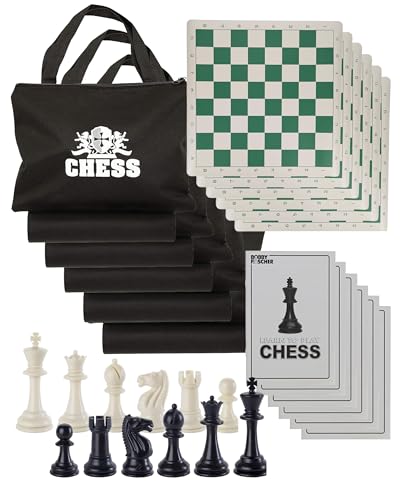
Roll-up vinyl at 2.25 inch squares with a 3.75 inch king, which on paper is the closest of the three to a proper tournament setup and the one I'd buy for a club or a class.
Next step: set a board down tonight, put the white queen on d1, and count the ranks out loud from your side of the table. Eight rows. Say the square names as you place each piece, and setup stops being a puzzle.
Questions people ask me
How many rows are on a chess board?
Eight rows of eight squares each, which makes 64 squares total. The rows run left to right from each player's seat. Chess players call them ranks, and they're numbered 1 through 8 starting from White's side.
Are rows called ranks or rows?
Ranks. A rank is a horizontal row and a file is a vertical column, and both come in eights. You'll see the words in notation like "the back rank" or "an open file" far more often than you'll see row or column.
Does a chess board have more rows than a checkerboard?
No. A standard checkerboard is the same 8 by 8 grid, 64 squares, and checkers uses only the dark squares. Chess uses all 64, so the same board can serve both games as long as the squares are big enough for the pieces.