Is a Chess Board 8x8? Yes, and Here's What Those 64 Squares Do
Eight files, eight ranks, 64 squares. The grid is fixed. The sizes inside it aren't, and that's where buyers get burned.
Yes. A chess board is 8x8, which gives you 64 squares, 32 light and 32 dark. That's the standard for tournament chess, club chess, school chess, and the dusty folding set in your closet.
People ask this for three reasons. Someone is counting squares for the first time and wants confirmation. Someone bought a decorative board at a flea market and something looked wrong. Or someone is buying a set and wondering whether the 8x8 rule changes what size pieces and squares they should get. All three are worth a real answer.
The 64 squares split 32 and 32, and that shapes play
Thirty-two light, thirty-two dark, alternating from corner to corner. Piece count mirrors it: 16 per side, 32 on the board at move one. The starting position fills exactly half the grid.
That symmetry isn't decoration. A bishop on a light square stays on light squares for the entire game, which is why endgame books talk about a player being stuck with "the wrong bishop." A knight on a light square flips color with every move. Nothing about that changes on a bigger or smaller board, and nothing about it is negotiable.
If you want the count walked through square by square, how many squares on a chess board lays out the arithmetic and the coloring pattern.
Files and ranks: eight columns, eight rows, 64 unique names
Every square has one name and no name repeats. Columns are files, lettered a through h from White's left. Rows are ranks, numbered 1 through 8 starting at White's side. So a1 sits in White's near-left corner and h8 is diagonally opposite.
Say "f7" out loud in a chess club and anyone within earshot knows where you mean. That's the whole point of algebraic notation, and it only works because the grid is fixed. The labeling convention at chess board number of files ranks covers orientation, including the rule beginners forget: a1 is dark, h1 is light, and a light square sits at each player's right-hand corner.
Something to try at club night. Play one casual game where you say the name of every square you touch. Slow. Annoying. It sticks better than any app.
Where the 32 pieces start on those 64 squares
The setup is the same every game, which is why you can sit down at a strange board and start playing in 30 seconds.
| Piece | Number per side | White starting squares | | King | 1 | e1 | | Queen | 1 | d1 | | Rook | 2 | a1, h1 | | Bishop | 2 | c1, f1 | | Knight | 2 | b1, g1 | | Pawn | 8 | a2 through h2 |
Two memory hooks cover the back rank. The queen goes on her own color, so the white queen lands on the light d1 and the black queen on the dark d8. And the king takes the remaining middle square, e1, which means the king and queen face each other down the e and d files. The full walkthrough, including which way the board should face, is at how to set up a chess board.
Sixteen squares per side are left empty at the start. Those empty ranks 3, 4, 5 and 6 are where the game happens.
What an 8x8 grid means for square size and piece height
Because the grid never changes, the only real variable is how big each square is. That's where buying gets interesting, and where cheap sets fall apart.
US Chess guidance puts king height at roughly 3.375 to 4.5 inches and square size at 2 to 2.5 inches, with the king's base about 75 to 80 percent of a square. Get that ratio wrong and pieces crowd each other. A 4-inch king on 1.75-inch squares looks like one chess set that ate another chess set.
| King height | Square size | Board footprint as listed | Where you see it | | 3.75 in | 2.25 in | 19.75 in roll-up | Club and tournament vinyl sets | | 3.75 in | 1.75 in | 19.75 x 15.75 in folding | Learning boards with printed move guides | | 3.375 to 4.5 in | 2 to 2.5 in | roughly 17 to 21 in | US Chess guidance range |
The rule I use in a shop: put the king on a square and look for a visible ring of daylight, maybe a quarter inch on each side. Below that, knights start knocking bishops over mid-game. Full measurement conventions, including border widths, are at chess board dimensions.
Boards that break the 8x8 rule on purpose
Not every board you'll meet is 64 squares. Capablanca's chess uses a 10x8 board, Grand Chess uses 10x10, xiangqi plays on 9x10 intersections, and shogi uses a 9x9 grid. Those are seperate games with separate pieces, not chess with extra room.
And I'll concede something here. The 8x8 rule matters most when you're buying blind online, because the mistakes are sneaky. I've seen decorative boards with 7 squares per side, boards where the two corner colors match, and boards with a printed border that's counted as a playable row. Count the squares in the product photo before you pay. Also don't confuse a chessboard with a checkerboard, which happens more than you'd think; are chess and checker boards the same sorts that out.
If you need a set to learn on
I haven't played on any of these three. This is a read of the listings and what owners report, not a test.

The board prints setup and legal-move diagrams right on the surface, and the listing gives 1.75-inch squares with a 3.75-inch king, so I'd buy it for a kid learning the moves and skip it for anyone past that stage.

Spin Master Games Cardinal Classics Chess Teacher
- Includes: Chessboard, 32 Chess Pieces, Instructions
Spin Master stamps the piece name, direction and number of spaces onto every piece, which means a beginner can look at a knight and see the L before anyone explains it; no square size is listed, and I'd want that number before buying.
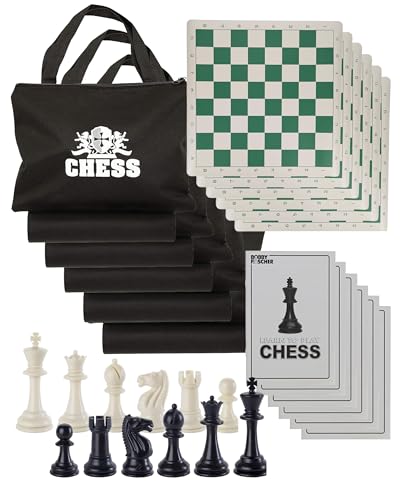
The WE Games set pairs a 3.75-inch king with 2.25-inch squares on a 19.75-inch vinyl roll-up, adds 34 pieces with two extra queens, a bag and equalizer dice, and that king-to-square ratio is the one I'd pick for a first real club set.
One note on those equalizer dice, which show up in two of these sets. Purists hate them and I count myself among the purists. For a family game night where a 9-year-old is facing an adult, though, the handicap does more good than harm.
Turn the board so a light square sits at your right hand, then play one game naming squares
That's the next step, and it takes 20 minutes. Check the corner orientation first, set the pieces from the table above, then play one slow game where you say each square name out loud as you move. Do that three times and the 64 squares stop being a number and start being a map.
Questions people ask me
Is a chess board always 8x8?
In standard chess, yes. You get 8 files lettered a through h and 8 ranks numbered 1 through 8, for 64 squares total. Variants exist (Capablanca chess uses 10x8, Grand Chess uses 10x10), but those are different games with different rules and different piece sets.
How many squares are on a chess board?
Sixty-four, split into 32 light and 32 dark. Each player starts with 16 pieces, so the opening position fills exactly half the board. That even split is why the piece count and the square count line up so neatly.
Does an 8x8 board work for checkers?
Yes, an 8x8 chessboard plays checkers fine, since checkers uses the same 64 squares with pieces on the dark squares only. The grids are identical; the markings and board design are what differ. Don't assume any board sold as a chessboard has the right count, though. Count it.