Chess Pieces Close Up: Free Printable Reference Cards
A parent-friendly printable sheet with close-up piece cards, a square-scaling ruler check, and simple laminating steps.
Free downloads
PDFs, 0.9 inch squares. Print at 100% (actual size), not “fit to page”.
- Blank board with coordinates: US Letter · A4
- Blank board, no coordinates: US Letter · A4
- Board with pieces in the starting position: US Letter · A4
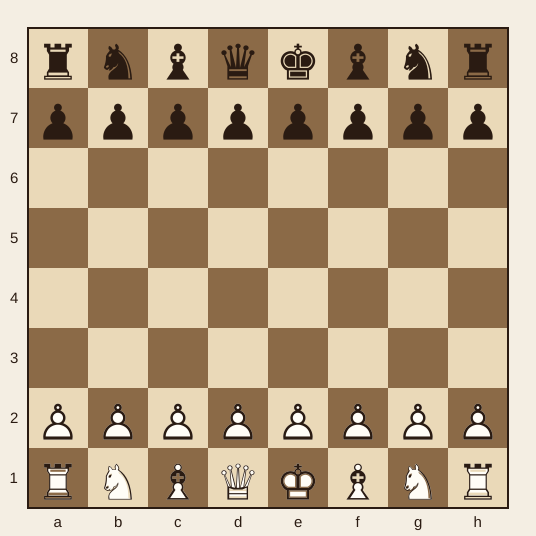
Print the free chess pieces close up sheets at 100 percent on US Letter or A4. Do not use Fit to Page. The free printable files are linked on this page, and the letter and A4 sets use the same six pages.
What the close-up cards show
The set I'd print is six pages, two cards per page, so 12 cards total. Each card gives one piece at large size, its name, its starting square, and a small move reminder. The king card gets the cross and the queen gets the coronet; those are the two close-up details new players mix up first. If you want a deeper look at crown shapes and heights, the king chess piece guide is the one I'd open. A standard king runs 3.375 to 4.5 inches tall, so the card can show a full-size profile rather than a thumbnail.
| Piece | Count per side | Starting squares | Close-up cue |
|---|---|---|---|
| King | 1 | e1 for White, e8 for Black | Cross on the crown |
| Queen | 1 | d1 for White, d8 for Black | Pointed coronet |
| Rook | 2 | a1 and h1, a8 and h8 | Flat crenellated top |
| Bishop | 2 | c1 and f1, c8 and f8 | Slit in the mitre |
| Knight | 2 | b1 and g1, b8 and g8 | Horse head and mane |
| Pawn | 8 | Second rank for White, seventh rank for Black | Round ball top |
The table gives you 6 piece types and 32 starting pieces. A new player can point at the knight's horse head and find b1 or g1 in about 10 seconds. That beats a 10-minute lecture.
Print settings that keep squares honest
Set the printer to Actual Size, 100 percent, and turn off "shrink to fit" or "scale to fit." On US Letter, 8.5 by 11 inches, the 2 inch test square should measure 2 inches across; on A4, check the metric bar at 50 millimeters. If the test square measures 1.9 inches instead of 2 inches, stop and fix the scale before you cut a single card, because every square and every base in the set will be off by the same 5 percent. Fix the scale.
For board diagrams, aim for 2 to 2.25 inch squares. US Chess guidance puts tournament squares at 2 to 2.5 inches and a king base at about 75 to 80 percent of a square. An 8 by 8 board at 2.25 inches is 18 inches across, so a single letter sheet won't hold it. Print the piece cards seperate from the board and keep the cards at 100 percent.
Laminating, trimming, and classroom handling
Print on 65 lb cardstock, 176 gsm. Trim with a 1/8 inch border and round the corners. I use 3 mil pouches for table cards and 5 mil for cards that go into a chess bag. A 3 mil pouch adds about 0.006 inch total thickness, and a 5 mil pouch adds about 0.010 inch, which matters when you stack 12 cards in a bag.
Lamination isn't free. A pack of 3 mil pouches costs less than 5 mil, and for one kid at the kitchen table a page protector works fine. I'd skip lamination before I'd skip the 100 percent print check.
Using the close-ups at the board
Start with three pieces, not 32. Put the king, rook, and pawn on the table, match each card, then move to starting squares e1, a1, and e2. Five minutes of that beats a 20-minute rules talk for a six-year-old.
For a club table, tape the piece card inside a plastic sleeve and set it beside the board. Wooden pieces at a 3.75 inch king height show the close-up profiles better than glossy plastic under fluorescent hall lights; best wooden chess pieces covers the finishes and weights I'd compare.
Kids will knock pieces over; weighted pieces stay put better than hollow ones. If that's your house, best weighted chess pieces is the list to read before you buy a set for a 2.25 inch square board.
If the printed cards lead to a real set
The cards are a reference, not a substitute for a board. For a first club set, I'd match a 3.75 inch king with 2.25 inch squares; that pairing suits most adults and kids over age eight.
Classic Staunton profiles are easiest to read across a 2.25 inch square, which is why I'd start with best Staunton chess pieces if you want the printed cards to match the real thing. I haven't bought or tested the sets on that page; I've read the specs and owner notes, same as I'd do before buying.
Loose lots and missing pawns are the main risk on the used market. The chess pieces for sale page is where I'd compare 32 piece sets against 34 piece sets with extra queens.
Questions people ask me
What paper size should I use for the chess pieces close up cards?
Use the US Letter file on 8.5 by 11 inch paper or the A4 file on 210 by 297 millimeter paper. Print at 100 percent and check the test square with a ruler before you cut. If the square is short, the cards and any board diagram will be short too.
Can I scale the printable to fit a 2 inch chess square?
Yes, but scale the board diagram, not the piece cards. A 2 inch square gives a 16 inch board, and a 2.25 inch square gives an 18 inch board, so most home printers need tiling or a larger sheet. Keep the piece cards at 100 percent so the close-up details stay crisp.
Do I need to laminate the printable pieces?
For one child, a page protector is enough and cheaper. For a classroom or club, 3 mil pouches on 65 lb cardstock survive a season of small hands. Use 5 mil only for cards that go on the floor or into a chess bag.