Shapes of Chess Pieces: A Printable Chart for Parents, Teachers and New Players
Six silhouettes, one printable sheet, and the measurement checks that keep the pieces the right size for your board.
Free downloads
PDFs, 0.9 inch squares. Print at 100% (actual size), not “fit to page”.
- Blank board with coordinates: US Letter · A4
- Blank board, no coordinates: US Letter · A4
- Board with pieces in the starting position: US Letter · A4
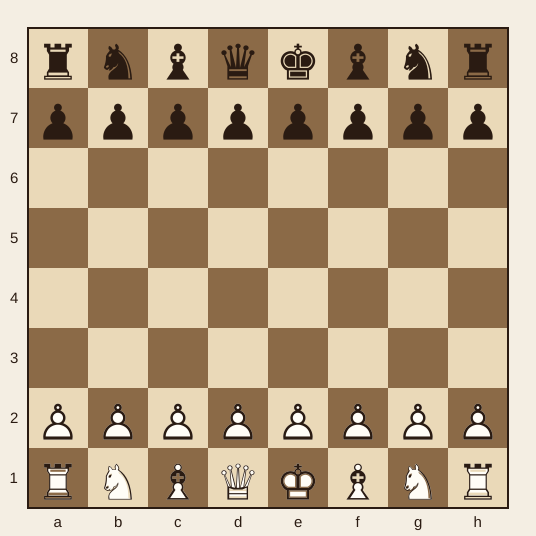
The six shapes, and the one clue in each
A chess set uses six shapes: king, queen, bishop, knight, rook, pawn. That's 32 pieces cut from six silhouettes, and on a decent set you can name every one from the far side of a table. The king carries a cross on top. The queen wears a coronet of points with no cross. The bishop is a tall cap with a diagonal slit. The knight is a horse's head, the only curved piece in the box. The rook is a tower with a flat, notched top. The pawn is the short one with a ball on its head.
I've taught beginners on an $8 plastic tube set and on a $400 club set, and the shape lesson takes about ten minutes either way. Themed sets with dragons and wizards look great on a shelf. Some of the best unique chess pieces around are genuinely fun to own. But a kid learning the game needs the standard silhouettes first, because that's what shows up at a tournament.
What each piece looks like up close
King
Tallest piece, cross on top. US Chess guidance puts king height at 3.375 to 4.5 inches, with the base running 75 to 80 percent of a square. On a 2.25 inch square that means a base between 1.7 and 1.8 inches. If a set's king base comes in well over 1.8 inches, the pieces will crowd each other on a standard board. There's more on the shape in this king chess piece breakdown.
Queen
Coronet of points, ball tips on better sets, never a cross. In a standard 3.75 inch Staunton set the queen usually lands around 3.5 inches. The fastest test with a new player is to hold up the king and queen together and ask which one has the plus sign.
Bishop
Pointed mitre with a diagonal cut. Cheap molded sets sometimes skip the slit entirely, and then the bishop and the pawn turn into a guessing game at 20 feet. The printable outline plays up the slit so it reads at arm's length.
Knight
Horse head, no symmetry, no flat top, nothing else in the box remotely like it. That's why it's the first piece most kids name. Base can be round or slightly oval depending on the maker, and on carved sets the mane is where the money goes.
Rook
Tower, four or six crenellations, dead flat top. Every rook I've handled in 30 years of club play has a top you could balance a coin on. The castle nickname comes from that shape, not from any rule in the book.
Pawn
Shortest piece on the board, ball on a collar. In a 3.75 inch set the pawn runs roughly 1.75 to 2 inches, so about half the king. Eight of them, all identical, which is the clue people forget when they're sorting a jumbled box.
Printable table of shapes, heights and moves
| Piece | Shape cue | Typical height | Movement |
|---|---|---|---|
| King | Cross on top | 3.75 in | one square, any direction |
| Queen | Coronet of points, no cross | 3.4 to 3.5 in | any direction, any distance |
| Bishop | Mitre with a diagonal slit | 3.0 in | diagonals only |
| Knight | Horse head | 2.6 to 2.75 in | L shape, jumps over pieces |
| Rook | Flat, crenellated top | 2.5 in | ranks and files |
| Pawn | Ball on a collar | 1.75 to 2.0 in | one square forward, two on the first move |
Those heights are conventions, not rules. Measure your own set with a ruler before you trust a printout to match it.
Setup coordinates, if you're using the sheet as a placement guide:
| Rank | Squares | Contents |
|---|---|---|
| 1st rank, White | a1 to h1 | rook, knight, bishop, queen, king, bishop, knight, rook |
| 2nd rank, White | a2 to h2 | eight pawns |
| 7th rank, Black | a7 to h7 | eight pawns |
| 8th rank, Black | a8 to h8 | mirror of the 1st rank |
The queen goes on her own color. That single line fixes more beginner mistakes than anything else I say at a club night.
Printing the file at true size
Letter paper is 8.5 by 11 inches and A4 is 210 by 297 millimeters, and the file is set up to fit both without scaling. Set the print dialog to 100 percent and switch off anything labeled "fit to page" or "shrink oversized pages." Then check the test square in the corner with a ruler. It should measure 2 inches on the nose. If it comes out at 1.8, your printer scaled and the piece outlines are wrong by the same amount.
Two sheets is enough for most families. One labeled sheet for reference, one blank sheet for quizzing.
Matching the printout to your board squares
US Chess guidance calls for squares between 2 and 2.25 inches, so a sheet drawn for a 2.25 inch square board needs a little math for anything smaller. Two divided by 2.25 is 0.889, so print at 89 percent for a board with 2 inch squares. For a classroom demo board with 3 inch squares, print at 133 percent on 11 by 17 paper and the silhouettes hold up from the back row.
A board with 1.5 inch squares, the kind that folds into a case the size of a paperback, wants about 67 percent. Anything below that and the bishop's slit turns to mush on a home printer.
Laminating so the sheets survive a term
Use 3 mil pouches for a flat reference sheet that stays on a desk, and 5 mil if it's going into a classroom or a kid's backpack. A 3 mil sheet curls less after trimming. A 5 mil sheet takes a bend without creasing. Either way, round the corners with a trimmer, because a laminated point is sharp enough to scratch and a paper cut on day one kills the activity.
Dry erase markers work on laminated sheets and wipe clean with a tissue. That turns the blank silhouette page into a reusable quiz.
Three ways to use the sheets tonight
- Sorting race. Print two copies, cut out all twelve shapes, and time the kid sorting them into six piles. Under 60 seconds is a good run for a six-year-old.
- Silhouette quiz. Cover the labels with a strip of card and ask for six names in a row. Miss one and you swap roles.
- Trace the knight. Lay the sheet under a plain page and trace the horse head, then have the kid draw the L shaped move path from b1 to c3 to d5 across a grid.
The knight is the piece that hooks them. It's also the one that trips them up on the board, so tracing the L on paper first is worth the five minutes.
Reading shape quality before you buy a set
When you're shopping, the shape tells you plenty before you ever touch a piece. A carved mane on the knight and a deep slit on the bishop are both signs someone cared, and both show up in the best Staunton chess pieces if you want the standard pattern done properly. A flat, featureless bishop is the first thing I look for as a warning sign.
Weight is a seperate question from shape. A heavy base doesn't change a silhouette, but it changes how the silhouette feels when you move it, and a room of tired players notices the difference around move 30. My take on that trade-off is in the best weighted chess pieces guide.
Where the free printable files are
The free printable files are linked on this page: a labeled silhouette sheet, a blank sheet for quizzes, and a to-scale strip you can hold against a real piece to check the size. Download, print at 100 percent, laminate, and keep the strip in your chess bag.
If you'd rather skip printing and go straight to a set that follows these shapes, the chess pieces for sale listings are the place I'd start. Just match the king base to your square size before you pay for anything with a carved mane.
Questions people ask me
What are the shapes of all the chess pieces?
King with a cross on top, queen with a coronet of points and no cross, bishop with a pointed mitre and a diagonal slit, knight as a horse head, rook as a flat-topped tower, and pawn as the short piece with a ball on its head. Six shapes total. The silhouette alone tells you which is which on any standard set.
What size should I print chess piece diagrams?
Print at 100 percent on letter or A4 so the test square on the sheet measures exactly 2 inches. If your board has 2 inch squares, scale the printout down to about 89 percent. Laminate at 3 mil and the sheet lasts a full school year.
How do I teach a child to tell the bishop from the pawn?
Start with the knight, because the horse head is the easiest shape in the box. Then point at the bishop's diagonal slit and the pawn's round ball and let the kid sort a mixed pile into two stacks. Most children get all six shapes in one sitting of about ten minutes.