Chess Set Sizes: How to Match King Height to Square Size
King height, square size, and board size travel together. Get the three numbers right and every other choice gets easier.
A standard chess set is a 3.75-inch king on a board with 2.25-inch squares, which works out to a 20-inch board. Those three numbers lock together, and once you know them you can size up any listing in about four seconds. I've spent decades buying, repairing, and lending out club sets, and sizing comes up more than any other question. Here's the whole ladder, from the magnetic set in your glovebox to a 25-inch plastic king in the front yard.
King height, square size, and board size travel as a trio
Three numbers decide everything. King height gets quoted first because it's the headline spec. Square size is the one that actualy governs how the game feels. Board size is just the sum of the squares plus a border.
Do the arithmetic on a standard tournament board: 8 squares across at 2.25 inches each is 18 inches of playing surface. Add a one-inch border all around and you land on 20 inches. That's where the familiar 20-inch folding board comes from, and it isn't arbitrary. It's 8 times 2.25 plus trim.
| Spec | Standard tournament figure | Why it matters |
|---|---|---|
| King height | 3.75 in | Middle of the US Chess guidance range |
| Square size | 2.25 in | Room for pieces to pass without nudging neighbors |
| Board footprint | 20 in by 20 in | 18 inches of play plus borders |
| Piece count | 32, often plus an extra queen | Spare queen for promotion |
| King base | 1.69 to 1.8 in | 75 to 80 percent of the square |
US Chess guidance puts king height somewhere between 3.375 and 4.5 inches, squares between 2 and 2.5 inches, and the king base at roughly 75 to 80 percent of a square. That's a range, not one blessed size. Which is exactly why two sets both labeled tournament can feel completely different at the board.
The 75 to 80 percent rule, and how to check it in the store
This is the single most useful thing I can hand you. Measure the flat bottom of the king. Divide it by the width of one square. You want a result between 0.75 and 0.80.
| Square width | King base that fits |
|---|---|
| 2.0 in | 1.50 to 1.60 in |
| 2.25 in | 1.69 to 1.80 in |
| 2.36 in | 1.77 to 1.89 in |
| 2.5 in | 1.88 to 2.0 in |
Go too big and the board turns into a traffic jam. Knights knock pawns over on the way past, and you can't slide a rook along the back rank without lifting it off the square. Go too small and the pieces look lost, like furniture in a rented hall.
And yes, some players prefer a wider base than the rule suggests because it feels planted in the hand. I'll allow it. Just know you're trading board tidiness for that planted feel, and that crowded boards slow down blitz more than people expect.
What each size class is actually for
| King height | Squares | Board | Where it belongs |
|---|---|---|---|
| 2.5 to 3.0 in | 1.25 to 1.75 in | 12 to 16 in | Travel, glovebox, coffee shop |
| 3.375 in | 2.0 in | 16 to 18 in | First set, kitchen table, school club |
| 3.75 in | 2.25 in | 20 in | Club nights, rated play, leagues |
| 4.0 to 4.5 in | 2.25 to 2.5 in | 20 to 22 in | Home set for big hands or older eyes |
| 5 in and up | 2.5 in and up | 22 in and up | Display, library, lobby |
The 3.75-inch class is the sweet spot for most people. Not because it's sacred, but because it's made at volume, so replacement pieces exist and boards are cheap and flat. The 4.5-inch class is where a lot of adult beginners overshoot. Big pieces photograph like quality. On a 20-inch board with 2.36-inch squares the 4.5-inch king still works, but the whole setup takes up more table than a tournament kit. I've played club games on sets that size and enjoyed them. I wouldn't teach a seven-year-old on one.
If you'd rather browse by material than by spec, the chess sets hub groups them by what they're made of, and you can cross-check the numbers above against each listing.
"Tournament size" on the label, and why board material matters
Any seller can type the word tournament. The spec line is what tells the truth.
The A&A set is the honest version: the listing states a 20 by 20 inch silicone board with 2.25-inch squares and a 3.75-inch king, quadruple weighted, with an extra queen in the bag. Those are the real tournament numbers, and the spare queen is the giveaway that someone thought about actual play. A silicone board folds and can be squeezed into a bag without creasing, which is why a 20-inch set like this survives a car trunk. Owners keep mentioning that it lies flat again after folding, and that's the thing which kills cheaper roll-up boards.
Wood is the opposite trade. Heavier, better at holding a crease, and a folding wooden board with storage inside is the classic club and living-room setup. The Tomost set pairs a 4.5-inch king with a 20-inch folding wooden board and 2.36-inch squares, with the pieces storing inside the folded halves. Roomier than a tournament kit, and it looks like something you'd leave out on a side table. If wood is the draw, browse best wooden chess sets before you lock in a size, and note that chunky Staunton patterns can eat a square even when the king height looks right; best Staunton chess sets covers which patterns run wide.
If rated play is the goal, start with the best tournament chess sets shortlist rather than trusting a product title.
Giant sets, oversized sets, and the board you forgot to buy
Outdoor chess runs on the same logic, just scaled up, and the same traps apply.
The MegaChess giant set runs a 25-inch king with 32 pieces in high-density polyethylene, and the listing says the hollow bases can be filled with sand or water up to 7 lbs for stability. Optional inserts take the pieces up to 37 or 49 inches, which is a different event entirely. Two things to plan for. The chessboard is sold separately. And the pieces are lighter than you'd guess, which is great for a kid dragging them across a lawn and less great in a crosswind, hence those fillable bases.
Here's where the sizing math bites. By the same 75 to 80 percent base rule, a 25-inch king wants squares around 15 to 16 inches across, which means a mat roughly 10 to 11 feet on a side. People buy the pieces, then discover the mat costs as much as the set. Measure the lawn first. For oversized indoor sets meant to be looked at as much as played, best luxury chess sets is better hunting ground than the plastic outdoor stuff.

The A&A tournament set is what I'd point a new club player at: 20-inch silicone board, 2.25-inch squares, 3.75-inch quadruple-weighted pieces, an extra queen, and a zippered case for the lot.

The Tomost wooden set suits someone who wants the big 4.5-inch king and a folding board with built-in storage, and who has the table space to leave it out.
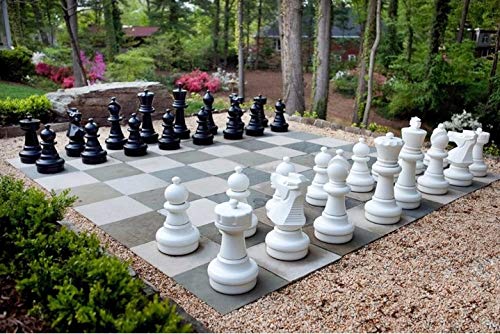
The MegaChess giant set isn't a learning set in the usual sense; it's the one that gets a whole family outdoors, with 25-inch pieces and bases that hold up to 7 lbs of sand.
One practical next step: measure the table you'd really play on, subtract a couple of inches per side for elbows and clocks, then pick the king height that fits instead of the one that photographs best. A 3.75-inch king on 2.25-inch squares needs 20 inches of board and about 30 inches of table. If your table can't give you that, drop to a 3.375-inch king and 2-inch squares and stop feeling bad about it.
Questions people ask me
What is the standard size of a chess set?
The standard tournament figure is a 3.75-inch king on a board with 2.25-inch squares, which makes a 20-inch board. US Chess sizing guidance gives a range instead of one number: kings from about 3.375 to 4.5 inches, squares from 2 to 2.5 inches. The 3.75-inch king sits in the middle of that range and is what most clubs actually use.
Is a 20-inch chess board tournament size?
Yes, if the squares measure 2.25 inches. Eight squares at 2.25 inches is 18 inches of playing surface, and the extra two inches on a 20-inch board is border. Watch out for 20-inch boards with 2-inch squares, which leave a fat border and a slightly cramped playing area.
What size chess set should a beginner buy?
A 3.75-inch king on 2.25-inch squares, or a 3.375-inch king on 2-inch squares if the table is small. Both are easy to find, easy to replace pieces for, and roomy enough that you aren't knocking pawns over on every move. Save the 4.5-inch king for later, when you know you have the table space.