How to Build a Homemade Chess Set That Plays Like a Real One
Measure the king, size the squares, then build. A homemade set fails on math long before it fails on carving skill.
A homemade chess set is a set you make or finish yourself, and one number decides whether it works: the square size, which should land between 2 and 2.5 inches on a standard set. Miss that range and 32 pieces of beautiful work won't play. Hit it and almost any style will.
I've watched this go wrong at club night more than once. A guy hauls in a set he carved over the winter, proud as anything, and the knights clip the pawns on every square. Lovely carving. Unplayable board. So we measure before we cut.
Three routes to a homemade set, and how many weekends each one eats
| Route | What you need | Realistic time | Where it usually fails |
|---|---|---|---|
| Carve all 32 pieces from scratch | Knives, gouges, hardwood blanks | A winter of evenings; a good carver spends 45 minutes on one knight | The 16 pawns never quite match |
| Turn the pieces, finish by hand | Small lathe, spindle blanks, sandpaper | 8 to 12 hours | Base diameters drift, so pieces sit at different heights |
| Buy plain wooden pieces, build and paint the board | Brushes, painter's tape, acrylics, sealer | 3 to 5 hours | Sealer lifts under sweaty fingers |
My bias, after years of watching first builds stall: put your hours into the board and buy the pieces plain. A board you made yourself is the part people notice, and it's the part you can get right with a ruler and a straight edge. If you'd rather compare finished timber before committing, the best wooden chess sets roundup covers what good grain and good hinges look like.
Board math: king height, square size, and the 75 percent rule
The numbers I check are the ones US Chess publishes: king height around 3.375 to 4.5 inches, squares 2 to 2.5 inches, king base about 75 to 80 percent of a square. Everything else is arithmetic.
| Square size | Max king base (80%) | King height that looks right | Playing surface (8 squares) |
|---|---|---|---|
| 2 inches | 1.6 inches | 3.375 to 3.75 inches | 16 inches |
| 2.25 inches | 1.8 inches | 3.75 to 4 inches | 18 inches |
| 2.5 inches | 2 inches | 4 to 4.5 inches | 20 inches |
Playing surface is just square size times eight. Then add your border, and add it twice, because a 2 inch frame on an 18 inch field gives you a 22 inch board and that changes which table it fits. Measure the table before you cut the frame. If you want a reference point for what the standard looks like in the wild, the best tournament chess sets are all built to roughly this grid.
32 pieces, and the four that get handled first
| Piece | Per side | In the box | What to get right |
|---|---|---|---|
| King | 1 | 2 | Height is measured to the top of the cross, since that's how sets are sold |
| Queen | 1 | 2 | Add two more for promotion; most makers ship 34 pieces for this reason |
| Rook | 2 | 4 | Crenellations snag on felt, so sand the notches properly |
| Bishop | 2 | 4 | The mitre slot is the tell; cut it too deep and the head looks thin |
| Knight | 2 | 4 | The hardest piece by a wide margin, and the one people pick up first |
| Pawn | 8 | 16 | All 16 need to be within a hair of each other or the eye catches it |
The pawns do the most work in a set. You touch them on move two and again on move forty, and sixteen of them sitting in a row will expose any inconsistency in height faster than the knights ever will. Cut one pawn, live with it, then use it as your gauge for the other fifteen. For a sense of the proportions a Staunton piece should have, the best Staunton chess sets are worth a look before you sharpen anything.
Painting and sealing a hand painted set so it survives real handling
Acrylic craft paint, three thin coats rather than one thick one, with a light 400 grit pass between coats. Thick paint fills the detail you just carved, and detail is the only reason to hand paint a set instead of buying a plain one.
Seal it. Two coats of matte lacquer over acrylic, and let the first coat cure a full day before the second, or you'll get a sticky finish that picks up lint from the box. Matte beats gloss here; gloss on a chess piece looks like a toy, and it shows every fingerprint from a warm hand.
Then felt the bottoms. Thin self-adhesive felt discs in a size that matches your base diameter, and press them on with the piece upside down on a flat surface so they sit level. Skip this and your handmade board gets scratched to pieces inside a month of club play. Weight matters too. A hollow wooden pawn feels like a chess piece the day you finish it and like a checker by Christmas, so if the blanks are light, drill a shallow hole in the base and Epoxy a washer in there.
What the three folding sets in the listings actually measure
I haven't handled these three, so I'm going off the listings and the specs printed on them. Worth saying plainly: none of them list a customer rating in the data I have, so I can't lean on owner scores.
| Set | Board open | Folded | Square size | King height | Pieces | Weight |
|---|---|---|---|---|---|---|
| FanVince walnut 15" | 15 x 15 x 0.9 inches | 15 x 7.5 x 1.8 inches | Not listed | 3.1 inches, 0.98 inch base | 34 | Not listed |
| Hurdaos 15" | 15 x 15 x 1 inch | 15 x 7.5 x 2 inches | About 1.61 inches | Not listed | 34 | 3.6 pounds |
| AMEROUS 15" | 15 inches (no depth listed) | Not listed | Not listed | Not listed | 32 plus 2 extra queens | Not listed |
Two things jump out. The Hurdaos 1.61 inch squares sit below the 2 inch floor from the US Chess guidance, so it's a travel board and a learner board, not a tournament board, and their own copy doesn't claim otherwise. The FanVince listing calls the set handmade while the same copy says the pieces are CNC-milled and hand-finished, which is a diffrent thing from carved by a person, and I'd rather you know that going in. Its 3.1 inch king is slightly under the 3.375 inch guide too, which is fine at the kitchen table. When you're sizing up any folder, the broader chess sets section lays out the size classes side by side.

Chess Set Board Games for Adults: Handmade Walnut Wooden 15" 2 Extra …
The FanVince folder gives you a 3.1 inch king on a 15 inch walnut board that closes into a magnetic storage box, and the two extra queens mean promotion never needs a stand-in.

Magnetic Wooden Chess Set for Adults Kids 15'' Chess Board with Handm…
The Hurdaos set is the one I'd point a traveling club player toward, since the 1.61 inch squares keep it compact, the pieces are magnetic, and 3.6 pounds is light enough to carry without thinking about it.
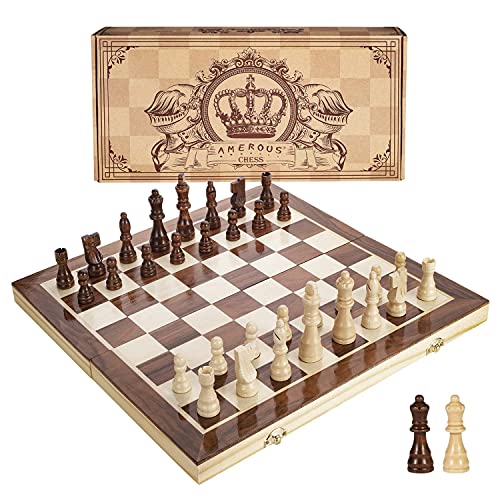
The AMEROUS 15 inch set is aimed at kids six and up, and the magnetic pieces staying put in a car or on a plane is the whole reason to buy it.
Before you buy anything or pick up a saw, measure the base of the tallest piece you already own with a ruler or calipers and write that number down. Then build or buy a board whose squares are about 1.25 times that base, and you'll have a homemade set that plays as well as it looks.
Questions people ask me
What size squares should a homemade chess board have?
Between 2 and 2.5 inches for a standard-size set, matched to the king you're using. The king's base should be about 75 to 80 percent of the square, so a 2.25 inch square wants a base no wider than 1.8 inches. That puts the playing surface somewhere between 16 and 20 inches across.
How many pieces does a homemade chess set need?
32 pieces total: 16 pawns, 4 rooks, 4 knights, 4 bishops, 2 queens and 2 kings. Carve two extra queens as well, because promotion comes up in most real games and swapping in an upside-down rook gets old fast. That makes 34 pieces in the box.
Can you use a homemade chess set in a tournament?
Most rated events supply the boards, and a tournament director can ask for standard equipment, so ask before you lug yours in. A homemade board with 2.25 inch squares and a king around 3.75 inches tall matches the shape of the rules. Get the director's yes first, then enjoy the stares.