Printable Chess Board: Getting 2 Inch Squares Out of a Home Printer
A printable chess board lives or dies on square size. Print one at 2 inches, tape it square, and make the pieces heavy enough to stay put.
Free downloads
PDFs, 0.9 inch squares. Print at 100% (actual size), not “fit to page”.
- Blank board with coordinates: US Letter · A4
- Blank board, no coordinates: US Letter · A4
- Board with pieces in the starting position: US Letter · A4
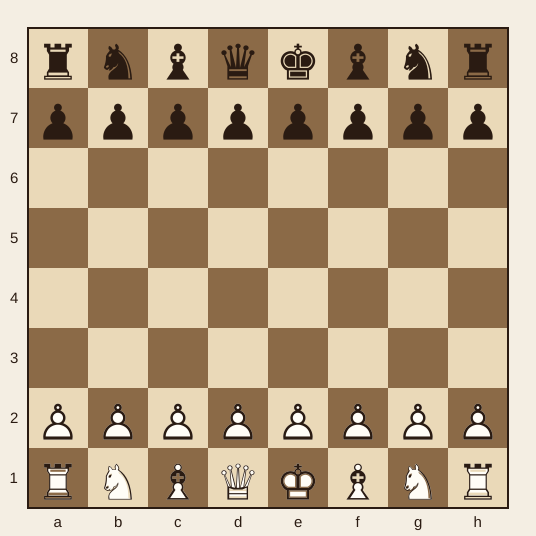
A printable chess board is a PDF you print at home, and one number decides whether it works: the square size. Print a single sheet of US Letter at 100 percent and the board comes out about 7.5 inches wide, with squares just under an inch. That's a diagram for the fridge. Not a board.
Do it right and you tape four sheets into a 16 inch board with 2 inch squares. Same footprint as a club set, same square size, somewhere around 30 cents of cardstock.
The free printable files linked on this page
The board PDF and the paper pieces templates are linked on this page, free, no sign-up. Download both first. Then print page one alone and measure a square with a ruler before you run the other three sheets. A 5 percent scale error is nearly an inch of drift across a 16 inch board, which is the difference between a board that sits flat and one with a visible gap running down the d-file.
Set the print dialog to Actual Size, then check with a ruler
Two settings ruin printable boards: "Fit to Page" and "Shrink Oversized Pages." Both rescale the artwork to whatever the printer decides fits, and both ignore the square size you wanted. Pick Actual Size or 100 percent.
Home printers also can't print to the edge. A typical unprintable margin is 0.25 inch on each side, which is why a true 2 inch square board needs tiling rather than a single page.
If you're close but not quite, nudge the percentage:
| Printed square measures | Set scale to | You get |
|---|---|---|
| 1.80 in | 111% | 2.00 in |
| 1.90 in | 105% | 2.00 in |
| 1.95 in | 103% | 2.01 in |
| 2.10 in | 95% | 2.00 in |
| 2.25 in | 100% | leave it alone |
If your square is under an inch, no percentage in the dialog saves you. The board has to be split across pages.
The square size you get from letter, tabloid, and A4
| Paper (0.25 in / 5 mm margins) | Sheets | Squares per sheet | Square size | Finished board |
|---|---|---|---|---|
| US Letter, whole board on one page | 1 | 8 x 8 | about 0.9 in | about 7.5 x 7.5 in |
| US Letter, tiled 2 x 2 | 4 | 4 x 4 | 2.0 in | 16 x 16 in |
| US Letter, tiled, safe margins | 4 | 4 x 4 | 1.9 in | 15.2 x 15.2 in |
| Tabloid 11 x 17, tiled | 2 | 8 x 4 | 2.0 in | 16 x 16 in |
| A4, tiled 2 x 2 | 4 | 4 x 4 | 48 mm (1.9 in) | 384 mm (15.1 in) |
| A3, tiled | 2 | 8 x 4 | 51 mm (2.0 in) | 408 mm (16.1 in) |
Why 2 to 2.25 inches? Because that's what club sets use, and because a king with a 1.5 to 1.6 inch base sits on a 2 inch square without covering the corners. US Chess guidance puts king height at 3.375 to 4.5 inches with a base about 75 to 80 percent of the square. I'd aim at the middle: 2 inch squares, 3.75 inch king.
Taping four sheets into a 16 inch board
Print all four pages at the same scale. Trim the white margin off the right edge of the left-hand sheets and the bottom edge of the top sheets, then butt the printed edges together instead of overlapping them. Run a full-length strip of 2 inch packing tape down the seam on the back, then a second strip at 90 degrees across it. Two strips per seam, four seams, done.
Check the corners before you glue anything permanent: a1 is a dark square and h1 is light, every time. Then walk through the full arrangement on how to set up a chess board, because piece placement is where the queens get swapped (white queen on d1, a light square).
Paper pieces that stand when someone reaches across the board
| Piece | Per side | Cut in total | Base width | Height |
|---|---|---|---|---|
| Pawn | 8 | 16 | 1.1 in | 1.5 in |
| Rook | 2 | 4 | 1.3 in | 1.8 in |
| Knight | 2 | 4 | 1.3 in | 1.9 in |
| Bishop | 2 | 4 | 1.3 in | 2.0 in |
| Queen | 1 | 2 | 1.5 in | 2.3 in |
| King | 1 | 2 | 1.5 in | 2.5 in |
That's 32 pieces, which is a lot of cutting for one evening. Print on 65 lb cardstock, not 20 lb copier paper. Fold the tab, glue it to the back, and tape a penny inside the base: a penny is 0.75 inch across and weighs 2.5 grams, and two of them under the king and queen keeps a tall piece from tipping. Cap the bases at 1.5 inches on 2 inch squares, which leaves a quarter inch of clearance per side so you can slide a piece without knocking its neighbors over.
If you want a cleaner shape guide before you start cutting, the piece profiles on chess pieces are worth a look.
Laminating, paper weight, and keeping the board flat
Use 3 mil pouches for a board that lives folded in quarters in a drawer, and 5 mil for one that gets stacked under chairs in a classroom. Go matte if you play under gym lights or a bright overhead lamp, since gloss lamination throws glare exactly where the pieces are. A 100-pack of letter-size 3 mil pouches usually runs under $20, and one pouch covers one board quarter.
3D printed boards and STL files, with the math
The printed version is a weekend project, not an afternoon one. A typical 220 x 220 mm bed is 8.66 inches, and a 4 x 4 block of 2 inch squares measures 8 inches (203 mm), which leaves you 8 mm for a border. So a 2 inch board means four borderless plates that get taped or bolted together, plus a seperate job for all 32 pieces.
PLA is fine here. PETG survives a hot car better. Either way, expect stringing on the knights, and sand the bases flat before the first game, because a piece that rocks on the square is more annoying than one that looks rough.
A paper board handles a first month of club chess
A lunchtime club, a hotel room, a rainy Tuesday with a kid who just learned how the knight moves. The setup takes two minutes, the whole thing folds into a shopping bag, and if a piece gets left on the bus you print another. That's the honest case for paper, and it's a good one. For the version that survives a backpack, see best travel chess sets.
When paper stops being enough
Here's my concession: a laminated paper board slides. Humidity warps it, tape seams creep, and after a month in a car it never quite lies flat again. I'd happily teach with one and I wouldn't run a rated game on one.
If a kid is still playing after two months, the paper has done its job and it's time to spend money. Start with best chess sets for beginners, where the useful spec is a king base that fills 75 to 80 percent of the square. And if you want the board to outlive the phase entirely, look at chess sets in wood or heavy vinyl, where a 2.25 inch square will feel enormous after a summer of paper.
Questions people ask me
What size should a printable chess board be?
Aim for 2 to 2.25 inch squares. That puts the whole board around 16 to 18 inches across, which means tiling four sheets of US Letter or two sheets of tabloid. A single sheet gives you squares under an inch, which is only good for a diagram.
How do I stop my printer from shrinking the board?
Choose Actual Size or 100 percent in the print dialog, never Fit to Page. Then measure one square with a ruler before printing the rest. If it's off by a little, change the scale percentage and reprint one test page.
What paper should I print chess pieces on?
65 lb cardstock, not 20 lb copier paper, and laminate the sheet before you cut. Fold the tab into a base and tape a penny inside so the piece doesn't tip when someone reaches across the board.