Chess Pieces: All 32, Their Names, Moves and Starting Squares (2026)
Six kinds of pieces, 32 in total, and one rule per piece. Here's how each moves and how big it should be.
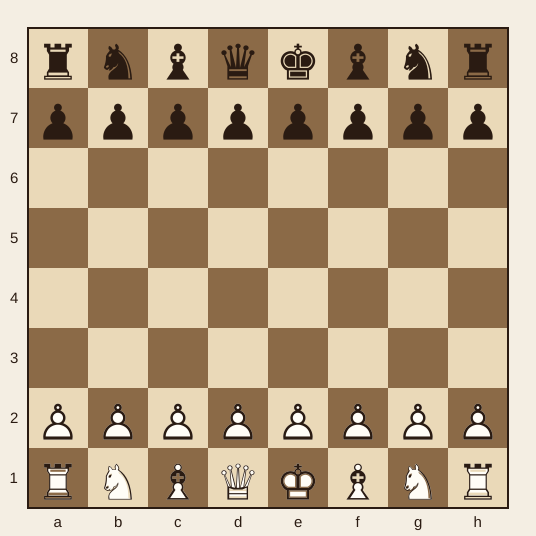
A standard chess set holds 32 pieces: 16 per side, split into six kinds. That's the entire inventory, and once you can name those six and say how each one travels, you can play a legal game tonight. I've sat across from adults at club nights who'd been calling the rook a castle for twenty years. Nobody died of it.
The searches that lead people here are telling: chess pieces names with pictures, how many pieces in chess, can chess pieces move backwards. All fair questions, and the last one has a short answer I'll get to. First the names, then the moves, then the sizing numbers nobody mentions until you've bought a set that looks wrong on the board.
The six names, in the order they sit on the back rank
| Piece | How many per side | What people call it | Its job in one line |
|---|---|---|---|
| King | 1 | the king | One square in any direction. Lose it and the game ends. |
| Queen | 1 | the queen | Any distance in straight lines or diagonals. |
| Rook | 2 | castle | Any distance along ranks and files. |
| Bishop | 2 | the pointy one | Any distance diagonally, stuck on one color. |
| Knight | 2 | horse | The L jump, and the only piece that leaps. |
| Pawn | 8 | the little ones | One square forward, captures diagonally. |
Eight pawns per side means half your army is the cheapest piece on the board. Beginners count the big pieces first and the pawns last, which is backwards; almost every won game at club level starts with a pawn move you got right or wrong on move six.
Two names catch people out. Rook and knight. The tower is a rook, the horse is a knight, and no amount of correcting the guy next to you at the library will change what he calls them. Learn the proper names anyway, because every book and video uses them.
How each piece moves, square by square
| Piece | The move | Can it jump? | White starting square |
|---|---|---|---|
| Rook | Any number of squares up, down, or sideways | No | a1 and h1 |
| Knight | Two squares one way, then one square at a right angle | Yes | b1 and g1 |
| Bishop | Any number of squares diagonally | No | c1 and f1 |
| Queen | Rook and bishop combined | No | d1 |
| King | One square, any direction | No | e1 |
| Pawns | One forward, two on the first move only | No | a2 through h2 |
Read the white back rank from the left: rook, knight, bishop, queen, king, bishop, knight, rook. The queen lands on d1, which is a light square, so the old saying holds, the queen starts on her own color. Black's back rank is the mirror image on the eighth rank. If you want the full sequence with the pawns placed, I've written it out in the guide to how to set up a chess board.
The knight is the piece that confuses everyone for a week and then never again. From the middle of the board it reaches 8 squares. From a corner it reaches 2. That difference is why club players push knights toward the center by move five, and why a knight stuck on the rim is worth about as much as a decent pawn.
Only pawns can't move backwards
Every piece except the pawn can retreat. Kings, queens, rooks and bishops travel back toward their own side as easily as forward, and knights jump whichever way they're facing because they don't have a facing. Pawns only ever push toward the far end of the board. That single asymmetry is the engine of the whole game.
It's also the rule that ends more beginner games than any other: pawns capture diagonally. They can't take the piece sitting directly in front of them, they can't take forward at all, and a blocked pawn is a stuck pawn. Two odd cases fall out of this. En passant lets a pawn capture one that just ran past it, and a pawn reaching the last rank promotes, usually to a queen. I go through the whole rule set in the beginner's walkthrough on learning chess if you want the illegal moves spelled out too.
Practically, this is why pawn moves are the ones to slow down on. You can bring a knight back. You can't bring a pawn back, and every pawn push leaves a square behind it that stays weak for the rest of the game.
What the pieces are worth on a club scoresheet
| Piece | Rough value in pawns |
|---|---|
| Pawn | 1 |
| Knight | 3 |
| Bishop | 3 |
| Rook | 5 |
| Queen | 9 |
| King | not counted, because losing it ends the game |
Point counts are a crude tool. Strong players barely think in them, and a bishop "worth 3" can be worth nothing at all when it's buried behind its own pawns. I still teach the numbers first, because a beginner needs something to count when deciding whether to trade.
The one place the count pays off fast is bishops versus knights. Both sit at 3, but a bishop on an open board covers 13 squares from the center, and a knight covers 8 regardless of what's in the way. Two bishops together are usually stronger than two knights. Knights like closed, cluttered positions where nothing can see across the board. Ask yourself which one your position suits before you swap.
King height and square size: making the pieces fit
US Chess guidance puts king height at roughly 3.375 to 4.5 inches, square size at 2 to 2.5 inches, and the king's base at about 75 to 80 percent of a square. The tournament standard is a 3.75 inch king on 2.25 inch squares, and that pairing is what most club sets copy. Go under it and the pieces feel like toys in adult hands.
The base is the number people ignore and then regret. If the king's base is wider than the square, the pieces physically shove each other off their squares, and castling becomes a negotiation. You can check a set you already own by cutting out squares of paper at 2.25 inches and seeing how four of them sit under the pieces. If you'd rather eyeball the geometry first, a printable chess board gives you a full-size template for the price of paper.
The same sizing logic runs through the whole category, from $15 folding sets to $300 wooden ones. I've laid out the trade-offs by material and price in the chess sets section, because the difference between a set you keep for thirty years and one that lives in a closet is mostly base width and weight.
If you need a set to learn on
The labeled-piece idea looks like a gimmick on the shelf. For a nervous eight-year-old working out what a bishop does, it genuinely helps, and the adults in the room stop having to answer the same question eleven times. If you want the full shortlist, these are the best chess sets for beginners I'd point a new player toward.

Spin Master Games Cardinal Classics Chess Teacher
- Includes: Chessboard, 32 Chess Pieces, Instructions
Spin Master's Cardinal Classics Chess Teacher prints the name, direction and number of squares on each of the 32 pieces, so the move is readable off the piece itself.

The HI-Q Classic from Point Games is the plain route: standard flat-bottomed plastic pieces, a folding cardboard board, ages 6 and up, nothing to charge or assemble.

WE Games ships 34 pieces including two spare queens, a 3.75 inch king, 2.25 inch squares on a 19.75 inch roll-up vinyl board, plus a carry bag and equalizer dice I'd leave in the bag.
Next step: set up all 32 pieces tonight and say the name and starting square of each piece out loud before you touch it. Ten minutes, once, and the names stop being trivia and start being the board.
Questions people ask me
How many pieces are in a chess set?
A full set has 32 pieces, 16 for each player. Those 16 break down as 8 pawns, 2 rooks, 2 knights, 2 bishops, 1 queen and 1 king. Some tournament sets ship with 34 pieces because they include two spare queens for promotion.
What are the six chess pieces called?
King, queen, rook, bishop, knight and pawn. The rook is the tower people often call a castle, and the knight is the horse-shaped piece. Each name comes with its own movement rule, which is why the names and the moves get taught together.
Can chess pieces move backwards?
Every piece except the pawn can move backwards. Rooks, bishops, queens and kings retreat along their normal lines, and knights jump in any direction including back toward their own side. Pawns only ever push forward and can never move back, which is why pawn moves are permanent.