Chess Starting Position Board: What It Looks Like and a Free Printable
Every piece on every square, and how to print it at a size that actually works on a table.
Free downloads
PDFs, 0.9 inch squares. Print at 100% (actual size), not “fit to page”.
- Blank board with coordinates: US Letter · A4
- Blank board, no coordinates: US Letter · A4
- Board with pieces in the starting position: US Letter · A4
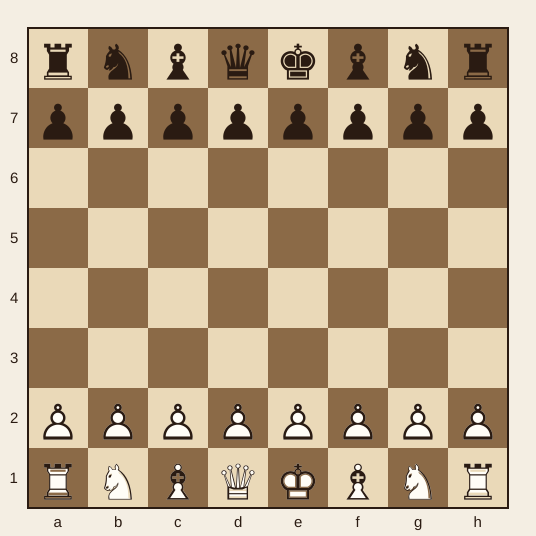
The starting position in one look
The chess starting position isn't a choice. It's fixed, and it's the same in every game you'll ever play. White's 16 pieces sit on ranks 1 and 2. Black's 16 sit on ranks 7 and 8. Thirty-two pieces total, with the pawns forming a wall in front of each army.
Two rules cover almost every mistake. The queen goes on her own color, which puts the white queen on d1 (a light square) and the black queen on d8 (a dark square). And the board itself goes down with a light square in each player's right-hand corner, so h1 is light for White and a8 is light for Black.
The back rank reads the same way for both sides: rook, knight, bishop, queen, king, bishop, knight, rook. If you want the full count side by side, I've written about how many pieces in chess in more detail.
Every square, piece by piece
Here's the whole setup as a table. Read down the file column and across for each side.
| File | White rank 1 | White rank 2 | Black rank 7 | Black rank 8 |
|---|---|---|---|---|
| a | rook | pawn | pawn | rook |
| b | knight | pawn | pawn | knight |
| c | bishop | pawn | pawn | bishop |
| d | queen | pawn | pawn | queen |
| e | king | pawn | pawn | king |
| f | bishop | pawn | pawn | bishop |
| g | knight | pawn | pawn | knight |
| h | rook | pawn | pawn | rook |
That's 64 squares doing work, and 32 of them start empty. If you're teaching a kid the grid itself, how many squares on a chess board is the page to hand them next.
Queen on her color, kings on the e file
Say it out loud while you set up. "Queen on her own color." The white queen lands on a light square, the black queen on a dark one. The two kings then face each other down the e file with nothing but pawns and empty squares between them, which is the picture most players carry in their head for the first move.
The three mix-ups I see at every club night
First, king and queen swapped. Second, bishop and knight swapped on the b and c files. Third, the whole board turned 90 degrees, which puts a dark square in the near right corner and makes every coordinate wrong from move one.
The board rotation one is the sneaky mistake. You can shuffle pieces for ten minutes and still have a board that's technically sideways. Check the corner square before you touch a single piece.
What the free printable files give you
The free printable chess starting position boards are linked on this page. There's a labeled board with the a to h files and 1 to 8 ranks printed along the edges, and a plain board with no labels at all, which is the version I'd give a kid who's learning to set the pieces up from memory. Print both. The labeled one lives on the wall or the table for reference, and the plain one is the test.
I'd also print a spare plain copy to keep uncut and unlaminated. Pencil wipes off a plain sheet, and that matters if you want to mark starting squares for a beginner.
Paper size and scaling for a real 2 to 2.25 inch square
Do the arithmetic before you hit print. Eight squares at 2.25 inches is 18 inches of board. That does not fit on letter paper (8.5 x 11) or A4 (210 x 297 mm). It doesn't fit on 11 x 17 either, not with margins.
What you get on each size:
- Letter or A4 at 100 percent: roughly 1 inch squares. Fine as a wall chart or a desk reference, small for moving pieces.
- 11 x 17 tabloid: about 2 inch squares. This is the sweet spot for a tabletop board you actually play on.
- Tiled across four letter sheets: 2 to 2.25 inch squares, taped together. More fuss, same result, and you need to trim the edges clean or the squares go out of alignment.
Set your printer to actual size or 100 percent and turn off "fit to page" and "shrink to fit." Those two settings quietly undo the math. Print one sheet, then measure square a1 with a ruler before you commit to the rest. I haven't tested every printer on the market, so trust your ruler over my numbers.
When you're sizing pieces against the printout, the general guidance is a king height of about 3.375 to 4.5 inches, squares of 2 to 2.5 inches, and a king base around 75 to 80 percent of the square. A 2.25 inch square handles most club-sized sets without crowding. There's more on that at chess board dimensions.
Laminating it so it survives a classroom
A plain sheet lasts about a week with a room full of eight-year-olds. Laminate it.
For a folder insert or a sheet that gets waved around, 3 mil pouches are enough. For a board that sits flat on a table and gets pointed at, 5 mil gives it some body and stops the corners curling. Go matte if it will sit under a lamp, because gloss throws a glare line right across the d and e files and nobody can read the queen's square.
Dry erase markers write on laminated sheets and wipe off, which turns the printed board into a drill sheet you can reuse. Round the corners with a trimmer after sealing; laminated points are sharp. Sheet protectors are the cheap version of the same idea, and honestly they work fine for a single afternoon.
I'll concede one thing: a printed sheet will never feel like a wooden board, and a laminated one slides on a smooth table. Put a rubber mat or a piece of felt underneath, or tape the corners down.
Using it in the first ten minutes
Start with placement, not movement. Hand over the pieces and let them build the position from the plain board while the labeled one sits face up nearby for checking.
Then run the point-and-name drill. You call "c3," they put a finger on it. That's coordinate practice, and it pays off the day they start writing moves. Chess notation makes alot more sense once the squares have names.
Once the setup is automatic, move to setting up from memory with a timer, then to naming the pieces themselves. Beginners mix up rooks and bishops more than you'd expect, and chess pieces covers how each one moves.
The full step-by-step version, including the two-minute version for setting up a physical set, is at how to set up a chess board. Print the board, set it up wrong on purpose once, and let them find the swap. That lesson sticks harder than being told.
Questions people ask me
Where does the queen go in the chess starting position?
The white queen goes on d1 and the black queen goes on d8. The rule that sticks with beginners is that the queen sits on her own color, so the white queen starts on a light square and the black queen starts on a dark one. Kings go on the e file, directly facing each other.
Can I print a whole chess board on one sheet of letter paper?
Yes, but the squares come out around 1 inch, which is small for handling real pieces. A square of 2 to 2.25 inches needs a board 16 to 18 inches wide. Print on 11 x 17 tabloid for a 2 inch square, or tile the file across four letter sheets at 100 percent.
How many pieces are on a chess starting position board?
Thirty-two, arranged as 16 white and 16 black. Each side has eight pawns, two rooks, two knights, two bishops, one queen and one king. The pawns fill the second rank for White and the seventh rank for Black.