Chess Notation: How to Read the Board's 64 Squares
Sixteen labels, a dozen symbols, and every game you play becomes a document you can study later.
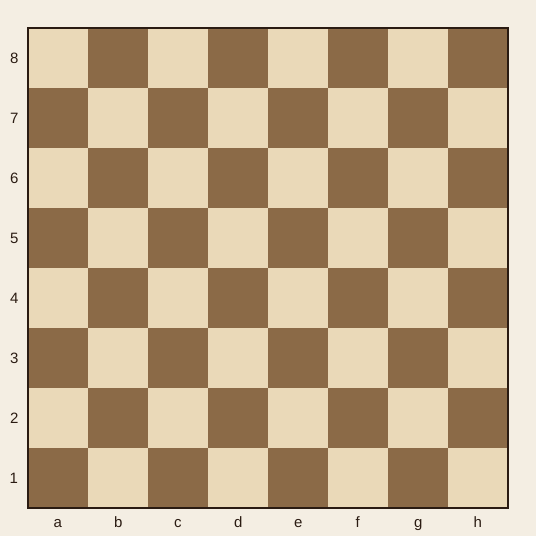
Chess notation is a coordinate grid: 8 files lettered a through h and 8 ranks numbered 1 through 8, which gives all 64 squares a name like e4 or c6. Learn those 16 labels and you can read any chess book, score sheet, or tournament result without guessing.
Files run left to right, ranks run away from you
Set the board so each player has a light square in the right-hand corner. That's the whole orientation rule. From White's seat, the files go a, b, c, d, e, f, g, h from left to right, and the ranks go 1 through 8 starting with the row closest to you. h1, your near-right corner, is light. a1, your near-left corner, is dark. And the names stay put for both players: a1 doesn't turn into h8 when your opponent sits down across from you.
Getting the board turned 90 degrees is the single most common setup error I see at club nights, and it makes every coordinate wrong for the whole game. The how to set up a chess board guide walks through it in the order you should actualy do it.
Reading a square without counting on your fingers
Once you've played a few hundred games you'll just know. Until then, use the border: find the file letter along the edge, slide your finger to the rank number, and that's your square. Here's what the labels produce on a correctly oriented board.
| Square | File | Rank | Color | | a1 | a | 1 | dark | | h1 | h | 1 | light | | d4 | d | 4 | dark | | e4 | e | 4 | light | | h8 | h | 8 | dark |
There's a cheap self-check if you're ever unsure. Count the file's position (a is 1, h is 8), add the rank number, and look at the total: odd means a light square, even means dark. a1 gives you 2, so it's dark. h1 gives you 9, so it's light. It works on all 64 of them, and it's a faster way to settle an argument than staring at the board. If you want the fuller picture of how the grid is built, the how many squares on a chess board breakdown covers the geometry.
The starting position, square by square
Before you can read notation you have to know where everything begins, because a move like Nf3 only means something if you know the knight started on g1.
| Piece | White starts on | Black starts on | Letter used in notation | | King | e1 | e8 | K | | Queen | d1 | d8 | Q | | Rook | a1 and h1 | a8 and h8 | R | | Bishop | c1 and f1 | c8 and f8 | B | | Knight | b1 and g1 | b8 and g8 | N | | Pawns | a2 through h2 | a7 through h7 | none |
Two mnemonics survive because they work. "Queen on her own color": White's queen sits on d1, which is light, and Black's sits on d8, which is dark. "King next to the queen, on the e file." Thirty-two pieces on the board, thirty-two empty squares at the start, and ranks 3 through 6 are entirely bare. The chess pieces guide covers each one's movement if any of the names are still fuzzy.
What the letters and symbols actually mean
Piece letters are K, Q, R, B, and N. The knight takes N because K was already spoken for. Pawn moves get no letter at all, so it's e4 and never Pe4, which trips up just about everyone in their first week.
| Symbol | Meaning | Example | | (nothing) | pawn move | e4 | | N | knight | Nf3 | | x | capture | Nxe5 | | + | check | Qh5+ | | # | checkmate | Qh7# | | O-O | kingside castling | O-O | | O-O-O | queenside castling | O-O-O | | =Q | promotion to queen | e8=Q | | e.p. | en passant capture | exd6 e.p. |
Put it together and you get a real game: 1. e4 e5 2. Nf3 Nc6 3. Bb5 a6. That's the Ruy Lopez, and you can replay the whole thing from a printed page with no board in front of you. Which is the entire point. The chess rules for beginners page covers castling and en passant if those two symbols look strange.
Older books use descriptive notation instead, where P-K4 means the same thing as e4 and N-KB3 means Nf3. Different system, same board, and it's worth recognizing even if you never write in it.
Boards that print the coordinates, and boards that don't
Roll-up vinyl boards almost always print file letters and rank numbers along the border. Wooden boards usually don't, and plenty of cheap folding sets skip them too. If yours is bare, masking tape and a fine marker take about four minutes and cost nothing.
Here's my concession. I used to think printed coordinates were a crutch for beginners. Then I started playing rated games where I had to write every move down, and I changed my mind in roughly one round. Any board you plan to score games on should have them, and the chess board dimensions page explains why square size matters as much as the labels do.

Spin Master Games Cardinal Classics Chess Teacher
- Includes: Chessboard, 32 Chess Pieces, Instructions
The Chess Teacher set prints the piece name and the number and direction of squares on each piece, and I'd buy it for a kid who's still asking which way the knight goes.

The Point Games folding set is 32 standard plastic pieces on a cardboard board that folds in half, and the listing says ages 6 and up; it's the basic option I'd keep in a bag for club nights.

The WE Games tournament set gives you 34 pieces including two extra queens, a 3.75-inch king, and a vinyl roll-up board with 2.25-inch squares and algebraic coordinates printed on it, which is the one I'd pick for a player who's ready to start writing games down.
Tonight, set up the board and put a pawn on e4. Say out loud the name of every square that pawn can reach in one move, then do the same thing tomorrow with the knight. A week of that and you'll stop counting letters on the border.
Questions people ask me
What do the letters and numbers on a chess board mean?
The letters a through h label the eight files (columns) and the numbers 1 through 8 label the eight ranks (rows). Together they name all 64 squares, so e4 means the file-e, rank-4 square. The corner nearest White's right hand is always h1, and it's always light.
Which way do the letters go on a chess board?
From White's side, files read a to h left to right and ranks read 1 to 8 from nearest to farthest. Black sees the same board with the same names; a1 is dark and stays dark. Set the board with a light square in each player's right-hand corner and the letters line up correctly.
Is chess notation hard to learn?
The coordinate part takes an evening: 8 letters, 8 numbers, and a handful of piece symbols. Writing full algebraic notation fluently takes longer, maybe a few weeks of scoring your own games. Most players learn to read it faster than they learn to write it.