Chess Board Pictures to Print: Sizes, Files, and How to Use Them
Every file prints on Letter or A4, scales to 2 to 2.25 inch squares, and survives a laminator.
Free downloads
PDFs, 0.9 inch squares. Print at 100% (actual size), not “fit to page”.
- Blank board with coordinates: US Letter · A4
- Blank board, no coordinates: US Letter · A4
- Board with pieces in the starting position: US Letter · A4
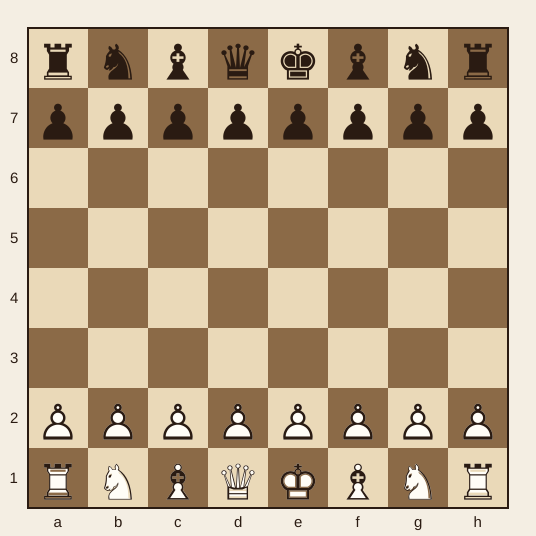
The pictures on this page are print-ready chess boards: blank grids, labeled grids, and flat pieces you can cut out. Here's the short version on sizing. Print at 100 percent when you want a diagram for a worksheet, and each square lands at about an inch. Print at 200 percent and tile the file across four sheets when you want a board with 2 inch squares that holds a real king base without the pieces looking like they're standing in puddles.
The free printable files are linked on this page, in both Letter and A4. Every version keeps the coordinates outside the grid, which is the detail most free downloads get wrong. Coordinates printed inside the corner squares steal playing space from the a1 rook and the h8 rook.
A board is 8 by 8, 64 squares, and that number never changes. Square size is what turns a picture into a playable board, and that's where people get stuck.
What each printable chess board picture contains
The set covers four jobs: a blank grid, a labeled starting position, pieces to cut out, and a transparent board for documents.
| Version | What's on it | Best use |
|---|---|---|
| Blank board, Letter | Empty 8x8 grid, coordinates on all four sides | Diagrams and coordinate drills |
| Blank board, A4 | Same grid on 210 by 297 mm paper | Printers set to A4 |
| Starting position | All 32 pieces on their squares, flat 2D icons | Teaching setup to a new player |
| Pieces only | Two colors with cutting guides between them | Homemade sets for a classroom |
| Transparent PNG | Empty board, no background | Worksheets, slides, diagram apps |
If you only pull one file, pull the plain printable chess board with coordinates on all four sides. It's the version that survives being photocopied forty times for a club handout, because it has no gray fills to muddy and no tiny piece graphics to lose in a bad copy.
Print at 100 percent, then measure a square with a ruler
The "Fit to page" checkbox is the enemy. Choose "Actual size" or type 100 into the scale box, then print one test page before you commit to four. A printer that shrinks to fit its own margins turns a 2 inch square into 1.9 inches, and you lose nearly an inch across the finished board. Nobody notices untill the pieces are set up and the eighth rank hangs off the edge.
Measure one square with a ruler. If it reads 2 inches, you're done. If it reads 1 7/8, go back and fix the scale before you print anything else. Chasing that error after you've taped four sheets together is an afternoon you don't get back.
| Paper | Scale setting | Sheets for the board | Square size |
|---|---|---|---|
| US Letter, 8.5 by 11 in | 100% | 1 | about 1 inch |
| US Letter | 200%, tiled 2 by 2 | 4 | about 2 inches |
| US Letter | 225%, tiled 2 by 2 | 4 | about 2.25 inches |
| A4, 210 by 297 mm | 100% | 1 | about 24 mm |
| A4 | 200%, tiled 2 by 2 | 4 | about 48 mm |
The square size that matches real pieces
US Chess guidance puts tournament kings at 3.375 to 4.5 inches tall, squares at 2 to 2.5 inches, and the king's base at roughly 75 to 80 percent of a square. So a 2 inch square wants a king base of 1.5 to 1.6 inches, and a 2.25 inch square takes up to about 1.7. Nail that ratio and even cheap plastic pieces look like they belong. I've laid out the full number set on chess board dimensions if you're matching a set you already own.
A paper board is not a tournament board, and I won't pretend a taped grid plays like a 2 inch walnut board with felt underneath. It doesn't. But for teaching, diagramming, and a club night where twelve kids share four sets, four sheets of paper does the job.
Paper weight, ink, and the settings that wreck a grid
Standard 20 lb copy paper prints the grid fine and curls like a potato chip by move 20. Step up to 32 lb paper or 65 lb cardstock if the board gets handled at all. Save the 110 lb index for pieces you plan to cut out, where stiffness actualy helps.
Turn borderless printing off. It crops to the page edge and takes the a-file and the first rank with it. On a cheap inkjet, solid black squares drink ink and dry streaky, so use a 20 to 30 percent gray fill instead of black. Check the grid line at 100 percent zoom before you hit print. A hairline can vanish completely on a laser printer running at 600 dpi.
Taping four Letter sheets into one 16 inch board
Print four pages at 200 percent, then trim 1/4 inch off the two interior edges of each sheet so the grid lines butt together instead of overlapping. Tape the seams on the back first. Flip the board over and run one strip of matte tape down each front seam, because glossy tape catches the light and hides the squares underneath it.
A steel ruler and a cutting mat cost less than a ruined print job, and a rotary trimmer is faster if you own one. Line the grid up before the tape, not after. Once tape touches paper you get one adjustment.
Laminating a paper board without wrecking it
3 mil pouches are the right call for a board. 5 mil comes out stiff and refuses to lie flat, so you spend the whole game pressing a corner down with your elbow. If the sheet curls out of the machine, run it through once more on the cool setting, then stack two hardcover books on it for ten minutes.
Dry erase markers wipe off a laminated board. Permanent marker doesn't, and no amount of rubbing alcohol gets the ghost out of the grid lines. Keep a fine-tip dry erase marker in the same drawer and a printed sheet becomes a reusable diagram for knight moves, pawn structure, and king and pawn endings.
Using a blank board for coordinate and setup drills
Point at a square and have the kid name it. Then flip it: name a square, they drop a coin on it. Five minutes of that teaches more coordinates than a page of a-h labels.
For setup, hand them the blank board and the pieces sheet and let them build the starting position from memory, then check it against the labeled version. Order matters. Pawns on the second and seventh ranks, rooks in the corners, queen on her own color. There's a full walkthrough on how to set up a chess board if you want a script to read from.
Cutting out paper pieces that stand up
| Piece | White | Black | On the board |
|---|---|---|---|
| King | 1 | 1 | 2 |
| Queen | 1 | 1 | 2 |
| Rook | 2 | 2 | 4 |
| Bishop | 2 | 2 | 4 |
| Knight | 2 | 2 | 4 |
| Pawn | 8 | 8 | 16 |
| Total | 16 | 16 | 32 |
Glue each piece to a cereal-box backing, fold the tab, and drop a penny inside before you close it. The penny is what stops a paper king from tipping over when a six year old grabs it mid-game.
The flat icons print plain, so let kids color their own side. The chess pieces drawing page covers the shapes piece by piece if you want them drawn by hand instead of cut from a sheet.
For something heavier than paper, the DIY chess pieces page walks through the builds that use hardware you already have in a drawer. Weight is the whole game with homemade pieces. Anything under about half an ounce feels wrong in the fingers.
Empty boards for worksheets, diagram books, and club handouts
The transparent PNG is the one to keep on your desktop. Paste it into a document, drop arrows and circles on top, and you have a position diagram in about 90 seconds. Set the image width to 3 inches for a printed handout and 6 inches for a worksheet. Squares stay legible at both sizes.
Print a stack of ten blank boards at the start of a term and you stop hunting for paper every Thursday. The chess printables page collects the rest of what a club needs on the table, and once the boards are laminated you can reuse the same set for years.
Print one, laminate it, and keep it in the car. A 16 inch paper board folded into a grocery bag has rescued more rainy club nights than any set on my shelf.