Chess Pieces Drawing Printables: Trace a Full Set at the Right Size
Six piece outlines, a board grid, and the scaling numbers that make a traced set fit a real tournament board.
Free downloads
PDFs, 0.9 inch squares. Print at 100% (actual size), not “fit to page”.
- Blank board with coordinates: US Letter · A4
- Blank board, no coordinates: US Letter · A4
- Board with pieces in the starting position: US Letter · A4
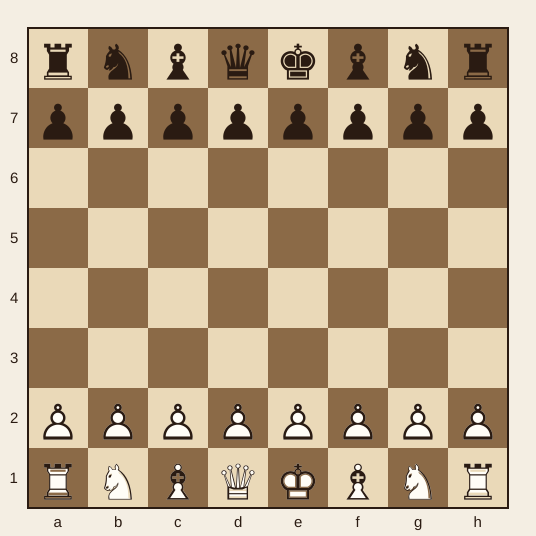
What the free chess pieces drawing sheets contain
Short answer first. Print the sheets at 100 percent, trace or color the outlines, cut them out, and you've got a playable set of 32 pieces. The free printable files are linked on this page.
Six shapes carry the whole army: pawn, rook, knight, bishop, queen, king. You need 16 light pieces and 16 dark ones, so the small shapes get printed more than once and half of them get shaded in.
Alongside the outlines there's a board grid you can color, plus a couple of practice sheets with the outlines repeated small so nobody wastes a full page on a wobbly first pawn. The rest of the paper kit sits in the chess printables collection if you want score sheets and a board in the same style.
Print settings that keep the pieces the right size
Print at 100 percent. Not "fit to page," not "shrink to fit." On a 3.75 inch king, a 92 percent shrink pulls the height down to about 3.45 inches, and the base stops matching the squares you cut for it.
The target numbers come from US Chess guidance rather than from me: king height 3.375 to 4.5 inches, squares 2 to 2.5 inches, king base roughly 75 to 80 percent of one square. On a 2.25 inch square, that's a base of about 1.7 to 1.8 inches. Write those three numbers on a sticky note before you open the printer dialog.
US Letter at 8.5 by 11 inches and A4 at 210 by 297 millimeters both fit the layouts. Use 65 lb cardstock if the pieces will actually be played with. Twenty pound copy paper is fine for tracing drills, but it curls at the corners inside a week.
How many of each piece to draw, and where they start
Draw smallest to tallest. You'll need 16 pawns, and nobody enjoys saving the pawns for last.
| Piece | Count per side | Starting squares (White) | Drawing note |
|---|---|---|---|
| Pawn | 8 | a2 through h2 | Smallest outline, round head, short collar |
| Rook | 2 | a1 and h1 | Flat top, four crenellations |
| Knight | 2 | b1 and g1 | Only piece drawn in profile, horse head facing left |
| Bishop | 2 | c1 and f1 | Pointed mitre with a slit cut into it |
| Queen | 1 | d1 | Crown with points, taller than the bishop |
| King | 1 | e1 | Cross on top, tallest piece on the sheet |
The black side mirrors it on the eighth rank, so the table works for both colors once you flip the numbers. If a new player asks why there are 32 pieces and not 16, the how many pieces in chess breakdown covers the setup piece by piece.
Tracing and cutting with a kid or a beginner
Give a 6-year-old a pawn outline and a pencil and you'll get something recognizable in about a minute. The knight takes longer. It's the only piece drawn in profile, and that horse head is where drawings tend to go sideways.
Say the piece names out loud while they get traced: pawn, rook, knight. The chess pieces guide pairs each shape with its name and its move if you want a reference sheet on the table next to the pencils. Cheap insurance against a kid who can draw a bishop but can't tell you what it does.
Tools are simple. Blunt-tip scissors for small hands, sharp ones for the adult, and a 12 inch ruler as a straight edge on the board grid. A shoebox holds the finished pieces while the glue or the marker dries.
Laminating so a traced set survives a club night
3 mil pouches feel like a plastic bag with ambition. 5 mil pouches keep a cut-out pawn flat after a season of being shuffled in and out of a box, and a 100-pack of letter size pouches covers a classroom with room to spare.
Laminate the full sheet first, then cut out the pieces. That way every outline ends up sealed on all sides instead of open at the edges. A dry erase marker writes on the laminated surface and wipes off with a thumb, so the same sheet can be traced by 20 kids in a row without reprinting.
Store the cut pieces in a ziplock bag with a square of cardboard underneath. It's not glamorous. It works.
Where a traced paper set falls short
Paper slides. A cardstock pawn nudged with a knuckle drifts half a square, and no amount of laminating adds weight to it. If you're running a real game with clocks and touch-move rules, the paper set is a teaching tool, not a tournament set.
And tracing an outline won't teach freehand proportion. If the goal is drawing a knight from scratch, copy from photos of real carvings and skip the outlines entirely. For anyone going the other direction, toward a set made of wood, clay, or resin, the DIY chess pieces route beats paper on every count except speed.
Matching the drawing scale to a board you already own
Boards come in 16, 17 and 18 inch sizes, which works out to 2, 2.125 and 2.25 inch squares. Measure one square with a ruler before printing, because the size on the box refers to the whole board and the border eats into it.
For a 17 inch roll-up, aim for a king base near 1.6 inches, which is 0.75 times the 2.125 inch square. For a 2 inch square, 1.5 inches. For a 2.25 inch square, 1.7 to 1.8 inches.
If you'd rather print the board too, the printable chess board files use the same measurements, so the traced pieces land on squares that actualy match them. Pencil in the coordinates on the grid before you laminate, and the whole thing turns into a practice board for notation.
One last piece of advice from too many club nights: keep the sheet at full size, store the cut pieces flat, and reprint the pawn page when they go missing. Pawns always go missing.
Questions people ask me
What size should drawn chess pieces be for a real board?
US Chess guidance puts the king at 3.375 to 4.5 inches tall, with squares between 2 and 2.5 inches and a king base about 75 to 80 percent of one square. On a 2.25 inch square that means a base near 1.7 to 1.8 inches. Print at 100 percent and check the first piece with a ruler before you cut the rest.
Can I print the drawing sheets on regular copy paper?
For tracing practice, yes. For pieces that will actually get played, use 65 lb cardstock. Copy paper curls at the corners and a paper pawn slides across the board when someone breathes on it.
Do the printables work on A4 paper?
Yes. The layouts fit both US Letter at 8.5 by 11 inches and A4 at 210 by 297 millimeters. Set your printer to actual size and measure the king outline once it comes out, since fit-to-page will quietly shrink everything.