3D Printed Chess Pieces: Files, Scaling, and What Actually Fits a Board
Get the king's base right and your printed set fits a real board. Everything after that is detail.
Free downloads
PDFs, 0.9 inch squares. Print at 100% (actual size), not “fit to page”.
- Blank board with coordinates: US Letter · A4
- Blank board, no coordinates: US Letter · A4
- Board with pieces in the starting position: US Letter · A4
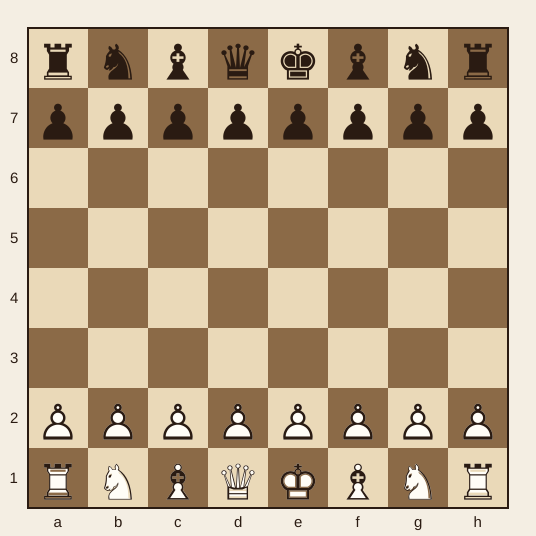
Print one pawn before you print a set
Short answer: choose your board first, measure one square, and scale every file off the king's base. A tournament board with 2.25 inch squares wants a base around 1.7 to 1.8 inches, which is the 75 to 80 percent rule US Chess puts in its equipment guidance. Nail that and the rest of the set follows. Miss it and you've made 32 pieces that bump into each other every time you push a pawn.
Then do the cheap test. Print one pawn at your chosen scale, set it on the board, and walk it to the far corner. Daylight around the base means you're good. Twenty minutes of checking beats a weekend of printing.
Paper sheets and filament spools solve different problems
A paper set is the right answer for a classroom, a library program, or a kid who wants to play tonight. Print on 65 lb cardstock, about 176 gsm, at 100% scale, cut with a 1/8 inch border, and laminate in 3 mil pouches. The free printable files are linked on this page, both the paper piece sheets and the STL list, so you aren't digging through forums for a clean pawn.
A filament set is the right answer if you want pieces that survive a backpack and a dropped box. PLA at 0.16 mm layers feels like inexpensive plastic and plays fine on a club table. Here's the concession: neither version replaces a weighted set for a rated game. Light pieces slide, and you'll be nudging a knight back onto its square for the third time in an evening.
Sizes that fit a 2 to 2.25 inch square
These are the proportions most Staunton sets follow, so use them as a sanity check on whatever file you download. Check the bounding box in your slicer before you commit. If the king base measures about 1.75 inches, you're set for a 2.25 inch board; drop to 1.5 or 1.6 inches for a 2 inch board.
| Piece | Count in a full set | Height with a 3.75 in king | Base | Where prints go wrong |
|---|---|---|---|---|
| King | 2 | 3.75 in | 1.75 in | cross finial snaps if it's dropped |
| Queen | 2 | 3.4 in | 1.6 in | crown points want a slow outer wall |
| Bishop | 4 | 2.9 in | 1.45 in | mitre slit traps stringing |
| Knight | 4 | 2.6 in | 1.45 in | muzzle and ears need supports |
| Rook | 4 | 2.5 in | 1.5 in | crenellations print cleaner at 0.12 mm |
| Pawn | 16 | 1.9 in | 1.2 in | batch all 16 on one plate |
Those heights are typical Staunton proportions, not gospel. If you're comparing against a set you already own, the chess pieces reference covers the standard measurements piece by piece.
Paper setup: Letter size, 100% scale, 5 mil laminate
Turn off "fit to page." It shrinks a sheet by roughly 4 percent and quietly breaks your scale, which is the most common reason a printed set doesn't fit a real board. US Letter is 8.5 by 11 inches, and an 8x8 board with 2.25 inch squares runs 18 inches across, so the board can't live on a single sheet. Print it across four sheets and tape the seams, or use a one-page board and scale the pieces to about 60 percent for a travel set.
Laminate pieces in 3 mil pouches and the board in 5 mil, since boards get folded, dragged, and sat on. Leave an 1/8 inch margin when you cut or the laminate edge lifts within a week. If you're printing a board to go with the pieces, start with the printable chess board page and measure one square with a ruler before the scissors come out.
What to put under a paper piece so it stays put
A penny weighs 2.5 grams. Tape one under the base of every piece and the set stops skating across the table when a sleeve catches it. A pea of adhesive putty does the same job and won't rattle. Write the piece letter on the underside in marker while you're at it; sorting 32 pieces back into two colors takes a minute instead of five.
If you want pieces with real heft, the diy chess pieces projects cover wood and resin routes that cost more and last longer.
Slicer settings that matter more than the file
Run a 0.4 mm nozzle, 0.16 mm layers, three perimeters, 15 percent infill, PLA at 200 C on a 60 C bed. Knights get supports under the muzzle and the ears. Everything else prints upright without them, including the king when the finial is rounded rather than a thin cross. Batch the 16 pawns on one plate; at a 1.2 inch base they sit in a 4x4 grid with room left over on a 220 by 220 mm bed.
I'd skip rafts entirely. Budget a weekend and probably under half a 1 kg spool of filament, most of it chewed up by pawns. Which is exactly why you print one pawn first.
Running a club night or classroom on printed sets
Twenty-four kids means 12 boards, 12 board printouts, and 384 pieces if you're cutting paper. Give yourself two evenings with a paper cutter. Painter's tape holds laminated boards to tables without leaving residue, and spare pawns in a zip bag rescue a session when one disappears. Print each color on diffrent paper so a mix-up takes seconds to fix.
For younger players, scale the pieces to fit 2 inch squares. Smaller hands do better with shorter kings, and the whole board still fits a 16 inch footprint on a classroom table.
When you're ready for a real board
If printing 32 pieces sounds like a lot of weekends, the best 3d printed chess sets roundup covers sets that arrive finished.
The Lobyn half set is essentially what you just printed, done properly: 3D printed in Texas by a veteran-owned shop, a 3.75 inch king on a 1.44 inch base, and 17 pieces in one color with an extra queen for promotion. Solid plastic, unweighted, so it plays like a home print, only more consistent from piece to piece. Buy two half sets to fill a board. And yes, 1.44 inches is a touch narrow on 2.25 inch squares, though it lands near 72 percent on a 2 inch board, which is close enough for club play.

The cactus set is a different animal: 32 pieces, a roll-up mat, and a planter box that doubles as storage, 2 pounds for the lot. The listing doesn't state a king height or a square size, which is the first thing I'd want to know before using it for anything beyond a coffee shop game. As a gift for a plant person who plays chess, it's a fun object. As your tournament set, no.

Questions people ask me
What size should 3D printed chess pieces be?
Match the king's base to your squares, not your shelf. On a 2.25 inch square, aim for a base around 1.7 to 1.8 inches and a king near 3.75 inches tall, which is the 75 to 80 percent rule US Chess uses. A 2 inch board wants a base closer to 1.5 or 1.6 inches with everything scaled down to match.
Can you 3D print chess pieces without supports?
Most Staunton profiles print upright with no supports at all. Knights are the exception, since the muzzle and ears overhang, so switch supports on for those four pieces and leave the rest clean. Kings with a thin cross finial may want a little help at the very top too.
Is a paper chess set good enough to actually play on?
For teaching, classroom play, and travel, yes, if you print on 65 lb cardstock and laminate in 3 mil pouches. For rated games, no, because paper pieces slide and laminate curls at the edges. Tape a penny under each base and it stops being a problem.