Chess Grid Printables for 2026: Sizes, Coordinates, and Scaling Math
A chess grid is easy. Printing one at a size real pieces fit takes a little arithmetic, and I'll walk you through it.
Free downloads
PDFs, 0.9 inch squares. Print at 100% (actual size), not “fit to page”.
- Blank board with coordinates: US Letter · A4
- Blank board, no coordinates: US Letter · A4
- Board with pieces in the starting position: US Letter · A4
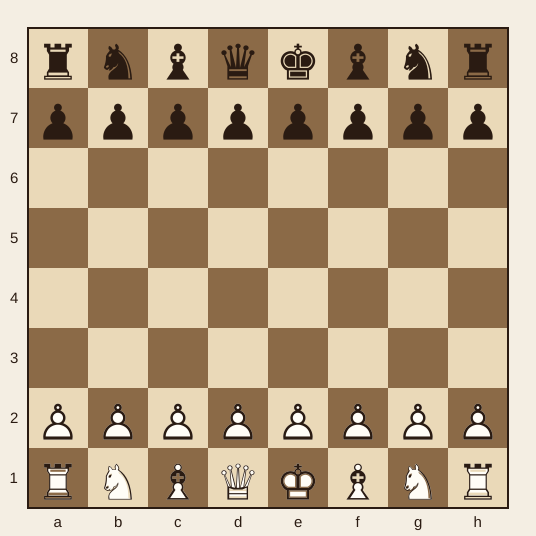
A chess grid is 64 squares in an 8 by 8 layout, alternating light and dark, with files lettered a through h and ranks numbered 1 through 8. That's the whole definition. The hard part is getting one onto paper at a size where a real king doesn't look like a mailbox on a postage stamp.
The free printable files are linked on this page. Three versions: a blank grid, a coordinate-labeled grid, and one with the starting position already marked. Print the labeled one for drills, the blank one for kids to write on.
What each printable chess grid version is for
The blank grid is for filling in. I use that shape for square-color drills and for having a kid write the coordinates themselves, which sticks better than copying a finished board. The labeled grid gives you a1 through h8 printed in the corner of all 64 squares, and that's the version I'd laminate, since it doubles as a wipe-clean answer sheet. The setup grid shows all 32 pieces on their starting squares, which is the one to hand a parent who's forgotten where the queens go.
The empty grid is also the cheapest piece of chess equipment you'll ever own. A single sheet of letter paper, about 4 cents at retail, replaces a board for a beginner who just needs to see the geometry.
Paper size, margins, and scaling to a 2 to 2.25 inch square
Here's the arithmetic, because this is where most printables quietly fail. US Chess puts a tournament square between 2 and 2.5 inches, with the king's base running about 75 to 80 percent of that square. Letter paper gives you 7.5 inches of usable width after half-inch margins, so a full 8 by 8 board printed at 100 percent lands on 0.94 inch squares. Too small for pieces. To reach 2.25 inches, print at 240 percent.
| Paper | Usable width after margins | Square at 100% | Scale for 2.25 in squares |
|---|---|---|---|
| US Letter (8.5 x 11 in) | 7.5 in | 0.94 in | 240% |
| A4 (210 x 297 mm) | 190 mm | 23.75 mm | 240% |
| Tabloid (11 x 17 in) | 10 in | 1.25 in | 180% |
At 240 percent your scaled page is roughly 20 by 26 inches, so the board tiles across at least three sheets wide and three tall. Nine sheets and a roll of tape. Adobe's poster print setting does the tiling for you if you check the box before you hit print, and I'd add a quarter inch of overlap so the tape has something to bite.
The alternative is a copy shop. An 18 by 18 inch color print on heavier stock usually runs a few dollars, and it comes out flat, square, and free of tape seams. If you're printing for a classroom of 20 kids, that's the version to buy.
The 64 squares, named
The board is always drawn from White's side, so a1 sits at the bottom left and h8 at the top right. The light square goes on the right-hand corner nearest each player. Get that one detail wrong and every drill after it goes sideways.
| Rank | a | b | c | d | e | f | g | h |
|---|---|---|---|---|---|---|---|---|
| 8 | a8 | b8 | c8 | d8 | e8 | f8 | g8 | h8 |
| 7 | a7 | b7 | c7 | d7 | e7 | f7 | g7 | h7 |
| 6 | a6 | b6 | c6 | d6 | e6 | f6 | g6 | h6 |
| 5 | a5 | b5 | c5 | d5 | e5 | f5 | g5 | h5 |
| 4 | a4 | b4 | c4 | d4 | e4 | f4 | g4 | h4 |
| 3 | a3 | b3 | c3 | d3 | e3 | f3 | g3 | h3 |
| 2 | a2 | b2 | c2 | d2 | e2 | f2 | g2 | h2 |
| 1 | a1 | b1 | c1 | d1 | e1 | f1 | g1 | h1 |
If the letter-first order feels backwards, that's normal for the first week. The full explanation of why files run letters and ranks run numbers lives in the guide to chess square names, and it's worth ten minutes before you print anything for a class.
For the setup grid, the letters that go in those squares are short. Pawns get no letter at all, just the file they stand on.
| Piece | Letter | Count per side |
|---|---|---|
| King | K | 1 |
| Queen | Q | 1 |
| Rook | R | 2 |
| Bishop | B | 2 |
| Knight | N | 2 |
| Pawn | none | 8 |
Laminating the grid so a dry-erase marker works
Plain paper survives about one session with a pencil and zero sessions with a marker. A 5 mil laminating pouch handles dry-erase fine, and a 3 mil pouch is thinner but still wipeable if you press lightly. A basic letter-size laminator is a $25-ish tool and a 100-pack of pouches runs maybe 25 to 35 cents a sheet, which is cheap enough that I'd laminate the labeled grid and the blank one and leave the setup grid plain.
One warning from experience: wet-erase markers and laminating film are a bad pair. Use dry-erase only, and wipe within a day or two. The ink ghosts if it sits on the plastic for a week, and you'll spend more time scrubbing than teaching.
Drills that actually work on a printed grid
The best five-minute drill is square color. Call out a square, say g6, and the kid writes L or D in it. Pull the answer from the coordinate table above. Then flip it: you write L or D in 10 random squares and they name the coordinates. Both directions matter, and both fit on one laminated sheet.
Second drill: draw a knight's path. Put a marker on b1 and get to g8 in five moves without landing on the same square twice. On paper, kids will happily do this for 15 minutes. On a real board they get distracted by the pieces. The movement patterns behind it are covered in the chess moves breakdown if you need to check the rules mid-drill.
Third drill, for notation practice: play a short game on a real board, then have the student write the moves on the blank grid instead of lined paper. The squares give them a visual check on whether the piece could actualy have reached that square. The chess notation guide covers the letter and number format the grid expects.
Using the grid at club night or in a classroom
Here's my honest read, and it's a concession. Paper boards slide. They buckle at the tape seams, the pieces catch on the overlap, and a 9-sheet tiled board is not something I'd set up for a rated game. For teaching, though, they beat a real board, because a kid can draw an arrow on them with a marker and nobody yells about the furniture.
For a classroom, print one labeled grid per two students and one setup grid per table. Twenty kids, ten laminated boards, one laminator, an afternoon. Add a printed sheet of chess rules for beginners to each table and the whole station runs itself for a rainy lunch period.
And when a new player asks who moves first, hand them the who goes first in chess page rather than repeating it for the fourth time that hour. White moves first. Always.
When you're ready for a real board
Paper teaches the layout. It doesn't survive a season.
The Spin Master Games Cardinal Classics Chess Teacher puts the instructions on the pieces themselves. The listing says each piece shows its name plus how many spaces and which direction it moves, and the set includes the board, 32 pieces, and instructions for ages 8 and up. No dimensions are listed and no rating is listed, so I can't tell you the square size. For a young beginner who keeps asking which way the knight goes, I'd buy it. Anyone past the basics will outgrow it in a month.

Spin Master Games Cardinal Classics Chess Teacher
- Includes: Chessboard, 32 Chess Pieces, Instructions
The WE Games Value Tournament set is the other end of the scale. 3.75 inch king, 34 pieces with two extra queens, a 19.75 inch vinyl roll-up with 2.25 inch squares and algebraic coordinates printed on the surface, a bag, and equalizer dice for pairing a beginner against a stronger player. The listing says it meets FIDE and USCF height, weight, and proportion rules, which lines up with the numbers on the spec sheet. If your printed grid was a placeholder untill the real thing arrived, I'd skip straight to this one.

Questions people ask me
What is a chess grid?
It's the board itself: 64 squares in an 8 by 8 layout, half light and half dark, with files lettered a to h and ranks numbered 1 to 8. A printable version puts that same layout on paper so you can label it, write on it, or set pieces on it. The light square sits at each player's right-hand corner.
What size should a printed chess board be?
Aim for 2 to 2.25 inch squares if pieces are going on it, which makes the board 16 to 18 inches across. US Chess guidance pairs that with a king 3.375 to 4.5 inches tall and a king base about 75 to 80 percent of the square. Squares around 0.9 inch are fine for notation drills and nothing else.
Can I print a chess board on regular paper?
Yes, but a full board won't fit one letter sheet at playing size. Letter paper gives you about 7.5 inches of usable width after margins, so a single-page board runs on 0.94 inch squares. Scale to 240 percent and tile it, or have a copy shop run it at 18 by 18 inches.