Chess Rules: How All Six Pieces Move, Capture, and Set Up (2026)
Six pieces, 64 squares, and a handful of rules people get wrong for years. Here is the whole set, taught simply.
Chess rules come down to six piece types on 64 squares, and only one of them, the pawn, is barred from moving backwards. Learn how those six pieces move and capture, add the three special rules (castling, en passant, promotion), and you can play a legal game tonight. Everything else is bookkeeping. The board is 8 squares by 8, a light square sits in each player's near right corner, and each side starts with 16 pieces: 8 pawns, 2 rooks, 2 knights, 2 bishops, a queen, and a king.
Setup: queen on her own color, pawns on the second rank
The starting position never changes, and the whole thing takes about 30 seconds once you know the rhyme. Queen on her own color. White's queen goes on d1, which is a light square. Black's queen goes on d8, which is a dark square. Get that backwards and both kings land on the wrong squares, which quietly breaks castling later because castling is defined from e1 and e8.
Fill the rest of the back rank in this order from the corner: rook, knight, bishop, queen, king, bishop, knight, rook. Then eight pawns on rank 2 for White, eight on rank 7 for Black. For a slower walkthrough with coordinates, see my guide to how to set up a chess board.
Count the squares once and you'll never wonder again: 64 total, 32 light and 32 dark, with a1 sitting on a dark square in the bottom left from White's view. That number is fixed and it's the same on a $12 folding board and a tournament vinyl roll-up. The full breakdown is over at how many squares on a chess board.
How each piece moves, with the numbers
Learn the movement, not the shape of the plastic. A piece is defined by the lines it travels.
| Piece | How it moves | Can it move backward? | Typical value |
|---|---|---|---|
| King | One square in any direction, plus castling | Yes | The game itself |
| Queen | Any distance along a rank, file, or diagonal | Yes | 9 |
| Rook | Any distance along a rank or file | Yes | 5 |
| Bishop | Any distance diagonally, stuck on its starting color | Yes | 3 |
| Knight | Two squares one way, one square perpendicular, jumping anything in between | Yes | 3 |
| Pawn | One square forward, or two from its starting square; captures diagonally | No | 1 |
Two facts that surprise beginners. A knight on b1 has exactly two legal moves at the start of the game, a3 and c3, and no piece can block it. A bishop that begins on c1 will never in its life touch a dark square, and a bishop on f1 will never touch a light one. The rook is the one to watch indoors: it slides the length of the board but cannot hop over a single pawn. More on each of them lives on my chess pieces page.
Which pieces can move backwards, and the one that can't
Five of the six move backward without complaint. Rooks, knights, bishops, queens, and kings all retreat as easily as they advance, and this matters more than most new players expect. A knight on d4 controls eight squares, and half of them are behind it. A queen on d4 in an open position touches 27 squares in every direction, backward included. That is the maximum for any piece on any square.
Pawns are the exception, and it's not a small one. A pawn only moves forward. Once it steps to e4, the square e3 is gone forever as far as that pawn is concerned, which is why pawn structure is the part of the game that hardly ever repairs itself. You can't undo a pawn move. You can walk a rook back to defend your king's second rank, though, and you'll do it constantly.
Pawn captures, en passant, promotion, and castling
A pawn captures one square diagonally forward. That's it. A white pawn on e4 can take on d5 or f5, but a black piece sitting on e5 blocks it completely; the pawn has no legal way to remove something directly in front of it. Same rule for Black, mirrored. This is the single most common misunderstanding I see at club level, usually from someone who has played for a month and thinks pawns run over things.
| Special rule | Piece involved | What happens | Written as |
|---|---|---|---|
| Castling kingside | King and h1 rook | King to g1, rook to f1 | O-O |
| Castling queenside | King and a1 rook | King to c1, rook to d1 | O-O-O |
| En passant | Pawn | Capture a pawn that just ran two squares past you, on the square it skipped | exd6 |
| Promotion | Pawn | Reaching the 8th rank turns it into a queen, rook, bishop, or knight | e8=Q |
En passant has a short shelf life: you must take immediately, on the very next move, or the right disappears. Castling has four conditions, all of them legal requirements. King and rook can't have moved, the squares between them must be empty, the king can't be in check, and it can't cross or land on a square an enemy piece attacks. I'll concede that these are the fiddly bits, and even tournament players occasionaly ask a director to confirm the en passant rule. If you want these drilled in order, my chess rules for beginners page walks through them one at a time.
Check, checkmate, stalemate, and the draws people argue about
You never capture the king. When a king comes under attack you say check, and the player in check must answer it: move the king, block the line, or take the attacking piece. If none of the three is possible, that's checkmate and the game ends on the spot with 32 pieces still on the board.
Stalemate is the cousin nobody likes. The player to move has no legal move at all but isn't in check, and the game is a draw. I've watched a strong club player blow a won endgame this way with a queen and king against a lone king, and he knew better. Other draws: both sides repeat the same position three times, 50 moves pass for each side without a pawn move or a capture, or neither side has enough material to force mate. Learning the shorthand for recording all this is genuinely useful; my chess notation page covers it in about ten minutes.
One more habit worth forming early. Touch a piece, and you have to move it if a legal move exists. It's called touch move, and it's a real rule in tournament play, not etiquette.
If you need a set to learn on
I haven't unboxed any of these three. What follows comes from reading the listings closely and from what owners keep mentioning, which is how I shop for gear myself.

Spin Master Games Cardinal Classics Chess Teacher
- Includes: Chessboard, 32 Chess Pieces, Instructions
The Cardinal Classics Chess Teacher prints the piece name and movement direction on the pieces themselves, and for an 8-year-old learning the board that beats a plain Staunton set on day one.

The HI-Q set from Point Games is the cheap standard option: flat-bottomed plastic pieces, a folding cardboard board, and 32 pieces, listed for ages 6 and up.
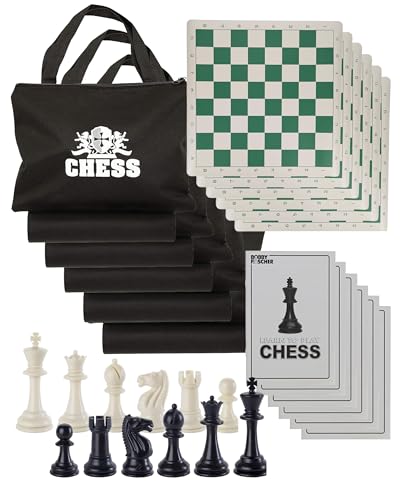
The WE Games value tournament set is what I'd buy for an adult: a 3.75 inch king, 2.25 inch squares, a 19.75 inch roll-up vinyl board with algebraic notation, 34 pieces including two extra queens, and a carry bag.
Those numbers aren't random. US Chess guidance puts king height at roughly 3.375 to 4.5 inches, squares at 2 to 2.5 inches, and the king's base at about 75 to 80 percent of a square, so the WE set lands right inside tournament spec. If you're checking a set you already own, the measuring method is on my chess board dimensions page.
Next step: set up all 32 pieces correctly, then play one short game where the only two goals are making a legal pawn capture and castling once. The rules stick after you've done them, not after you've read them.
Questions people ask me
Which chess pieces can move backwards?
Every piece except the pawn. Rooks, knights, bishops, queens and kings move backward as easily as forward. A pawn only ever goes forward, though it captures on a forward diagonal.
How do pawns capture other pieces?
A pawn captures one square diagonally forward, never straight ahead. A white pawn on e4 can take a piece sitting on d5 or f5, but a piece directly in front of it on e5 blocks the pawn instead of being capturable by it.
Can you castle out of check?
No. Castling is illegal if your king is in check, if the square it crosses is attacked, or if the square it lands on is attacked. You also lose the right permanently once the king or that rook has moved.