Chess Rules for Beginners: What Actually Matters in Your First Month
A club player's plain-English rundown of the rules that decide real games, and the three you can learn next week.
Chess rules for beginners come down to about a dozen things you can learn in 20 minutes: 64 squares, 16 pieces per side, white moves first, and you win by checkmating the enemy king. The rest (castling, en passant, the 50-move rule) is detail you'll absorb across your first month of games. I've taught this enough times at club nights to know which parts stick immediately and which parts need a board in front of you.
Set the board right and half the confusion disappears
A chessboard is 8 squares by 8 squares, 64 total, and the first rule costs nothing: put a light square in each player's right-hand corner. "Light on right" is the phrase to carry with you. From there the back rank runs rook, knight, bishop, queen, king, bishop, knight, rook, with the white queen on d1 (a light square) and the black queen on d8 (a dark one). Queens sit on their own color. Pawns fill the second rank for white and the seventh for black.
If you want the full walk-through with each step spelled out, my guide to how to set up a chess board covers it square by square. It takes two minutes and prevents the argument I've overheard at every club I've ever visited.
Each side starts with 16 pieces: 8 pawns, 2 rooks, 2 knights, 2 bishops, 1 queen, 1 king. That's 32 on the board, which is why tournament sets often ship 34, adding a spare queen for promotion. I count the pawns at the start of every serious game, because a missing one changes the whole opening. More on the roster in how many pieces in chess.
How the six pieces move, in one table
| Piece | Movement | Rough value |
|---|---|---|
| Pawn | One square forward; two from its starting square; captures one square diagonally forward | 1 |
| Knight | Two squares one way, one perpendicular; jumps over anything in between | 3 |
| Bishop | Any distance diagonally | 3 |
| Rook | Any distance along a file or rank | 5 |
| Queen | Rook plus bishop in one piece | 9 |
| King | One square in any direction, never into check | the whole game |
Those values are the shorthand club players use when trading, not an official rule. A rook for a bishop is a bad deal. Two rooks for a queen is a good one. Learn the moves first and the arithmetic second.
The knight trips people up because it's the only piece that ignores blockers. A knight on f3 attacks eight squares and cares nothing about the pawn wall in front of it. Bishops want long open diagonals and spend the first ten moves getting in each other's way. If you want each piece in full, with the traps, see my chess pieces breakdown.
Two things worth fixing in your head now: pawns capture differently than they move (a pawn on e4 attacks d5 and f5, not e5), and the king is never actualy captured. For the trade math, chess piece values has the table I keep in my head during games.
Castling, en passant, and promotion, the three rare ones
Castling is the only move where two pieces move at once. The king slides two squares toward a rook, and the rook jumps to the square the king crossed. You can only do it if neither the king nor that rook has moved, the squares between them are empty, and the king isn't in check, doesn't pass through an attacked square, and doesn't land on one.
En passant happens when a pawn runs two squares forward and lands beside an enemy pawn. That enemy pawn can capture it as though it had moved only one square, but only on the very next move. Miss the window and the right is gone. At club level it comes up maybe once every 15 or 20 games, which is why nobody remembers it.
Promotion is simple: a pawn reaching the far rank becomes a queen, rook, bishop, or knight of your color. Almost always a queen, which is the reason for the extra piece in the box. Nine queens on the board is legal.
Check, checkmate, and the draws that catch beginners
Check means the king is attacked. You have three ways out: move the king, block the line, or capture the attacker. Checkmate means none of those work, and the game ends there. The king stays on the board.
Draws are where beginners lose half-points they'd already banked. Stalemate is no legal move while not in check. Threefold repetition is the same position three times, which either player can claim. The 50-move rule is 50 moves each with no pawn move and no capture, also claimable. Insufficient material (king versus king) is automatic. My full chess rules page covers the tournament versions, including the 75-move and fivefold rules that end games whether anyone claims or not.
What to practice in your first month
Don't memorize openings. Play 15-minute games instead of 3-minute ones, because blitz teaches you to move fast before you've learned to see. Aim to castle by move 10, get both knights and at least one bishop off the back rank, and don't move the same piece twice in the opening unless you have a reason.
One concession: the touch-move rule feels harsh until it saves you. In tournament play, if you touch a piece you have to move it, and if you touch an enemy piece you have to take it. Casual games don't enforce it, but practicing it at home builds the habit. My learn chess hub has the order I'd teach these in.

Spin Master Games Cardinal Classics Chess Teacher
- Includes: Chessboard, 32 Chess Pieces, Instructions
The pieces are printed with their own movement directions and distances, which is the quickest way to get a kid or a total beginner through the first five games; the listing shows no rating yet, so you're judging the idea rather than the reviews.

A folding cardboard board and standard flat-bottomed plastic pieces, listed for ages 6 and up, which makes it the low-risk pick if you're not sure anyone in the house will stick with chess.
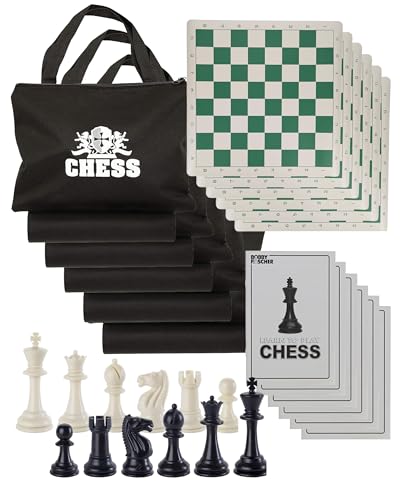
A 3.75-inch king, 2.25-inch squares, a 19.75-inch roll-up vinyl board and a carry bag, and those numbers sit inside the US Chess range, so it's the one I'd buy if the board needs to travel to a club or a park.
Set the board up tonight, light square on the right, and play one 15-minute game where you say each move out loud before you make it. Ten of those and the rules stop being rules and start being chess.
Questions people ask me
What are the basic rules of chess for beginners?
White moves first, players alternate one move at a time, and the goal is to trap the enemy king so it can't escape capture. Each of the six piece types moves differently, and the game ends at checkmate, not when the board is cleared. Draws are possible by stalemate, repetition, or the 50-move rule.
Can you castle out of check?
No. Castling is illegal if your king is in check, if it would pass through an attacked square, or if it would land on one. The king and the rook on that side also can't have moved earlier in the game, and the squares between them must be empty.
Is stalemate a win or a draw?
A draw. If the player to move has no legal move and isn't in check, the game is drawn on the spot, even if the other side has a queen and three pawns. I've watched beginners throw away won positions this way more than once.