Printworks Chess: Free Printable Boards and Pieces You Can Play On
What print-ready chess files actually contain, the paper and scaling that make them playable, and where the free downloads are.
Free downloads
PDFs, 0.9 inch squares. Print at 100% (actual size), not “fit to page”.
- Blank board with coordinates: US Letter · A4
- Blank board, no coordinates: US Letter · A4
- Board with pieces in the starting position: US Letter · A4
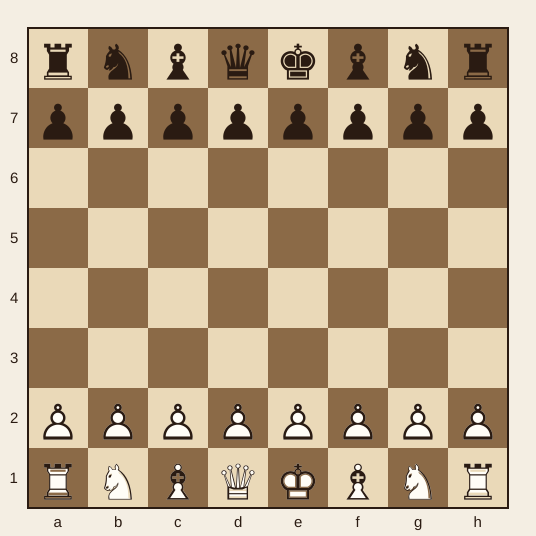
"Printworks chess" is the phrase people type when they want chess they can put through a printer. There's no single brand behind it. What you're after is a print-ready board and a print-ready set of pieces, and the free printable files are linked on this page. Print at 100 percent, then measure one square before you cut anything. A board with 2.25 inch squares and a king base around 1 inch plays like a real set. A board that came out at "fit to page" does not.
What the printable files actually contain
Most print-ready sets give you four things: the board, a piece sheet holding all 32 men, coordinate letters and numbers, and a one-page rules card. That's 64 squares and 32 pieces, and the rules card is the part people skip. Don't skip it. A kid who finds the sheet in a drawer six months later will read it, and that's how a printable set earns its keep. If you want more than the basics, the wider library of chess printables covers score sheets, notation pads and piece templates.
Paper size and scaling to a 2 to 2.25 inch square
US Letter is 8.5 by 11 inches and A4 is 210 by 297 millimeters. Neither fits an 8x8 board at tournament proportions on one page: 8 squares at 2.25 inches is 18 inches across. So the board tiles across pages, usually two or four, and you tape the seams.
The scaling part trips up more people than anything else. In the print dialog, choose "actual size" or 100 percent, never "fit to page" or "shrink to fit." Then print one page and measure a square. If it comes out at 2 inches and you want 2.25, divide 2.25 by 2 and you get 1.125, so set the scale to 112 or 113 percent. Two minutes with a ruler beats reprinting four pages.
For paper, I'd use 65 lb cardstock (about 176 gsm). It feeds through cheap printers without arguing and stiffens the board enough to pick up. Save the 110 lb stock for the pieces if your printer tolerates it.
Printing a blue chess board without draining the cartridge
Blue is the most requested color after the standard buff and green, and it's also the thirstiest. A solid navy 8x8 grid can drink a surprising share of a tricolor cartridge, so print one test page first and look at it under a lamp. Black pieces on dark navy disappear at arm's length.
Mid-blue works best. Think of the blue vinyl boards you see at club nights: light enough that black pieces read clearly, dark enough that the squares look deliberate. If you're set on a dark shade, print the board in grayscale first to check the contrast, then commit. More color options and layout ideas sit in the printable chess board collection.
Laminating, or three cheaper ways to stiffen the board
A 3 mil pouch keeps the sheet flexible and the corners curl within a week. A 5 mil pouch is the one I'd pick: it holds flat on a table and survives being folded into a bag. A basic thermal laminator usually runs under $30 and pays for itself after about four boards.
If you don't want to buy one, glue the printed sheets to cereal-box cardboard with a glue stick, or cover them with clear contact paper. Tape the seams on the back, not the front, or your pieces will catch on the ridge every time they cross the middle of the board. When you're ready to move past paper, a DIY chess board built from a square of MDF and paint will outlast anything that came out of a printer.
Cutting pieces that stand up
Fold-over tabs are the standard trick: print the piece front and back, fold along the base, glue, and you get a flat card that stands. The upgrade is weight. A US penny weighs 2.5 grams, and 32 pennies add roughly 80 grams (2.8 ounces) to the set. That's the difference between pieces that tip over when you breathe and pieces that stay put.
There's one honest limitation. The 75 to 80 percent rule (king base around three quarters of a square) means a 2.25 inch board wants a king with a base near 1.7 inches. Most printable piece sheets run smaller than that. Scale the piece file up and accept more pages, or accept a slightly undersized set. If you'd rather make the men by hand, DIY chess pieces covers clay, wood and cardstock builds.
Coordinate check before you glue anything down
Get the orientation wrong and every game is illegal. The bottom-right square from White's side is light, and a1 is dark. Set the board up against this table, then tape.
| File | White back rank (rank 1) | Black back rank (rank 8) | a-file square color |
|---|---|---|---|
| a | Rook | Rook | Dark (a1 dark) |
| b | Knight | Knight | Light |
| c | Bishop | Bishop | Dark |
| d | Queen | Queen | Light |
| e | King | King | Dark |
| f | Bishop | Bishop | Light |
| g | Knight | Knight | Dark |
| h | Rook | Rook | Light (h1 light) |
Queen goes on her own color: white queen on d1, a light square, black queen on d8, a dark square. Say it out loud once and you'll never fumble it again.
Piece counts so nothing goes missing
| Piece | Per side | Total in the set |
|---|---|---|
| King | 1 | 2 |
| Queen | 1 | 2 |
| Rook | 2 | 4 |
| Bishop | 2 | 4 |
| Knight | 2 | 4 |
| Pawn | 8 | 16 |
| All pieces | 16 | 32 |
Count the pawns first. They're the ones that vanish, and a set with 15 pawns starts arguments.
Running a classroom on paper sets
A class of 24 needs 12 boards, which is 384 pieces if you cut every one. That's alot of scissors. Here's my concession: paper sets are a teaching tool, not a playing set. They're cheap, they're replaceable, and they let 24 kids learn the moves on the same afternoon. But they slide, they crease, and a laminated board still feels nothing like a real one under the fingers.
For a club that meets weekly, I'd print the boards as templates and buy a $20 roll-up vinyl board instead. For a one-off lesson or a rainy Sunday, print away. The make your own chess set guide has plans that sit between the two: printed patterns, real materials, a set that lasts.
Questions parents and teachers keep asking
How long does a printed set last? A laminated board on 65 lb cardstock lasts a school term with normal use. Unlaminated, expect a few weeks before the corners go soft.
What if my printer only does black and white? Print the board in grayscale and color in the dark squares with a blue pencil or a light wash of watercolor. It looks handmade, and kids like doing it.
Can I make the pieces bigger? Yes, scale the piece sheet up to 120 or 130 percent and print on more pages. Just keep the king base at or under 80 percent of your square, or the men will crowd each other in the middle game.
Questions people ask me
What does printworks chess mean?
It's a search phrase, not a brand. People use it when they want chess files they can send straight to a printer: a board, a sheet of pieces, and often a rules card. The free printable files are linked on this page, and any home printer will handle them.
What size should a printable chess board be?
Aim for squares between 2 and 2.25 inches, which matches most club sets and keeps a standard king from looking lost. Eight squares at 2.25 inches gives an 18 inch board, so it usually tiles across two or four pages. Print at 100 percent and measure a square with a ruler before you cut.
Can I print a chess set for free at a library or school?
Usually yes, and most charge somewhere between 10 and 50 cents a page depending on color. Ask for actual size, not fit to page, or your squares will shrink. Bring a ruler so you can check one square before paying for the rest.