Step by Step Chess Strategy: What to Do on Move One, Move Ten, and Move Thirty
Four questions, one ten-move opening plan, and the board setup mistakes that make beginners look lost.
A step by step chess strategy is a fixed order you run on every move: check for checks and captures, count the material on the board, then improve the piece doing the least work. Four steps, about 40 moves a game, and no memorization. I've watched club beginners stop hanging pieces inside a month once they started saying those four questions out loud, and I've watched others drown for a year because their board was set up wrong and their bishops never left the back rank.
Set the board right, because confusion starts at move zero
Sixty-four squares, 32 pieces, 16 per side, and exactly one correct setup. A light square goes in each player's right-hand corner. The queens sit on their own color, so the white queen is on the light d1 square and the black queen is on the dark d8 square, and the kings face each other down the e-file.
| White's back rank | Pieces |
|---|---|
| a1 and h1 | Rooks |
| b1 and g1 | Knights |
| c1 and f1 | Bishops |
| d1 | Queen |
| e1 | King |
| a2 through h2 | Eight pawns |
Black mirrors the whole thing on ranks 8 and 7. The file letters run a to h from White's left, the ranks run 1 to 8 from White's side, and if you can name the square you can describe the move; /chess-square-names/ handles that part in a few minutes of reading.
On a physical board the sizing matters as much as the placement. US Chess guidance puts the king at 3.375 to 4.5 inches tall, squares at 2 to 2.5 inches across, and the king's base at roughly 75 to 80 percent of a square. A set that breaks those ratios plays like a box of dominoes: the pieces overlap, you can't trace a diagonal, and a beginner starts moving by feel instead of by sight.
White moves first, always, and that half-tempo is the only permanent advantage in the game. The convention itself is older than any opening book you'll find, and /who-goes-first-in-chess/ covers where it came from.
Give every piece a number before you trade anything
Counting is arithmetic, not intuition, and beginners lose most of their games on a bad trade rather than a brilliant attack.
| Piece | Value in pawns | Its actual job |
|---|---|---|
| Pawn | 1 | Blocks, then promotes on the 8th rank |
| Knight | 3 | Jumps; 8 squares from the center, 2 from a corner |
| Bishop | 3 | Stuck on one color for the whole game |
| Rook | 5 | Owns open files and the 7th rank |
| Queen | 9 | Fast, and a target |
| King | The game itself | Castle it, don't march it |
So queen for rook plus bishop is 9 for 8, close enough to even. Queen for rook alone is a 4-pawn hole you'll feel for the next 30 moves. Two bishops together are worth more than 6 in an open position, which is the one place the table lies to you.
If you can't picture what a knight attacks from c3, that's a rules problem, not a strategy problem. /chess-moves/ walks through every piece's reach, and it's worth an evening before you try anything fancy.
Run four questions before you touch a piece
Ask these in order, every move, even the obvious ones.
- Checks. Can I give one, and can my opponent? A check is a forcing move, and forcing moves come first.
- Captures. What can I take, and what happens if I do? Count the material before you commit.
- Threats. What is my opponent threatening right now? Not last move. Right now.
- Worst piece. Which of my pieces is doing nothing, and where does it belong? Improve that one, not the one that's already good.
Then the blunder check: before you let go of the piece, look at the square you're landing on and ask what can capture you there. Ten seconds, maybe less. That single habit clears up most of the one-move disasters I see at club nights.
Yes, this feels mechanical for the first week, and your results may get slightly worse before they get better because you're thinking instead of reacting. Sit with it. The players who stick with the loop for a month look completely different by the second month.
A ten move opening plan, and the five habits that wreck it
You don't need theory. You need three goals for the first ten moves: a pawn in the center, knights and bishops out, king castled.
The plan
- 1. e4 (or 1. d4). One center pawn, and it opens a bishop and the queen.
- 2. Nf3. A knight toward the center, and it eyes d4 and e5.
- 3. Bc4 or Bb5. Bishop out before the queen, always.
- 4. d3 or d4. Support the center pawn instead of pushing a wing pawn.
- 5. Nc3. Second knight, second center square.
- 6 to 8. Castle. King two squares toward the rook, rook jumps over the king. Not through check, not out of check, and not if either piece has already moved.
- 8 to 10. Rooks to e1 and d1. Put them on the files that will open.
- By move 10, connect the rooks. No pieces left between them on the back rank.
| Move goal | The beginner version |
|---|---|
| Two center pawns by move 3 | One pawn pushed, then the queen comes out |
| Knight and bishop developed by move 5 | The same knight moved three times |
| King castled by move 8 | King still on e1 at move 25 |
| Rooks connected by move 10 | Rooks boxed in behind a bishop |
Castling is the move beginners get wrong most often, and /chess-rules-for-beginners/ covers the exceptions better than I can in a paragraph.
The five habits that wreck it
| Habit | What it costs you |
|---|---|
| Early queen sorties | 9 points of material doing a 3-point job |
| Moving the same piece twice in the opening | A full tempo, which is a free move for your opponent |
| Grabbing a wing pawn with the queen on move 4 | Your queen gets chased for six moves |
| Delaying castle past move 10 | The center opens while your king sits in it |
| Trading without counting | 2 to 4 pawns of material, quietly, per game |
Fifteen minutes a night beats a three hour weekend cram
Tactics first, ten minutes. Eight to ten puzzles a night on a free trainer, and don't drag the pieces around on the screen; solve it in your head and count the material before you guess. That's the same counting step from earlier, drilled untill it stops requiring effort. There's a longer week-by-week order of study in /learn-chess/ if you want structure.
Then five minutes of review. Play one slow game a week at 15+10 or longer and write the moves down, because a blunder you can't remember is a blunder you'll repeat. Writing them means algebraic notation, and /chess-notation/ explains the letters and numbers in about one sitting. Twenty of your own games with the mistakes marked up will teach you more than 200 blitz games you never looked at again.

Spin Master Games Cardinal Classics Chess Teacher
- Includes: Chessboard, 32 Chess Pieces, Instructions
The Spin Master Games Cardinal Classics Chess Teacher prints each piece's name and its movement on the piece itself, which is exactly the crutch a brand new player needs, and the listing includes the board, 32 pieces and instructions for ages 8 and up.

The Point Games HI-Q set is the plain option: standard flat-bottomed plastic pieces, a folding cardboard board, nothing printed on anything, and it's rated for ages 6 and up, so it works the moment the training-wheels version gets outgrown.
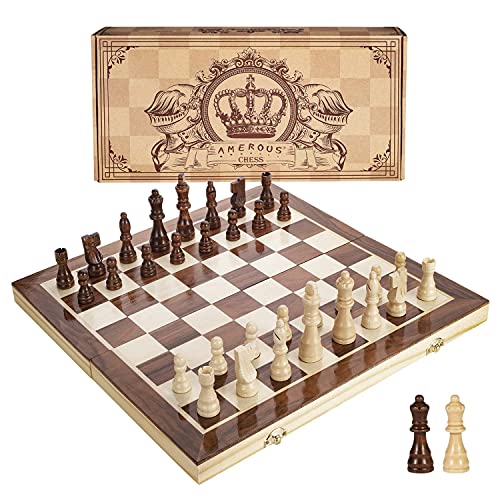
The AMEROUS 15 inch magnetic wooden set adds two extra queens and magnets that hold the pieces to the board, which matters if practice happens in a car or on a train, and the listing says the pieces store in slots inside the folding board.
The printed pieces are a crutch, and a kid will outgrow them in six months. Fine by me. Six months of actually playing beats six months of a nice wooden set nobody touches.
Here's the assignment for this week. Set the board up from scratch without looking at a diagram, play one 15+10 game, and say those four questions out loud before every move, including the obvious ones. Do it five nights running and the step by step part stops being a checklist and starts being how you see the board.
Questions people ask me
How do you set up a chess board step by step?
Put a light square in each player's right-hand corner, then place the back rank from the a-file outward: rook, knight, bishop, queen, king, bishop, knight, rook. The white queen goes on d1, which is a light square, and the black queen goes on d8, which is dark. Eight pawns fill the second rank for White and the seventh for Black.
What is the first step in chess strategy?
Learn what each piece is worth before you study a single opening. Pawn 1, knight 3, bishop 3, rook 5, queen 9. Once you can count to 9 across the board, every trade becomes a simple arithmetic decision instead of a guess.
How many moves ahead should a beginner think?
One, done properly. Look at the move you want, then look at your opponent's most annoying reply to it, and that is the whole calculation for the first few months. Two-move thinking you trust beats five-move thinking you don't.