Can a Knight Jump Over a Pawn? The Jump Rule in Plain English
The knight is the only piece that ignores traffic, and that one rule changes how you attack, defend, and teach the game.
Yes, a knight can jump over a pawn. It can jump over a bishop, a rook, a queen, or all 32 pieces at once, because the knight is the only piece in chess that ignores what stands in its path.
The move is an L: two squares in one direction, then one square at a right angle. Nothing on the passed squares matters. Only the landing square counts, and that square has to be empty or hold an enemy piece.
I've explained this at club nights to adults who'd played for a month and still slid knights around pawn chains like small bishops. Then you show them a knight hopping a solid wall of pawns and the light comes on. It's the most forgiving move on those 64 squares, and beginners overcomplicate it because every other piece obeys traffic laws.
The knight is the only piece that jumps
| Piece | Can it jump over other pieces? | What actually stops it |
|---|---|---|
| Pawn | No | Any piece directly in front of it (pawns capture diagonally, one square) |
| Knight | Yes, always | Nothing in between. It only needs a legal landing square |
| Bishop | No | The first piece on its diagonal, yours or theirs |
| Rook | No | The first piece on its file or rank |
| Queen | No | The first piece on any line it travels |
| King | No | Nothing blocks it, but it moves one square and can't step onto an attacked square |
Look at that right-hand column. Every piece except the knight is stopped by the first thing it touches, which is why two pawns can wall a queen out of an entire flank. En passant comes up whenever I teach this, so to be clear: that's a special pawn capture on the square a pawn skipped over, not one piece jumping another.
The knight hops over both colors, by the way. It doesn't care whether the piece in the way is yours or your opponent's, and it can even jump over the enemy king on its way to a square behind him. Nobody gets protective airspace. More on that in this breakdown of the knight jumping over pieces in chess.
Counting the squares a knight reaches
| Square | Squares the knight can reach |
|---|---|
| a1 (corner) | 2 |
| b1 | 3 |
| e1 | 4 |
| c3 | 8 |
| d4 | 8 |
| e5 | 8 |
| h8 (corner) | 2 |
From the middle the knight touches 8 squares. From the edge it usually touches 3 or 4, and from a corner just 2. That drop from 8 to 2 is why coaches nag about rim knights, and why a knight belongs on c3, f3, d4, or e5 rather than h3.
The count has a second use. When you're deciding whether to trade knights, count their squares first. A knight with 8 squares is a piece. The same knight parked on a1 with 2 squares is close to a spectator, which is the sort of thing that separates the pieces when you're still learning what each one is for, as covered in this guide to chess pieces.
What the jump does not let a knight do
- Land on a friendly piece. The landing square must be empty or hold an enemy. A teammate sitting there makes the move illegal, exactly as it would for a rook.
- Take the pawn it hopped over. Captures happen only on the landing square. That pawn on f5 is still on f5 after Nxe4, and it can take your knight next move.
- Move while pinned. Put a white knight on e2, the white king on e1, and a black rook on e8. The knight is frozen. It can physically jump, but the move is illegal because it exposes the king. This one catches players who've memorized "the knight always jumps."
- Block a check against it. You can't interpose a piece against a knight check. Capture the knight or move the king. Those are the two answers, every time.
- Leave the board. Obvious, but worth saying out loud to a kid. The 2-and-1 shape has to fit.
There's no such thing as a blocked knight. If somebody tells you your knight can't move because a pawn sits in front of it, they're wrong, and a tournament director would side with you in about four seconds.
Knights, horses, and what the piece is worth
Knight and horse are the same piece. On a Staunton style set it's the one carving with ears and a mane, and a full box has four of them, two white and two black. The naming history is older than the modern piece shapes, and it's worth five minutes if you like that sort of thing: knight in chess.
On the standard scale the knight is 3 points, level with the bishop, behind the 5-point rook and the 9-point queen, ahead of the 1-point pawn. Those numbers matter less than people think, but they explain why a knight for a rook is a good day and a knight for a bishop is usually a wash. The full scale is here: chess piece values.
Teaching the jump in ten minutes
Set up one position and nothing else. Black knight on f6, white pawn on f5, white pawn on e4. Ask the beginner: can the knight take the e4 pawn? The pawn on f5 sits right on the path, and it doesn't matter. Nxe4 is legal. Nine out of ten say no the first time, and they remember the answer forever.
Next, a counting drill. Drop a lone knight on d4 and have them count the 8 squares out loud. Slide it to a4 and count 4. Then a1, and count 2. Five minutes of that does more than any diagram, and it pairs well with the basics in this learn chess walkthrough.
Last one, for the kids who like a puzzle. Build a pawn wall on c4, d5, and e4 and ask which pieces can get through it. Bishops and rooks can't. The knight can, and that single position teaches the whole rule.
If you need a set to learn on
US Chess sizing guidance puts king height at roughly 3.375 to 4.5 inches, squares at 2 to 2.5 inches, and the king's base at about 75 to 80 percent of a square. For teaching, go toward the large end, because small pieces get knocked over by small hands and the lesson dies. None of the three listings below gives a king height, so measure when the box arrives.
The Spin Master Games Cardinal Classics Chess Teacher is the one I'd hand a total beginner, since the listing says each piece prints its name plus the direction and number of spaces it moves, with a board, 32 pieces, and instructions for ages 8 and up.

Spin Master Games Cardinal Classics Chess Teacher
- Includes: Chessboard, 32 Chess Pieces, Instructions
The HI-Q Classic set from Point Games is a folding cardboard board with standard flat-bottomed plastic pieces and an age rating of 6 and up, which I'd treat as a cheap first set and not much more.

The AMEROUS 15 inch magnetic wooden set folds in half with storage slots for the pieces and ships with 2 extra queens, and the magnetic hold is the reason I'd pick it for car trips and club nights where boards get bumped.
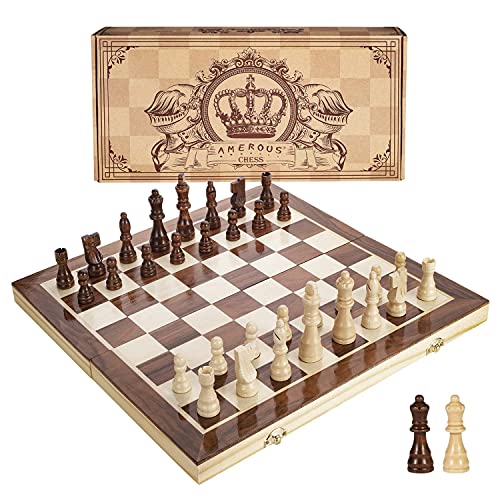
Set a knight on f3, drop one of your own pawns directly in front of it on f4, and play Ne5 anyway. The pawn sits on the exact square the knight passes over, the move is legal, and that ten-second demo will stick with you longer than anything you read today.
Questions people ask me
Can a knight jump over a pawn and capture it?
No. The knight only captures what sits on its landing square, so the pawn it hops over is untouched. You'd have to land on that pawn's square on a later move to take it.
Can you block a knight check with another piece?
No, and that's the practical cost of the jump. Against a bishop or rook check you can drop a piece into the line, but against a knight check your only answers are to capture the knight or move the king.
Is the horse in chess the same as the knight?
Yes, horse and knight mean the same piece. The name comes from the carved horse head on Staunton style sets, and a full set has four of them, two per side.