Chess Piece Values: The Point Chart, and the Positions Where It Lies
The point chart in one table, four positions where it misleads you, and how to count a trade without a calculator.
A pawn is worth 1 point, a knight 3, a bishop 3, a rook 5, and a queen 9. Total one side's army on that chart and you get 39 points, with the king left off because checkmate ends the game rather than a capture. That's the short answer, and it's the one most club players learn in their first month. The longer answer is where the arguments start, because those numbers are a counting shortcut, not a law of chess.
The standard point chart, piece by piece
| Piece | Value | How many per side | Points from that piece type |
|---|---|---|---|
| Pawn | 1 | 8 | 8 |
| Knight | 3 | 2 | 6 |
| Bishop | 3 | 2 | 6 |
| Rook | 5 | 2 | 10 |
| Queen | 9 | 1 | 9 |
| King | no number | 1 | not counted |
| Total | 16 | 39 |
Nobody ratified these numbers. You won't find them in the FIDE Laws of Chess, and no committee ever voted on them. They fell out of centuries of players counting material after a trade and noticing which side came out ahead, and they've survived because they're close enough to be useful. A knight plus two pawns comes to 5, the same as a rook. That equivalence is the whole point of the chart.
The queen is the most valuable piece you can actualy lose, and the pawn is the least. If you're still shaky on which unit moves where, the full guide to chess pieces covers the names and movement patterns in plain language. The chart only means something once you can look at a board and see 16 white units and 16 black units without recounting them twice.
Why the king isn't on the chart
Some beginner books hand the king a 4. Others print an infinity symbol. Both are telling you the same thing: his number doesn't work like the others, because he can't be captured and he can't be traded. A chart with the king in it would be fiction.
Where the king does earn his keep is the endgame. With queens off and a handful of pawns left, a king walking to the center is often worth more than the pawn he's chasing. There are 32 pieces on a full board, 16 per side, and 31 of them can change hands during a game. The king is the one that can't, which is exactly why he sits outside the arithmetic. My chess rules for beginners page walks through the checkmate conditions if you want the mechanics.
Four positions where the chart value is wrong
The chart is a summary. These four cases show up often enough at club level that you should know them cold.
| Situation | Chart says | What coaches actually say |
|---|---|---|
| Bishop pair against bishop and knight, open position | 6 vs 6 | The pair is worth about half a pawn more |
| Rook on the seventh rank hitting pawns | 5 | Often worth a pawn extra, sometimes the game |
| Knight on a protected outpost in a closed position | 3 | Plays above a bishop buried behind its own pawns |
| Queen against three minor pieces | 9 vs 9 | The three pieces usually coordinate better |
I'll be the first to admit the chart flattens real chess. A rook parked on a1 behind its own pawns is worth less than a bishop with a clear diagonal, and every coach has said it a hundred times. Half a pawn here, half a pawn there, and pretty soon the numbers stop matching the position in front of you.
What two minor pieces are worth against a rook
Here's a case where the arithmetic gets interesting. A bishop plus a knight is 6 points. A rook plus a pawn is also 6. The chart calls it dead even, and in practice the two pieces usually outplay the rook and pawn, because they can attack two things at once while the rook attacks one. That's why experienced players happily give up a rook for a bishop and knight when the position is open.
And no piece changes value faster than a pawn. A pawn on its original square is worth 1. The same pawn on the sixth rank, supported by another pawn, can be worth 3 or more in a rook ending. Push it to the eighth rank and it promotes, turning 1 point into 9. That single rule is the biggest jump in the chart, and it's why endgame books obsess over passed pawns more than any other unit.
Counting a trade without a calculator
When a burst of captures ends, add up both sides before you touch another piece. Do it with pieces, not with memory. Say he took your knight (3), you took his bishop and a pawn (4), so you're up 1. That's the whole skill, and it takes about five seconds once you've done it a hundred times.
The common mistakes are simple ones. Trading a rook (5) for a bishop (3) is a 2 point giveaway unless it wins something immediately. Trading a bishop for a rook makes you 2 points. If you keep a score sheet and read chess notation, you can reconstruct every trade afterward and check your math, which is how I learned to stop guessing at material and start counting it.
If you need a set to learn on
A beginner board needs pieces big enough to sit on their squares without crowding. US Chess guidance puts the king at 3.375 to 4.5 inches tall, squares at 2 to 2.5 inches, and the king's base at roughly 75 to 80 percent of a square; chess board dimensions covers the math if you're buying a board separately from the pieces.

Spin Master Games Cardinal Classics Chess Teacher
- Includes: Chessboard, 32 Chess Pieces, Instructions
The Cardinal Classics Chess Teacher prints the direction and number of squares on the pieces themselves, which is the fastest way to get an 8 year old through the first ten games, and the listing says it includes the board, 32 pieces, and instructions.

The HI-Q Classic set is the cheap standard option: traditional flat-bottomed plastic pieces, a cardboard board that folds in half, and a 6 and up age label, so nothing on it will teach the moves for you.
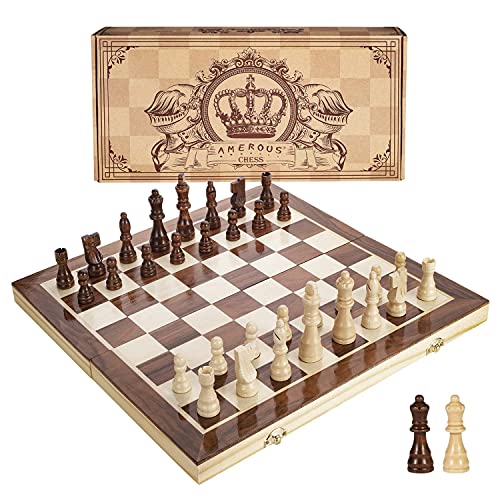
The AMEROUS 15 inch set is magnetic wood with a folding board and two extra queens for promotion, and the listing says the pieces stay put in a car or on a plane.
Play one game this week with a pen beside the board, write down every capture, and at move 20 add up both sides from scratch. Ten games of that and the chart stops being a chart and turns into a habit.
Questions people ask me
What is the point value of each chess piece?
Pawn 1, knight 3, bishop 3, rook 5, queen 9. Add up one side and you get 39 points. The king has no number because the game ends in checkmate, not in his capture.
Is a bishop worth more than a knight?
On the chart they're both 3, and that's the honest answer for most positions. Bishops want open diagonals and long pawn structures; knights want closed positions with fixed pawns to hop around. The pawn structure decides which one is better, not the chart.
How many points is a king worth?
Most charts leave the king blank or print an infinity symbol next to him. In the endgame, coaches often treat a centralized king as worth roughly 4 points of fighting strength. He's never traded, so the number is bookkeeping rather than currency.