Knight Chess: How the Horse Moves, Jumps, and Forks
The horse is the piece beginners misjudge longest, and the one that wins the most club games.
The knight in chess is the horse-headed piece that moves in an L: two squares in one direction, then one square at a right angle. Each side starts with two of them, so a full board holds four knights, and the knight is the only piece that can jump over anything standing in its way. Call it a three-square trip with a turn in the middle. A knight on d4 has 8 legal moves. From a1, just 2. Nothing else on the board travels that way, which is why the horse causes more confusion in a beginner's first month than every other piece combined.
That confusion is fixable. The move is small enough to memorize in an evening and strange enough to keep surprising people for years.
The L-shaped move, counted square by square
Beginners count hops out loud. One, two, turn, one. That works, but it's slow under pressure. Count the squares the knight travels and the turn at the end instead, because that's what decides whether the move is legal.
A knight has eight legal moves from d4 and only two from a1. That single gap explains most of how knights play.
| Where the knight stands | Squares it can reach | Why |
|---|---|---|
| a1, the corner | 2 | six of the eight Ls fall off the board |
| b1, edge next to a corner | 3 | one more opens up |
| a4, edge in the middle | 4 | half the moves survive |
| d4, center | 8 | every L lands on the board |
One more rule that never breaks: a knight changes square color every single move. Land on a light square and the next landing is dark. No exceptions, no matter what's around it. Watch a knight for four moves and you can predict which half of the board it can attack next.
New players also wonder whether the piece can reverse. The L works in every direction, so the short answer to can knights move backwards is yes, and the move looks identical going back as it does going forward.
Why the jump matters more than the move
Picture a crowded middlegame. Twenty pieces on the board, pawn chains locked on c4 and d5, nobody trading anything. A bishop on c1 is furniture. A knight on c3 is already poking at b5, d5 and e4 through the traffic.
That's the trade. Knights are weak on an empty board and strong on a busy one, and the reason is the jump. Blocking a knight is impossible, so the only defense is covering the squares it can land on. Beginners lose material to this constantly because they check the straight lines and forget the L. The mechanics of knight jumping over pieces are worth ten minutes of study, and then worth another ten every time you drop a rook to one.
And the jump cuts both ways. It's also why knights are hard to chase: a knight on d5 with a pawn on c4 behind it can sit there for thirty moves, because nothing attacks it and nothing blocks it.
Forks are the reason knights win club games
A fork is one piece attacking two things at once, and no piece forks as well as a knight, mostly because people don't see it coming. The classic is a knight landing on c7 with check, hitting the king on e8 and the rook on a8 at the same time. One move, a whole rook.
The trick is that the knight often arrives on a square your opponent considers safe. Pieces around it don't matter. Pawn walls behind it don't matter. That's the can a knight jump over a pawn question, and it's the reason knight forks seem to appear out of nowhere.
Learn four fork squares first: c7 and f7 against a castled king, plus c2 and f2 when you're on the other side of the board. Once those are automatic, the rest of the pattern starts finding you.
Knight or bishop: what the three points don't tell you
The usual counting system gives pawns 1, knights 3, bishops 3, rooks 5 and queens 9. If you want the full breakdown, my chess piece values page walks through every exchange, but here's the short version for the horse: it's worth 3 points in the middle of the board and closer to 2.5 on the rim.
I'll concede the long argument to the bishops. Open position, pawns on both wings, a bishop slicing from b2 to h8, and I'd rather have the bishop nearly every time. Knights are the ones that get better when the game gets ugly.
Where the knight wins is the blocked position. Put a knight on d5 protected by a pawn on c4 and it's worth more than 3. It attacks eight squares, it can't be kicked away by a pawn, and the bishop on the other side of the pawn chain can't touch it. I'd take that over a "better" bishop in a locked position, and I've won alot of slow club games that way.
Two knights can't force mate, and that costs people games
Two knights and a king cannot force checkmate against a lone king. Not slowly, not with perfect play, not at all. The defender just has to avoid walking into a corner wrong, and the 50-move rule finishes the job. Bishop and knight can force it. Two knights cannot. If you're up two knights in an endgame, keep a pawn alive.
What to check on a set if you like the horse
Three things decide whether a set feels right: king height, square size and piece base. US Chess guidance puts king height around 3.375 to 4.5 inches, squares 2 to 2.5 inches, and the king's base at roughly 75 to 80 percent of a square. A set inside those numbers will feel normal in your hand and won't wobble when you play fast.
| Set | Piece count | King height | Square size |
|---|---|---|---|
| Cardinal Classics Chess Teacher (Spin Master) | 32 | not listed | not listed |
| HI-Q Classic (Point Games) | not listed | not listed | not listed |
| WE Games Value Tournament | 34, including 2 extra queens | 3.75 in | 2.25 in |
Worth saying plainly: none of these listings give a separate knight height, and I'm not going to guess one. What I can tell you is that a set with a 3.75 inch king and 2.25 inch squares sits right in the tournament range, and a knight that's too tall relative to the square is the usual reason a cheap set feels crowded. If you're starting from zero, my learn chess walkthrough covers the board layout before you worry about piece heights.
If you need a set to learn on
-

Spin Master Games Cardinal Classics Chess Teacher
- Includes: Chessboard, 32 Chess Pieces, Instructions
The Chess Teacher set prints each piece's name and movement directly on the piece, which is the closest thing to training wheels you can buy, and the listing puts it at 32 pieces for ages 8 and up.

The HI-Q Classic is plain flat-bottomed plastic with a folding cardboard board and nothing written on the pieces, so it suits someone who already knows the moves and wants a cheap set to keep in the car.
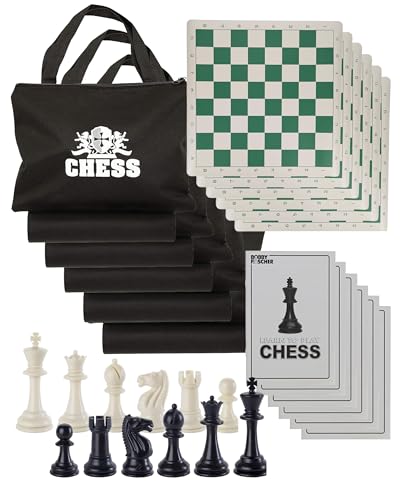
The WE Games Value Tournament set is the one I'd buy for a club or a serious beginner: 34 pieces with two extra queens, a 3.75 inch king, and a 19.75 inch roll-up vinyl board with 2.25 inch squares and algebraic notation.
Here's your next step. Set up a board, drop a knight on d4, and count its eight moves out loud, naming the square each one lands on. Do that once a night for a week. You'll stop miscounting the L in about three days, and you'll start seeing forks a week after that.
Questions people ask me
Why does the knight move in an L shape?
No rulebook ever explained it. The move comes down from older Indian and Persian games, where the horse piece already hopped two-and-one, and it survived because that awkwardness turned out to be useful. Modern players just learn it as two squares and a turn.
Can a knight jump over its own pieces?
Yes, and over your opponent's too. It's the only piece on the board that ignores blockers completely. You don't stop a knight by putting something in front of it, you stop it by covering the squares it can land on.
Is a knight worth more than a bishop?
Most players count both at 3 pawns and treat them as roughly equal. Knights do better in closed positions with locked pawn chains, bishops do better on open boards with play on both wings. The bishop pair is the usual exception, and it plays a bit above 3 points each.