Knight Jumping Over Pieces in Chess: How the Jump Works and Where It Stops
One piece ignores the traffic on the board. Here's how the knight jump works, square by square.
A knight can jump over any piece on the board, friendly or enemy, and it's the only piece in chess that can do it. From the middle of the board it reaches 8 squares, and nothing standing between the knight and those squares changes that.
The move is an L: two squares along one line, then one square at a right angle. That's the whole rule. The knight never passes through the squares it hops over, it simply lands, so a wall of four pawns stops a rook, a bishop and a queen cold and does nothing at all to a knight. Every other piece on the board can be shut down by traffic. This one can't.
The L shape, and why nothing gets in the way
Think about what "blocked" means for a rook. A rook on a1 heading for a8 crosses seven squares on the way up the file, and any single one of them ends the trip. The knight doesn't have a way up the file. It leaves g1 and arrives on f3, h3 or e2, and the squares it appears to fly over might as well not exist.
Sure, the L looks like a gimmick next to the bishop's clean diagonals, and I understand why beginners assume something that crooked must get obstructed. It doesn't. A knight on d5 with pawns on c6, e6, c4 and e4 around it still attacks eight squares behind that wall, which is why outposts matter so much in club games. There's more on the piece's movement and history in this guide to the knight in chess if you want the longer version.
Piece by piece: who jumps and who gets blocked
Six piece types, one jumper.
| Piece | Jumps over pieces | What stops it |
|---|---|---|
| Knight | Yes, always | Nothing on the board |
| Bishop | No | The first piece on its diagonal |
| Rook | No | The first piece on its file or rank |
| Queen | No | The first piece in any direction |
| King | No | Any adjacent piece (it only moves one square anyway) |
| Pawn | No | Any piece directly in front of it |
The pawn's two-square opening move fools people because it looks like a hop, and it isn't. Park a knight on e3 and the e2 pawn is going nowhere for the rest of the game. For that specific case, here's the full answer on whether a knight can jump over a pawn, including why a four-pawn chain can't slow a knight down at all.
Square by square: how much of the board a knight covers
| Knight on | Squares it controls | Which ones |
|---|---|---|
| a1, the corner | 2 | b3, c2 |
| b1, edge next to the corner | 3 | a3, c3, d2 |
| b2, one square in | 4 | a4, c4, d1, d3 |
| c2 | 6 | a1, a3, b4, d4, e1, e3 |
| d4, the center | 8 | b3, b5, c2, c6, e2, e6, f3, f5 |
Same piece, same rules, six extra squares just for standing in the middle. That's why the oldest line in junior chess is "a knight on the rim is dim." Weak players park a knight on a3 or h3 and then wonder why the thing does nothing for 20 moves. Every one of the chess pieces has geometry baked into it, but only the knight swings this wildly with a two-square walk.
I've taught this to kids at club night for years, and the jumping is never what trips them up. The L is. They'll slide a knight three squares in a straight line and look at you like the rules changed overnight. Two drills fix it: put a knight on d4 and count the 8 squares out loud, then move it to a1 and count 2, and separately ask them to find a four-move route from b1 to g8 (b1, c3, d5, e7, g8 works). If you're starting from zero yourself, the beginner path on learn chess covers this order of operations properly.
What the jump does not let you do
The jump is narrower than people think. Five limits worth knowing:
- You capture only on the landing square. Hopping over an enemy queen on the way to f3 leaves her sitting there, still worth 9 points.
- You can't land on one of your own pieces. One landing square, one destination, same as everything else.
- Two captures in one move? No. The knight attacks up to 8 squares but touches exactly one per turn.
- A pinned knight is still pinned. If moving it exposes your king on e1, the fancy jump doesn't rescue you.
- It can block a check, but only by landing on the line. A knight on e4 can block a rook checking along the e-file, and that's a normal move, not a jump past anything.
The practical upshot is that a knight and a bishop both count as 3 points, yet the knight's real value swings harder because of where it stands. A knight in the corner plays like a 1-point piece in plenty of positions. If you want the numbers laid out, the chess piece values breakdown is worth ten minutes of your evening.
Three ways the jump wins material
The fork is the club-level money maker. Drop a knight on c7 and it hits a king on e8 and a rook on a8 at the same time. That's 5 points of rook leaving the board while the king steps out of check, and the knight got there by hopping over whatever sat on b6 and d6.
The showpiece is the smothered mate. A king on h8 with its own pawns on g7 and h7 and its own rook on g8 is boxed in by its own army, and a knight landing on f7 is checkmate with all three of those pieces frozen in place. Nothing blocks it. That's the entire point of the piece.
And then the quiet version: the outpost. A knight on d5 defended by a pawn on c4, with enemy pawns stuck on c6 and e6, controls 8 squares and can never be chased off by a pawn. Rooks hate it. Bishops hate it. I'd take that knight over a rook in plenty of endgames.
If you need a set to learn on
I haven't had these three on my bench, so what follows comes from the listings and the specs, not from unboxing them. A plain unlabeled knight is fine for most learners, but these do diffrent jobs.

Spin Master Games Cardinal Classics Chess Teacher
- Includes: Chessboard, 32 Chess Pieces, Instructions
The Cardinal Classics Chess Teacher prints the name, direction and square count on every piece, which is exactly what a kid who keeps counting the L out loud needs, and the listing says it includes the board, 32 pieces and instructions.

The Point Games HI-Q set is the plain option: standard flat-bottomed plastic pieces, a folding cardboard board, ages 6 and up, and I'd buy it as the beater set that lives in the car.
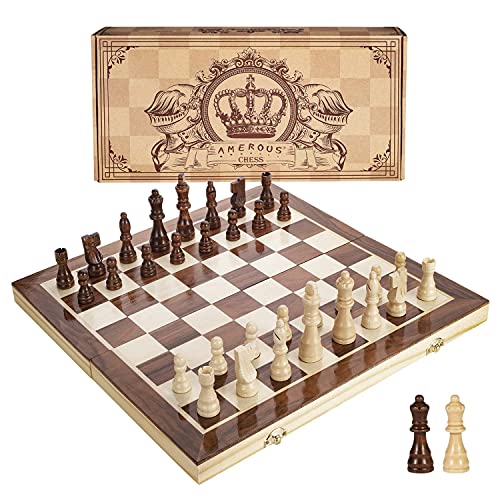
The AMEROUS set is the travel pick on paper, a 15 inch folding wooden board with magnetic pieces, storage slots and two extra queens.
Here's the one thing to do tonight. Put a knight on d4, count its 8 squares out loud, then move it to a1 and count 2. Do that once more from the edge, and the geometry stops being something you have to remember.
Questions people ask me
Can the knight jump over pieces in chess?
Yes. The knight is the only piece on the board that jumps over other pieces, friendly or enemy, and it does it whenever the L shape calls for it. Nothing standing on the board can block a knight.
Can a knight jump over a piece and capture it?
Only the piece on the landing square. A knight hopping over your queen to reach a square behind her leaves that queen completely untouched. One move, one landing square, one capture at most.
How many squares can a knight move to?
It depends where it stands. A knight in the corner reaches 2 squares, one on the edge reaches 3 or 4, and one on any of the 16 central squares reaches 8. Same piece, same rules, six squares of difference.