Can a Queen Move in an L Shape? No, and Here's What Does
The queen goes straight, the knight goes crooked, and one counting drill from d4 stops you mixing them up.
No. A queen cannot move in an L shape, and out of the 32 pieces in a standard set, exactly one travels that way: the knight. She works on straight lines, ranks, files and diagonals, up to 27 squares from a central square on an empty board. Every time a beginner tells me their queen "jumped like a horse," I know nobody has counted squares with them yet.
What the queen actually does
Pick a line, slide as far as you like, stop or capture. That's the whole rule. On an empty board a queen in the center attacks 27 squares; a rook on that same square attacks 14. The queen isn't a new kind of mover at all, she's a rook and a bishop stacked on one square, which is why her value sits at 9 pawns while the rook sits at 5 and the bishop at 3. Add those two line-movers together and you still can't produce a crooked step. If you want the rest of the cast laid out, the chess pieces reference covers every one of them.
| Piece | Lines it moves on | How far | Value (pawns) |
|---|---|---|---|
| Queen | rank, file, both diagonals | 1 to 7 squares | 9 |
| Rook | rank and file | 1 to 7 squares | 5 |
| Bishop | diagonals, one color only | 1 to 7 squares | 3 |
| Knight | the L, two then one | always 2 plus 1 | 3 |
| King | any direction, one square | exactly 1 | the game itself |
| Pawn | forward, captures diagonally | 1, or 2 on its first move | 1 |
Notice what the table shows: the king, rook, bishop and queen all travel on lines. Only the knight doesn't.
The L shape belongs to the knight
Two squares in one direction, then one square at a right angle, and it hops over anything in the way. From d4 a knight has eight landing squares; from a1 it has two. That jump is the reason the L exists at all, since a leaping piece can't be described by a line, so chess gave it a shape instead. At 3 points it's half a rook, and it's the piece that catches queens napping on an open diagonal. The chess piece values page has the trading math if you want it.
The king is the other one worth locking in while you're here: one square in any direction, castling aside. That's it. So the count is five line-movers to one leaper, and the queen is the longest of the line-movers. If you want that piece's rules straight, the king in chess page is a two-minute read.
Counting squares from d4
Clear the board, put a lone queen on d4 and count. This is the drill that turns a rule into a habit, and the numbers are worth memorizing.
| Queen stands on | Squares she attacks | Breakdown |
|---|---|---|
| d4, e4, d5 or e5 | 27 | 7 on the rank, 7 on the file, 7 and 6 on the two diagonals |
| d1 (edge) | 21 | 7 on the rank, 7 on the file, 3 and 4 on the diagonals |
| a1 (corner) | 21 | 7 on the rank, 7 on the file, 7 on the long diagonal |
Twenty-seven squares out of the 63 she doesn't stand on. That's more than a third of the board from a single square, which explains why the queen feels like she moves in every direction at once. She doesn't. She moves in eight directions, and every one of them is straight.
The two-second check for any queen move
Subtract. Take the file numbers, take the rank numbers, compare the differences. If one difference is zero, the move runs along a rank or file. If the two differences are equal, it's a diagonal. If neither is true, no queen on earth can make that move.
Four examples. From d4 to h4: zero and four, legal. From d4 to g7: three and three, legal. From d4 to f5: two and one, not a queen move, that's the knight's shape. From d4 to e6: one and two, same story.
I'll concede this much. On a crowded board, a queen who slides three squares and then sees a piece appear two squares over can feel like one crooked move. Two moves happened, not one. And the queen is the busiest piece in the game, so she takes the blame for geometry she never had. She also can't jump: park a pawn on d6 and the d-file is shut to her for the rest of the position, whatever the crown suggests.
A five-minute drill that settles it
Get the board the right way round first, light square on the right and the white queen on d1. The how to put chess pieces walkthrough has the diagram if you're starting from an empty box.
Then, with only a queen, a knight and a couple of pawns out:
- Queen on d4. Count the 27 squares aloud, touching each one.
- Swap in a knight on d4. Count 8.
- Move the knight to a1. Count 2.
- Call out pairs and let your kid answer "queen or knight." d4 to h8 is queen. d4 to f5 is knight. d4 to d7 is queen.
Run it twice. The second pass takes 90 seconds, and if the kid starts beating you, that's a good sign. They're subtracting files and ranks instead of guessing.
If you need a set to learn on
I haven't unboxed any of these three; the details come from the listings and from years of watching teaching sets survive club night. What matters in week one is a board big enough to count on and pieces that don't slide out of place.

Spin Master Games Cardinal Classics Chess Teacher
- Includes: Chessboard, 32 Chess Pieces, Instructions
The Cardinal Classics Chess Teacher prints each piece's name and movement right on the plastic, which is the closest thing to a coach at the table with you; the listing says 32 pieces, a board and instructions, ages 8 and up.

HI-Q Classic from Point Games is the plain folding option, with standard flat-bottomed plastic pieces and a cardboard board that folds in half, listed for ages 6 and up.
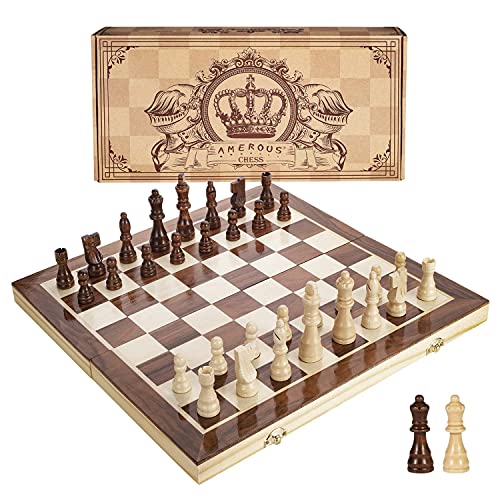
The AMEROUS set measures 15 inches, with magnetic wooden pieces, two extra queens and storage slots in a folding board, so nothing ends up under the car seat.
Your next step: tonight, clear the board, put one queen on d4 and count the 27 squares she touches. Do it once more with a knight in her place, and the L shape will stop following the crown around. When you want the rest of the rules in order, start with learn chess and take one piece at a time.
Questions people ask me
Can the queen move like a knight in any position?
No. There's no square, special rule or standard-chess situation where the queen gets the knight's move. She has ranks, files and diagonals only. If a queen lands where a knight could land, she got there along a straight line.
How many squares can a queen move?
Any number from 1 to 7 along an open line. From a central square on an empty board she attacks 27 squares, and from an edge or corner, 21. Pieces in the way cut those numbers down fast.
Why do people think the queen moves in an L?
Because the queen is the piece everyone labels as the strong one, and the L is the only move pattern that isn't a line, so it gets pinned on her by default. A queen's two-move path around a corner on a crowded board can also look like one crooked jump.