The Bishop in Chess: Diagonals, the Bishop Pair, and What It Can't Do
Two bishops, two colors, and neither one ever switches. Here's how to use that.
A bishop in chess moves any number of empty squares along a diagonal, and each player starts with two of them. That's 4 bishops among the 32 pieces, one pair working the light squares and one pair working the dark. It's worth about 3 pawns, same as a knight. And it can never, under any circumstances, change the color it stands on.
The bishops start on c1 and f1, and each one owns a color
White's bishops sit on c1 and f1, tucked between the queen and king on d1 and e1. Black's sit on c8 and f8. The c1 bishop is a dark-squared bishop for the whole game; the f1 bishop is light-squared. That never changes, no matter how many moves you play. If you're still shaky on the back rank, this walkthrough of how to put chess pieces covers the full setup square by square.
Centralize a bishop and it gets stronger, because diagonals get longer. Here's the count on an empty board:
| Bishop square | Squares it attacks |
|---|---|
| a1 | 7 |
| b2 | 9 |
| c3 | 11 |
| d4 | 13 |
Thirteen is the maximum, and a bishop reaches it from d4 or e4. That's a 6-square swing between a corner bishop and a central one, which is why "bishop to the rim" is a running joke at club level.
How the bishop moves and what stops it
A bishop slides diagonally as far as it wants. No limit on distance. It can move backwards as easily as forwards, and there's no such thing as a forward-facing bishop. In algebraic notation you write it as B, so Bc4 means bishop to c4.
What stops it: any piece in the way. A bishop can't jump. It captures by landing on the square of an enemy piece, and nothing else. If you've got pawns on e4 and d5 and your bishop is on c2, that bishop is going nowhere pleasant.
Because a bishop is stuck on one color, it can never attack a piece sitting on the other color. Your two bishops never cover the same square, which sounds like a weakness and is actually a quiet strength once you learn to use them together. A lone bishop also can't stop a passed pawn running for a promotion square of the wrong color, and I've watched plenty of club games drawn because of exactly that. For the full roster and how the pieces compare, the chess pieces overview is a decent refresher.
What a bishop is worth next to a knight
Both come in around 3 pawns. The bishop pair, though, is worth roughly half a pawn more than two knights in most open positions, and that's not folklore; it holds up in engine play at every level.
| Position type | Bishop | Knight |
|---|---|---|
| Open center, pawns traded | Stronger | Weaker |
| Locked pawn chains | Cramped | Stronger |
| Play on both wings | Stronger | Slower to switch |
Here's my concession, and I mean it: bishops are not better than knights, and I'll argue with anyone who says so. Put a knight on a protected square in a closed position and it'll outplay a bishop all night long. Most club players, though, trade a bishop for a knight on move 12 without a thought, and that's the habit worth breaking. If you want the numbers laid out, chess piece values has them.
Fianchetto, bad bishops, and the pawns that get in the way
The fianchetto is the cleanest way to give a bishop a job. Push the b-pawn or g-pawn two squares, then drop the bishop on b2 or g2. A bishop on g2 stares down the long diagonal straight at a8. It costs two pawn moves and one bishop move, and it's why openings like the King's Indian and the Catalan exist.
The opposite is the bad bishop: one sitting behind its own pawns on the same color. If your pawns are on light squares and your remaining bishop is light-squared, that bishop is a tall pawn. The fix is a rule you can apply in any game. Keep your pawns on the opposite color of your bishop. If you're new to all this and want a starting point, learn chess in the right order beats memorizing openings.
The name itself has some history. Bishop comes from the church, German speakers call the piece a Läufer (runner), and the French call it the fool. There's more on that in chess pieces meaning if word origins are your thing.
Checks, mates, and what a bishop simply can't do
A bishop alone can't mate a king. King and bishop against a lone king is a dead draw, because the bishop controls only half the board and can't cut off the escape squares on the other color. Two bishops mate. Bishop plus knight mates. Bishop plus king does not.
| Question | Answer |
|---|---|
| Can it jump? | No |
| Can it move backwards? | Yes |
| Can it change square color? | No |
| Can it give mate with just the king? | No |
| Can it capture a queen? | Yes, if she's on its diagonal |
That last row is the one beginners forget. Bishops take queens all the time, usually because someone left a queen on a long diagonal and forgot the bishop existed.
If you need a set to learn on
I haven't unboxed or played on any of these three, so take this as a read of the specs and the owner feedback, not a test report. Each one solves a diffrent problem.

Spin Master Games Cardinal Classics Chess Teacher
- Includes: Chessboard, 32 Chess Pieces, Instructions
The Cardinal Classics Chess Teacher prints each piece's name and the directions it can travel right on the piece, which is the fastest way to get an 8-year-old through the first month without you hovering over the board.

The HI-Q Classic from Point Games is the plain, cheap option: standard plastic pieces on a folding cardboard board, ages 6 and up, nothing on the board to distract from the moves.
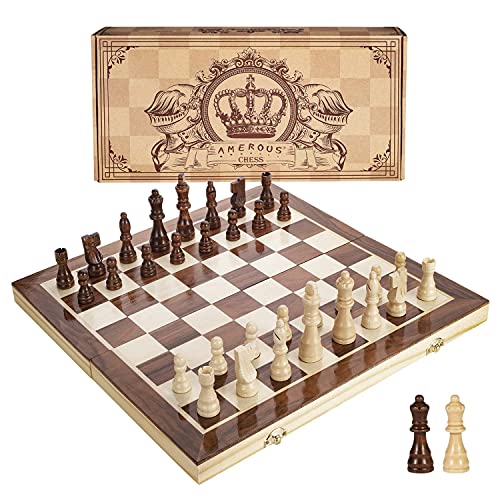
The AMEROUS 15-inch set is the one I'd throw in a club bag or a car, with a folding wooden board, magnetic pieces that stay put, and 2 extra queens for promotion.
Here's your next step, and it takes two minutes. Put a bishop on a1 and count the 7 squares it can reach, then move it to b2, then c3, then d4, counting each time. Four squares, 7 to 13, and you'll never again wonder why coaches nag about centralizing. Then play a five-minute game with only kings, bishops, and pawns and watch how fast a diagonal opens up.
Questions people ask me
Can a bishop jump over other pieces?
No. A bishop stops at the first piece in its path, friendly or enemy. It can capture an enemy piece by landing on that square, but it can't hop over anything, which is why blocked pawn chains cramp a bishop so badly.
Is a bishop better than a knight?
Depends entirely on the position. Both are worth about 3 pawns. Bishops want open diagonals and a lot of traded pawns; knights want locked pawn chains and a fixed target. Having both bishops (the bishop pair) is usually worth roughly half a pawn.
Can you checkmate with only a bishop and king?
No. King and bishop against a lone king is a draw, because the bishop only controls one color and can't help herd the king into a corner. You need two bishops, or a bishop plus a knight, to force mate.