Black and White Chess Board Printables: Sizes, Scaling, and Setup
Letter paper fits an 8 inch board at 1 inch squares. For 2 inch squares you tile four sheets. Here is the scaling, taping and setup.
Free downloads
PDFs, 0.9 inch squares. Print at 100% (actual size), not “fit to page”.
- Blank board with coordinates: US Letter · A4
- Blank board, no coordinates: US Letter · A4
- Board with pieces in the starting position: US Letter · A4
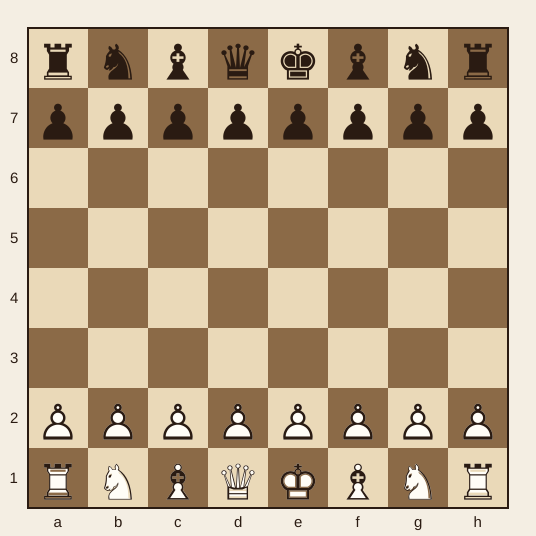
Print the board on US Letter (8.5 x 11 in) or A4 and set the printer to Actual Size, not Fit to Page. Then measure one square with a ruler before you run thirty copies. At 1 inch squares the board comes out 8 x 8 inches and fits on a single sheet. At the 2 to 2.25 inch squares a tournament set wants, you're building a 16 to 18 inch board and tiling four sheets. The free printable files are linked on this page, in Letter and A4, with coordinates and plain.
What the printable files include
Four versions: a labeled board with files a to h and ranks 1 to 8, a plain board, a page of 32 flat piece counters for when you don't have a set, and a one page setup diagram. There's also a light ink file that hatches the dark squares instead of flooding them with solid black. All 64 squares land in the same place across versions, so you can hand a beginner the labeled board and keep the plain one for yourself.
The square size that actually fits on each paper
Most people print at 1 inch, then set a 3.75 inch king on it and wonder why the board looks like a postage stamp. King base should run about 75 to 80 percent of a square, so a 1 inch square wants a king with a 0.75 to 0.8 inch base. That's a travel set. A club set wants more room.
| Square size | Board size | Paper that takes it | Margin per side | | 24 mm | 192 mm | A4, 210 mm wide | 9 mm | | 1 in | 8 in | Letter, single sheet | 0.25 in, right at the edge | | 1.25 in | 10 in | Tabloid, 11 x 17 in | 0.5 in | | 2 in | 16 in | Four tiled Letter sheets, or one 17 x 22 in sheet | 0.25 in tiled | | 2.25 in | 18 in | Tiled sheets, or one 20 x 30 in sheet | 1 in on 20 x 30 |
If you'd rather compare this against something you can fold up and carry, the main chess boards section is where I'd start looking.
Scaling to 2 inch squares on four sheets
Print the tiled file at 100 percent and lay all four pages out before you trim anything. If a square measures 1.9 in instead of 2, your printer quietly shrank the page to fit; go back and pick Actual Size, then measure again. Trim 0.25 in off the right edge of the left hand pages and 0.25 in off the bottom edge of the top pages. Tape the joins on the back with 2 in clear tape, then run one strip down each seam on the front. Two inch squares give you a 16 inch board, which sits inside the 2 to 2.5 inch range and matches a 3.75 inch king with a 0.75 inch base.
Laminating without the curl
A 3 mil pouch handles a board that lives in a folder. Go to 5 mil if a classroom is going to fold it in half twice a week. Lamination comes off the machine warped, so weight it under a stack of books overnight before anyone plays on it. Matte laminate is the better pick; gloss throws a reflection under gym lights and shows every fingerprint.
Squares, coordinates, and the setup
a1 is dark. Every square follows from that: add the file number (a is 1, h is 8) to the rank number, and an even total means a dark square. a1 is 1+1=2, dark. h1 is 8+1=9, light.
| Piece | White starts on | Black starts on | Count per side | | King | e1 | e8 | 1 | | Queen | d1 | d8 | 1 | | Rook | a1, h1 | a8, h8 | 2 | | Bishop | c1, f1 | c8, f8 | 2 | | Knight | b1, g1 | b8, g8 | 2 | | Pawn | a2 to h2 | a7 to h7 | 8 |
Queen on her own color: d1 is light at 4+1=5, and d8 is dark at 4+8=12. Sixteen pieces a side, 32 in total.
Printing black and white without a gray board
A laser printer does a solid black chessboard better than an inkjet at 600 dpi. Draft quality on an inkjet turns the dark squares gray-brown and slightly damp. The light ink file hatches the squares instead of filling them, which saves toner if you're printing 25 boards for a school club. For a demo board, a 20 x 30 in print pinned to the classroom wall does more for a beginner's board vision than any handout, and wall chess boards are the bought version of that idea.
Paper boards for kids, clubs, and drills
Teaching the knight move, drilling coordinates, keeping six kids from crowding around two boards. Twenty printed boards cost less than one decent set and every kid gets their own. They slide on a smooth table, and pieces fall over when someone bumps the sheet. I won't pretend otherwise. For a first year of chess, a printed board and a bag of plastic pieces does most of the job; chess boards for kids start to matter once they're playing real games with clocks.
Pieces, storage, and the missing box
A printed board has nowhere to put 32 pieces. If you're buying a set and want the whole thing to close up and travel, a chess board with storage saves you a shoebox and a lost queen every other month.
When a printed board stops being enough
Clubs run 2.25 inch squares and kings between 3.375 and 4.5 inches tall, and most organizers expect a board that lies flat with no tape ridges. Ask before you turn up with a laminated sheet. For regular play, the chess boards for tournament play I'd compare first are the roll-ups at 2.25 inch squares. Until then, keep printing.
Questions people ask me
What size is a printable chess board on normal paper?
On US Letter at 1 inch squares you get an 8 x 8 inch board, which is the most that fits on one sheet with sane margins. On A4, 24 mm squares give a 192 mm board with 9 mm to spare on each side. Both are teaching size, not tournament size.
How do I get 2 inch squares out of a home printer?
Print the tiled file at 100 percent across four Letter sheets, each holding a 4 x 4 quadrant. Trim a quarter inch off the joining edges, tape the back, and you have a 16 x 16 inch board. Measure one square before you trim anything; if it reads 1.9 inches, your printer scaled to fit.
Will a printed board do for a club or tournament game?
US Chess guidance puts squares at 2 to 2.5 inches and king height at 3.375 to 4.5 inches, and a tiled board at 2 inches can hit that. Whether paper is allowed is a local call, so ask the organizer. Most clubs want a board that lies flat without tape ridges.