Chess Board Top View: What to Print, and How Big the Squares Need to Be
A printed top view is fine for teaching and diagrams, as long as you get the squares between 2 and 2.25 inches and tape it flat.
Free downloads
PDFs, 0.9 inch squares. Print at 100% (actual size), not “fit to page”.
- Blank board with coordinates: US Letter · A4
- Blank board, no coordinates: US Letter · A4
- Board with pieces in the starting position: US Letter · A4
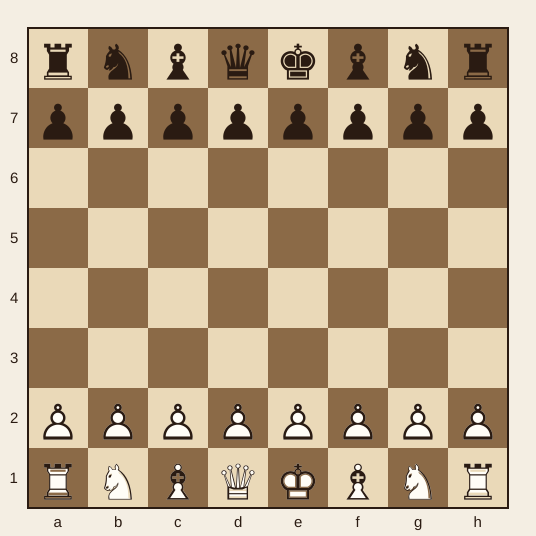
The short answer on printing a chess board top view
A top view printout is a flat grid of 64 squares seen straight from above, and you can print one on a home printer in about five minutes. People want it for two different jobs: a clean overhead diagram for a worksheet, puzzle sheet or lesson plan, or a flat board a kid can learn on without dragging out the good set. Those jobs want different square sizes, which is the part most printouts get wrong. The free printable files are linked on this page, in a single-sheet version and a four-sheet tiled version you tape together.
Square size is the number that decides everything else
US Chess guidance puts tournament squares between 2 and 2.5 inches, with a king height around 3.375 to 4.5 inches and a king base about 75 to 80 percent of a square. A printed board only feels like a board when it lands in that window. Below roughly 1.5 inches, standard plastic pieces crowd each other and start knocking neighbors off their squares. The whole thing plays like a diagram instead of a game. I'd aim at 2 inches for a playable printout and not lose sleep over hitting 2.25 exactly.
What fits on each paper size
These numbers assume half an inch of margin all around and landscape orientation unless noted.
| Paper | Printable width | Largest square for 8 files | What it's good for |
|---|---|---|---|
| US Letter, portrait | 7.5 in | 0.94 in | Worksheet diagrams, puzzle sheets |
| US Letter, landscape | 10 in | 1.25 in | Classroom handouts, analysis sheets |
| A4, landscape | 273 mm | 34 mm (about 1.34 in) | Same jobs, metric paper |
| Tabloid / Ledger 11 x 17 | 16 in | 2.0 in | A playable board on a single sheet, just barely |
| Four US Letter sheets, trimmed and taped | 16 in | 2.0 in | Full size on a cheap printer |
The math is unforgiving. Eight squares at 2.25 inches is 18 inches of board, and no consumer printer feeds an 18 inch sheet. Tabloid gets you to 2.0 inch squares and no further. That's exactly why the tiled four-sheet file exists, and why trimming the printer margins off before taping matters so much.
Print dialog settings that change your square size
"Fit to page" and "Actual size" are not the same thing, and the gap is usually somewhere between 5 and 10 percent of your square size. Pick actual size, or a 100 percent scale, then measure with a ruler. Eight 2 inch squares measure 16 inches across the board. Eight 2.25 inch squares measure 18 inches. If your first sheet lands somewhere in between, nudge the scale percentage and reprint that single page before you commit to the whole file. Nothing stings like laminating a board that turns out 8 percent short.
Coordinate grid to read off the sheet
Files run left to right as a through h, and ranks count up from White's side as 1 through 8. Use this table to call squares out loud during a lesson.
| a | b | c | d | e | f | g | h | |
|---|---|---|---|---|---|---|---|---|
| 8 | a8 | b8 | c8 | d8 | e8 | f8 | g8 | h8 |
| 7 | a7 | b7 | c7 | d7 | e7 | f7 | g7 | h7 |
| 6 | a6 | b6 | c6 | d6 | e6 | f6 | g6 | h6 |
| 5 | a5 | b5 | c5 | d5 | e5 | f5 | g5 | h5 |
| 4 | a4 | b4 | c4 | d4 | e4 | f4 | g4 | h4 |
| 3 | a3 | b3 | c3 | d3 | e3 | f3 | g3 | h3 |
| 2 | a2 | b2 | c2 | d2 | e2 | f2 | g2 | h2 |
| 1 | a1 | b1 | c1 | d1 | e1 | f1 | g1 | h1 |
Light squares go on h1 and a8 with the board oriented correctly, meaning a light square sits in each player's right hand corner. Get that backwards on a printed sheet and every diagram you produce from it is mirrored.
Laminating, taping and keeping the paper flat
A paper board slides. Catch a sleeve on the edge mid-game and it shifts an eighth of an inch, which is enough to start an argument about whether a knight was on c3 or d3. A 3 mil laminating pouch fixes most of that and lets you write on it with a dry erase marker. For the tiled version, trim the margins off each sheet, butt the printed edges together, and tape on the back side only. Tape across the front and the seam catches light and every marker stroke. Glue the finished board to a sheet of poster board and the whole thing stops curling at the corners.
Drills that work on a flat printed board
Name-the-square is the classic: call out a square, kid puts a finger on it, then swap roles. Then knight's tour, then pawn races, then setting up the starting position from a verbal list with no picture to copy. The flat board is also better than a real one for one specific thing, which is sliding pieces around during a post-game talk without the pieces toppling. Kids will still reach for the 3D set every time, and that's fine by me. The paper version is the spare, not the star.
Overhead diagrams, thumbnails and wall charts
A lot of searches for a chess board top view aren't about playing at all. They're about a clean overhead image for a thumbnail, a printable wall chart for a classroom, or a diagram in a handout. Print those at 0.75 to 1 inch squares so the whole board fits one sheet with room for an arrow or a caption. If you'd rather hang something permanent, the best wall chess boards solve the problem with actual wood instead of paper and tape.
When a printed sheet stops being enough
The sheet gives out when your pieces get real. A tournament-weight set with a 3.75 inch king and a 1.6 inch base needs 2.25 inch squares, and at that point you're taping four sheets together for something that still slides on a smooth table. That's the moment to look at chess boards built to the actual measurements. Teachers who want something that survives a classroom should look at the best chess boards for kids, and anyone heading to a club or a rated event should read the best chess boards for tournament play before buying. If the pieces are going to live with the board, a chess board with storage saves you from hunting for a missing rook every single week.
Questions people ask me
What size should the squares be on a printed chess board?
Aim for 2 to 2.25 inches. US Chess guidance puts tournament squares between 2 and 2.5 inches, with a king base about 75 to 80 percent of a square. Below about 1.5 inches, standard plastic pieces crowd each other and won't sit cleanly.
Can I print a playable chess board on one sheet of paper?
Not at full size. Eight 2 inch squares need 16 inches of width, and US Letter landscape gives you about 10 inches of printable area. One sheet works for a diagram or an analysis board; for something you can actually play on, print the four-sheet tiled file and tape it.
How do I keep a paper chess board from sliding or tearing?
Laminate it, or cover it with clear contact paper, and tape the seams on the back side only. Put a stiff sheet of poster board underneath and weight the corners. A laminated sheet wipes clean with a dry erase marker and survives a full club night.