Chess Board Map: A Free Printable With Coordinates and Setup
What to print, what paper to use, and how to scale a chess board map so the squares match the pieces you already own.
Free downloads
PDFs, 0.9 inch squares. Print at 100% (actual size), not “fit to page”.
- Blank board with coordinates: US Letter · A4
- Blank board, no coordinates: US Letter · A4
- Board with pieces in the starting position: US Letter · A4
What a chess board map actually is
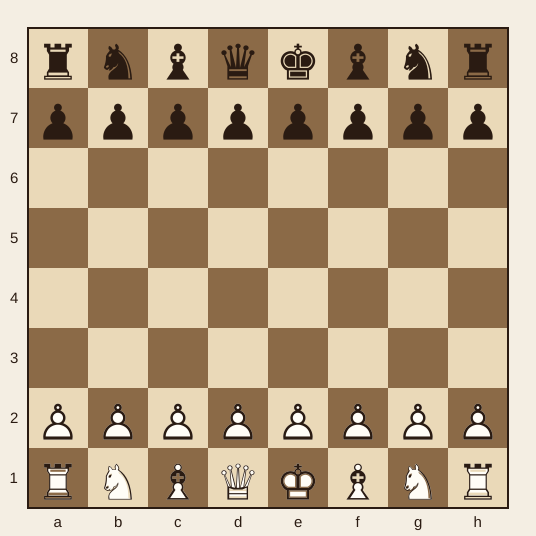
A chess board map is a printable sheet showing all 64 squares with the file letters a through h along the bottom and the rank numbers 1 through 8 up the side, usually with the starting position drawn in. You print it, and you have a reference you can set beside a real board, tape to a classroom wall, or slide into a plastic sleeve and draw on. The free printable files are linked on this page.
Two versions cover almost everyone: a blank coordinate map for notation practice and a labeled map with all 32 pieces in place. I once watched a club parent print 14 pages of "chess worksheets" from a site that wanted an email address for every single one. Skip that. Two sheets is the whole job.
What to print, and on what paper
Load standard letter paper, 8.5 by 11 inches, or A4 at 210 by 297 millimeters. Start with the blank coordinate map. It's the version that survives past week two, because once a kid knows where e4 lives, the setup diagram gets boring fast.
Square size and board footprint
| Square size | Board footprint | How it prints | | 0.9 in | 7.2 by 7.2 in | one letter sheet, room for labels | | 1.5 in | 12 by 12 in | tape 2 by 2 sheets, trim inner edges | | 2 in | 16 by 16 in | 2 by 2 sheets, or 3 across for margin room | | 2.25 in | 18 by 18 in | 3 sheets across, more trimming |
A board you can actualy play on sits at 2 to 2.5 inch squares, paired with a king 3.375 to 4.5 inches tall and a king base about 75 to 80 percent of the square. That's the US Chess range, and it's why the best chess boards for tournament play all cluster around the same dimensions. A map printed at 0.9 inch squares is a diagram, not a playing surface. Nothing wrong with that, as long as you know which one you're holding.
Scaling the print so it matches your pieces
Turn off "fit to page" and choose "actual size" first, then measure one printed square with a ruler. If it comes out at 1.8 inches and you want 2, divide 2.0 by 1.8, get 1.11, and set a custom scale of 111 percent. I do that on a phone calculator every time because I don't trust my own arithmetic.
Most printer drivers have a custom scale box, and 111 or 112 percent is a normal number to type in. Print one test page before you commit to six. The reason to bother: if the squares on paper match the squares on the chess boards you already own, you can lay pieces straight onto the print and run through a position without squinting.
The coordinate rules a good map makes obvious
| Square | File + rank | Sum | Color | | a1 | 1 + 1 | 2 | dark | | h1 | 8 + 1 | 9 | light | | a8 | 1 + 8 | 9 | light | | h8 | 8 + 8 | 16 | dark |
Even sum, dark square. Odd sum, light square. That's the whole trick, and a printed map with visible letters does more for a beginner than an hour of me talking. Two more rules the sheet should hammer: light square on the right (so h1 is light), and the queen starts on her own color, d1 for white and d8 for black.
And yes, I keep a folded map in my bag next to a scoresheet pad. Twenty-odd years of club chess and I still check d1 against d8 when I'm setting up a demo board in a hurry.
Where the 32 pieces start
| Piece | Per side | White squares | Black squares | | King | 1 | e1 | e8 | | Queen | 1 | d1 | d8 | | Rook | 2 | a1, h1 | a8, h8 | | Bishop | 2 | c1, f1 | c8, f8 | | Knight | 2 | b1, g1 | b8, g8 | | Pawn | 8 | a2 through h2 | a7 through h7 |
Sixteen pawns total, eight per side, and they're the pieces kids mix up first because there are so many of them. A labeled map settles it in about 30 seconds. Count the back rank with a finger: rook, knight, bishop, queen, king, bishop, knight, rook. Eight squares, one pass.
Laminating, taping, and the practical stuff
A 3 mil lamination pouch feels flimsy on a kid's table; 5 mil survives a backpack and a spilled juice box. Dry erase markers wipe clean off either one, and a plain sheet protector from an office store does the same job for a fraction of the price. Tape a map down with painter's tape rather than packing tape, because painter's tape lifts off a school table without taking the varnish with it.
If the map is going on a wall above a play area, it's worth pairing it with a real hanging board eventually. The best wall chess boards solve the "pieces everywhere" problem in a way paper never will.
Using it with a kid, a class, or a new club player
Three drills that work, all of them under five minutes. Call out ten squares and have the kid tap them, timed at 60 seconds. Cover the map with coins and have them name each hidden square. Or read out a short notation line like 1. e4 e5 2. Nf3 and let them move a coin to each square in turn.
I'll say the obvious thing plainly: a printed map won't teach anyone to play chess. It's a reference, not a coach. What it does well is remove the坐标 fumbling that makes beginners feel stupid, and that's worth two sheets of paper and a marker. When a kid is ready for pieces that stay put, the best chess boards for kids cover the wooden and silicone sets that survive being dropped.
When a printed map stops being enough
Paper has one real limit: you can't play a game on it. Once a new player is setting up without looking, the map has done its job. A 15 inch vinyl roll-up or a 2.25 inch square wooden board at roughly the same footprint is the next step, and that's a different purchase decision than a printout.
Print the files, scale them to whatever square size suits your table, and keep one copy unlaminated so it folds into a bag. Mine is dog-eared on the a-file. That's how you know it gets used.
Questions people ask me
What is a chess board map?
It's a printable diagram of all 64 squares with the file letters a through h and the rank numbers 1 through 8 labeled, usually with the starting position drawn in. People keep it beside a real board, tape it to a classroom wall, or use it for notation drills. On its own it's a reference sheet, not a playing surface.
What size should the squares be on a printable chess board?
For actual play, 2 to 2.25 inches per square lines up with US Chess guidance of 2 to 2.5 inch squares and a king 3.375 to 4.5 inches tall. A map printed at 0.9 inch squares is a diagram, which is fine for a reference sheet. If you want the print to match pieces you already own, measure one square on your board and set a custom scale in the print dialog.
Which way does the board go?
Light square on the right, so h1 is light and a1 is dark. White's pieces go on ranks 1 and 2, black's on 7 and 8, and each queen starts on her own color, d1 for white and d8 for black. Get those three things right and the rest of the setup falls into place.