Chessboard Pattern: What It Is and How to Print One That's Actually Square
Sixty-four squares, one correct answer, and a print dialog that will cheat you if you let it.
Free downloads
PDFs, 0.9 inch squares. Print at 100% (actual size), not “fit to page”.
- Blank board with coordinates: US Letter · A4
- Blank board, no coordinates: US Letter · A4
- Board with pieces in the starting position: US Letter · A4
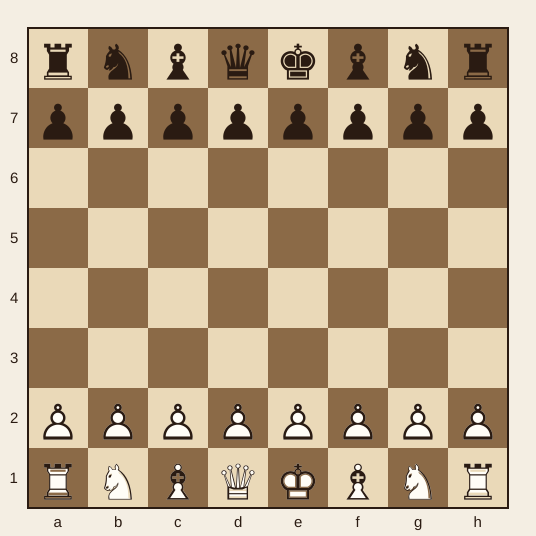
A chessboard pattern is 64 squares, 8 across and 8 down, alternating light and dark so that no two squares of the same shade touch along an edge. That's the whole rule. Most people searching for the name want "checkerboard," and the geometry is identical; a checkerboard just tends to run larger squares. The free printable files are linked on this page, in US Letter and 11 by 17 versions. Print one, measure it with a ruler, and you have a teaching board, a desk board for a kid, or a template to trace onto wood.
The two things the pattern has to get right
Eight rows, eight columns, and the bottom right square is light. Get that last one backwards and every diagram in every chess book fights you for the rest of your life. On a correct board a1 is dark and h1 is light, which is exactly what "light on the right" is telling you to check. The alternation follows automatically from there.
The other thing is geometry. Squares need to be square, and corners need to be 90 degrees. A board printed with squares that measure 2 inches across the top and 1.95 inches down the side looks fine to an adult and feels wrong to a kid sliding a knight into the corner.
Paper size, square size, and the arithmetic
Tournament squares run 2 to 2.25 inches, which is the range US Chess matches to a king 3.375 to 4.5 inches tall with a base around 75 to 80 percent of the square. That number is worth knowing before you hit print, because it decides your paper.
Eight squares at 2 inches is a 16 inch board. Letter paper is 8.5 by 11, so it cannot hold that in one piece. Here are the options that work:
- 11 by 17 tabloid, one sheet. Sixteen inches of board fits with about half an inch of margin on the long side. Cleanest result for a 2 inch square, and no taping.
- US Letter, tiled 2 by 2 (four pages). Same 16 inch board, assembled with tape. The seams fall on the d/e file line and the 4/5 rank line, so trim the white edges before you join them.
- 13 by 19 (Super B) for 2.25 inch squares. That's 18 inches of board, and tabloid falls 2 inches short at this size. Super B is the sheet that works.
If you want the shorter history of how these proportions settled in, the chess boards section covers standard sizing in more depth.
Set the print dialog to 100 percent
Every print dialog has a scaling dropdown and every one of them defaults to something unhelpful. Choose 100 percent or Actual Size. Never "Fit to page," never "Shrink oversized pages." Then print page one and measure a single square. It should come out at 2 inches, not 1.94. If it's off, your PDF reader is scaling and you need to fix that before you burn four sheets of card stock.
Check your darkness while you're at it. Printers render the dark squares anywhere from pale gray to near black depending on the toner level. A 60 percent gray fill reads clearly under a lamp and still lets pencil marks show. Solid black hides everything.
Square colors, file by file
Use this to check a printed board, or to settle an argument about a diagram you found online.
| Rank | a | b | c | d | e | f | g | h |
|---|---|---|---|---|---|---|---|---|
| 8 | light | dark | light | dark | light | dark | light | dark |
| 7 | dark | light | dark | light | dark | light | dark | light |
| 6 | light | dark | light | dark | light | dark | light | dark |
| 5 | dark | light | dark | light | dark | light | dark | light |
| 4 | light | dark | light | dark | light | dark | light | dark |
| 3 | dark | light | dark | light | dark | light | dark | light |
| 2 | light | dark | light | dark | light | dark | light | dark |
| 1 | dark | light | dark | light | dark | light | dark | light |
The shortcut is simpler than the table. Add the file number to the rank number; if the total is even, the square is dark. a1 is 1+1=2, so dark. h1 is 8+1=9, so light. That's the entire system.
Where the pieces go on your printout
The starting position, if you want it written down rather than remembered:
| Square | White | Black |
|---|---|---|
| a1 / a8 | rook | rook |
| b1 / b8 | knight | knight |
| c1 / c8 | bishop | bishop |
| d1 / d8 | queen | queen |
| e1 / e8 | king | king |
| f1 / f8 | bishop | bishop |
| g1 / g8 | knight | knight |
| h1 / h8 | rook | rook |
| rank 2 / rank 7 | eight pawns | eight pawns |
Two checks that catch most setup mistakes. The queens sit on their own color, so the white queen starts on d1 (light) and the black queen on d8 (dark). And the kings face each other on the e file, white on e1. Use the labeled printout, not the blank one, if you're teaching a beginner. Squares with no letters help nobody at the start.
Laminating, taping, and keeping the thing flat
A 3 mil pouch is fine for a single sheet a teacher handles. Go to 5 mil if a seven year old will be picking it up by the corner. Choose matte over gloss, because gloss throws your ceiling light straight back into your eyes at exactly the angle you need to see the board.
No laminator? Clear contact paper works, and so does taping the sheet to a piece of 1/8 inch hardboard from the hardware store. For the four-page version, tape on the back only. Tape on the front catches light and drags on the piece bases.
If you'd rather own a board that folds up and swallows the pieces, the chess board with storage options are worth a look before you spend an evening with a roll of tape.
What a printed board is genuinely good for
Teaching coordinates, running blindfold drills, playing through a book without dragging out the good set, and letting a six year old color squares with a marker without anyone wincing. It's also a template. Tape a 16 inch printout to a plywood offcut, drill the corners of the squares, and you have a guide for painting a tabletop. A kindergarten teacher I know printed six of them on tabloid and had a class labeling the files in one afternoon.
If the printout is a stopgap before buying something small and tough, the chess boards for kids picks cover the sizes that survive a backpack.
Where a printout stops working
I print boards constantly for diagrams and analysis, and I still wouldn't run a club night on one. Paper slides on a smooth table. Pieces slide on laminate. Card stock at 65 lb bows at the corners within a month of being rolled up. And a 16 inch board with a 3.75 inch king looks correct but sits low; you want the board raised off the table for a real game, which is why wooden boards are thicker than they strictly need to be.
For rated play, the chess boards for tournament play page covers roll-ups and folding boards that meet the spec. And if you want the pattern huge, on a wall, done properly, the wall chess boards options run from 24 inches up past 40.
Questions people ask me
What is the chessboard pattern called?
Most people call it a checkerboard or checkered pattern. The geometry is the same thing: 8 squares by 8 squares, alternating light and dark, 64 total. The name changes; the grid doesn't.
How big should each square be on a printable chessboard?
Aim for 2 to 2.25 inches, which is the range US Chess pairs with a king 3.375 to 4.5 inches tall. Eight squares at 2 inches means a 16 inch board, so 11 by 17 paper is the smallest sheet that holds it in one piece. Letter paper has to be tiled across four pages.
Which square is dark on a chessboard?
a1 is dark and h1 is light, which is what "light on the right" means. The shortcut: if the file number plus the rank number is even, the square is dark. So d4 (4+4) is dark and e4 (5+4) is light.