Chess Board Close Up: Print a Board at True Playing Size
A printable board with coordinates and piece setup, sized so you can actually read it from across a table.
Free downloads
PDFs, 0.9 inch squares. Print at 100% (actual size), not “fit to page”.
- Blank board with coordinates: US Letter · A4
- Blank board, no coordinates: US Letter · A4
- Board with pieces in the starting position: US Letter · A4
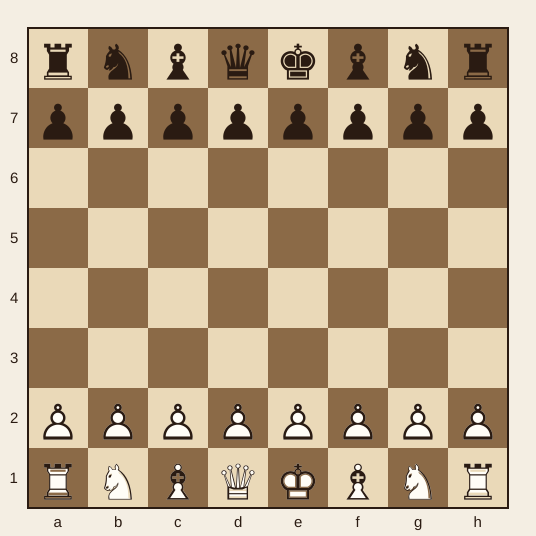
A chess board close up you can print in about five minutes
The free printable files are linked on this page: a labeled board, a coordinate strip for the edges, and a one-page piece setup sheet. Print at 100 percent scale, not "fit to page." On US Letter that gives you an 8-inch board with 1-inch squares, which is right for a desk and too cramped for a classroom demo. The four-quadrant tile set is the version to use when you want squares at 2 inches or larger.
I print the small one first, every time. It costs a single sheet and tells you straight away whether your printer is honest about scale.
Paper size, scale, and how to land a 2 to 2.25 inch square
US Letter measures 8.5 by 11 inches. A quarter-inch margin leaves 8 inches of printable width, which is exactly 8 squares at 1 inch. Legal paper doesn't help, since it's the same width and just longer. Tabloid (11 by 17) is the useful step up, because a 4-square quadrant at 2.25 inches comes to 9 inches and fits with room to trim.
Do the multiplication before you commit to anything. A board with 2-inch squares is 16 inches across. At 2.25 inches it's 18 inches across. Neither fits on one sheet, and both fit comfortably on four sheets taped in a 2 by 2 grid.
In the print dialog, look for "Poster" in Adobe Reader or "Tile large pages" in other drivers, and set the overlap to 0.25 inch so you have something to glue. Then measure one square with a ruler before you tape anything down. If it reads 1.9 inches when you asked for 2, the driver rescaled the page and every piece you set on it will look slightly wrong. My habit is to measure the king's base rather than the king's height when I'm matching a set to a board. The best chess boards for tournament play page walks through those sizing ratios in more detail.
The 32 pieces, their starting squares, and the count
Two things go wrong on a printed setup sheet: the king and queen get swapped, and the board gets turned 90 degrees. White's queen belongs on d1, which is a light square. Black's queen belongs on d8, which is dark. Get that right and the rest of the back rank falls into place, with a light square in the near-right corner for each player.
| Rank | Files a and h | Files b and g | Files c and f | File d | File e |
|---|---|---|---|---|---|
| 1 (White) | rook | knight | bishop | queen | king |
| 2 (White) | 8 pawns across the rank | ||||
| 7 (Black) | 8 pawns across the rank | ||||
| 8 (Black) | rook | knight | bishop | king | queen |
The coordinate strip is worth printing even if you skip everything else. A beginner who can name 10 squares cold is ready for real games.
| Piece | White | Black | Total |
|---|---|---|---|
| Pawn | 8 | 8 | 16 |
| Rook | 2 | 2 | 4 |
| Knight | 2 | 2 | 4 |
| Bishop | 2 | 2 | 4 |
| Queen | 1 | 1 | 2 |
| King | 1 | 1 | 2 |
| All pieces | 16 | 16 | 32 |
Laminating and taping so the board lies flat
Use a 9 by 11.5 inch laminating pouch for Letter sheets. That's the standard size and it leaves a clean sealed edge. A 3 mil pouch is fine for a board that lives in a folder. Go to 5 mil if a room full of kids will handle it, because the corners take a beating. Run it through a 13-inch laminator on the thick setting and let it cool flat under a book for ten minutes.
Joining four tiles takes a little patience. Trim one side of the overlap, butt the edges together, and tape the seam on the back with matte tape. Glossy tape throws a glare line under a lamp, and that glare line always lands right where the pieces sit. Laminated sheets also slide on a bare table, so put a piece of rubber shelf liner underneath. A roll of it runs about $6 to $10 and cuts with ordinary scissors.
Printing a photo close up instead of a diagram
If you're printing a photograph of a board rather than a diagram, resolution is the whole game. A 300 dpi print of an 18-inch board needs an image roughly 5,400 pixels wide. Most phone photos come in around 4,000 pixels, which prints fine at 220 dpi on that same 18-inch sheet and starts to soften past 24 inches. Paper choice matters here too. Matte photo paper hides glare; glossy turns the board into a mirror under a ceiling light.
Drills and classroom uses a printed board handles well
The close-up sheet is a teaching aid, not a playing set. I use mine for coordinate drills: call out 10 squares, have the kid point and say the color, and keep it under 5 minutes so it stays a game. The numbered edge strip does most of the work for a beginner. If you're kitting out a whole classroom rather than a single desk, the best chess boards for kids page covers sets that survive being dropped.
For a club room, an 18-inch print mounted about 60 inches off the floor makes a decent wall reference for the back-rank setup. The best wall chess boards page has the mounting options if you'd rather hang something permanent than tape paper to a whiteboard.
Where a printed board stops working
Paper slides. A knight tips over when you breathe on it. And 1-inch squares are too small for adult hands, which is why I don't print the single-sheet version for anyone past about age 12. It's a diagram you can touch, not a set, and nobody learns the feel of a piece from a laminated sheet.
Moving from paper to a board you own
When you're ready to spend, start with the chess boards hub, which sorts by material and price band. What I see in club pricing puts roll-up vinyl around $20 and wooden tournament boards from about $60 up. Keep the printed reference sheet in the bag with the pieces, since a quart freezer bag swallows all 32 without a fight. If you'd rather not own a bag at all, a chess board with storage does the same job with less clutter on the shelf.
Questions people ask me
What size should a printable chess board be?
For anything beyond a desk reference, aim for squares between 2 and 2.25 inches. US Chess guidance puts tournament squares at 2 to 2.5 inches, with king height from 3.375 to 4.5 inches and the king base around 75 to 80 percent of a square. A 2-inch square board is 16 inches across, so it takes four taped sheets, not one.
Can I print a whole chess board on one sheet of paper?
Yes, at 1-inch squares. A quarter-inch margin on US Letter leaves 8 inches of printable width, which is exactly 8 squares. That board measures 8 inches across, which works for a kid's desk and is too cramped for adult hands or a classroom demo.
Why do my printed squares come out smaller than they should?
The printer driver is scaling the page to fit, usually because "fit to page" or a similar option is on. Set scale to 100 percent, or use Poster or Tile mode, then measure one square with a ruler before taping the sheets together. A 2-inch square that prints at 1.9 inches throws off every piece you set on it.