Chess Board Starting Position Labeled: A Printable That Fits Real Pieces
A labeled board you can print, tape down, and hand to a kid, scaled to match the set you already own.
Free downloads
PDFs, 0.9 inch squares. Print at 100% (actual size), not “fit to page”.
- Blank board with coordinates: US Letter · A4
- Blank board, no coordinates: US Letter · A4
- Board with pieces in the starting position: US Letter · A4
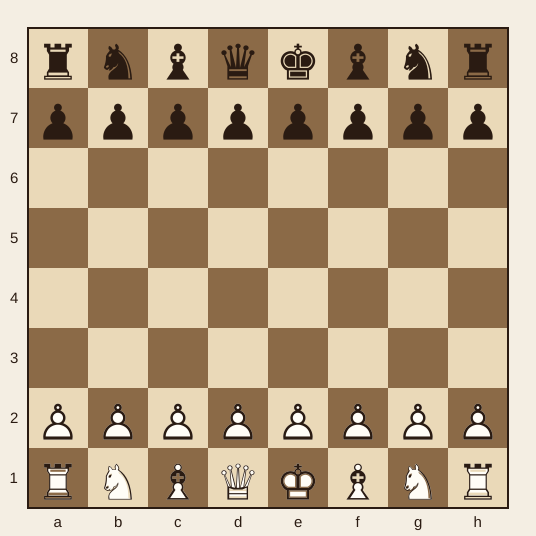
What the labeled starting position looks like
The labeled starting position is the standard chess array with coordinates printed on it: files a through h along the bottom, ranks 1 through 8 up the side, and every piece drawn on its named square. White's back rank reads rook, knight, bishop, queen, king, bishop, knight, rook from a1 across to h1, with pawns filling a2 through h2. Black mirrors that on ranks 8 and 7. The diagram is drawn from White's side, so a1 sits in the lower left corner and h8 in the upper right.
The free printable files are linked on this page: a labeled sheet for teaching, a blank grid of the same size for testing, in US Letter and A4. I'd start with the labeled one and keep the blank in the printer tray.
Two rules do most of the work. Light square on the right. Queen on her own color, which puts the white queen on d1 (a light square) and the black queen on d8 (dark). If a kid can hold those two, the setup stops being a memory test. The long version of the whole arrangement is in the chess starting position board guide.
Every piece and its starting square
Read the table top to bottom for one side, then flip it for the other. Pawns sit one rank in front of every piece on the back rank.
| File | White home square | Black home square |
|---|---|---|
| a | Rook on a1 | Rook on a8 |
| b | Knight on b1 | Knight on b8 |
| c | Bishop on c1 | Bishop on c8 |
| d | Queen on d1 | Queen on d8 |
| e | King on e1 | King on e8 |
| f | Bishop on f1 | Bishop on f8 |
| g | Knight on g1 | Knight on g8 |
| h | Rook on h1 | Rook on h8 |
| Pawns | a2 through h2 | a7 through h7 |
That's 16 pieces per side, 32 on the board at move one, and 32 empty squares waiting. The letters run left to right from White's view and the numbers climb from White's side. If you want the same information as a step by step walk, the how to set up a chess board page covers it in setup order, which is easier for a group of kids than a static diagram.
Printing at the size your pieces actually need
Here's the arithmetic nobody mentions. Eight squares at 2.25 inches across comes to 18 inches of board. US Letter is 8.5 by 11 inches, and A4 is 210 by 297 millimeters. A full tournament sized board does not fit on one sheet, and no print setting will change that.
So print for the job you have. A reference sheet can be any size that keeps the letters legible, since nobody is moving pieces on it. A playable sheet has to match your pieces: at 1 inch squares the grid is 8 inches wide and fits Letter with quarter inch margins, which suits a small travel set with a king around 1.5 to 2 inches tall.
In the print dialog, choose Actual size or 100 percent and switch off anything labeled fit to page or shrink oversized pages. Then measure. A1 to h1 runs 15.75 inches at 2.25 inch squares, or 14 inches at 2 inch squares, so a ruler across the bottom row tells you in two seconds whether the printer obeyed. The full set of standard proportions is on the chess board number of files ranks page, and the chess board dimensions breakdown covers square counts and overall footprint.
Laminating a sheet that gets handled by thirty kids
A 3 mil pouch is fine for home use and stays flexible. Classrooms chew through paper, so I'd go 5 mil and accept the stiffness. A dry erase marker on a laminated sheet lets you circle e4 mid lesson and wipe it clean, which beats pointing at a diagram while eight kids lean in.
If a laminator isn't handy, Letter size sheet protectors cost pennies and give you the same wipe clean surface. Tape the sheet to the table with painter's tape, not packing tape, because painter's tape lifts off school furniture without taking varnish with it.
Teaching with the labels, then taking them off
Start by asking the kid to put a finger on a square you name, then the reverse: point at a square and have them say the coordinate. Two minutes of that is worth a printed worksheet. Then switch to the blank grid and watch what happens.
I'll be straight with you: labels turn into a crutch if you leave them up for a month. Some coaches ban them after the second week. I don't go that far, but I do move to the blank version as soon as a child can find d5 without counting from the corner. The how to read a chess board walkthrough is the natural next step once the letters stop needing a cheat sheet.
Matching a printed square to the pieces you own
Before you pick a scale, measure the widest part of the king's base with a ruler, not the whole base including the felt. Standard guidance puts king height at 3.375 to 4.5 inches, squares at 2 to 2.5 inches, and the king base at roughly 75 to 80 percent of a square. A king with a 1.6 inch base plays comfortably on 2.25 inch squares and looks lost on 2.5.
Smaller sets break those numbers, and that's fine. A 2 inch king with a 0.9 inch base wants roughly 1.2 inch squares, which means a playable printed board at that scale fits on Letter with room to spare.
What I'd hand a new player on day one
Print the labeled sheet at whatever size reads clearly, laminate it, and tape it inside the lid of the box. Print the blank one for the day they claim they know the setup. Then sit down and play a real game, because a diagram teaches squares and only a game teaches why they matter. When the labels start slowing them down, move on to the learn chess basics and let the paper go.
Questions people ask me
Which square does the white queen start on?
d1, which is a light square. The black queen starts on d8, a dark square. That is what the old line means by queen on her own color, and it settles the trickiest part of the setup.
What square does the white king start on?
e1, with the black king on e8. The king sits to the right of the queen from White's view, and the two royals face each other across the board on the e-file.
Can I resize the printable to match my chess set?
Yes, but check the result with a ruler instead of trusting the preview. In the print dialog choose Actual size or 100 percent and turn off any fit to page setting, since that shrinks the squares unevenly and changes the size of the whole grid.