Chess Starting Position Board, Labeled: What to Print and How Big
A labeled starting position board gets a beginner from a bag of pieces to a legal game in about three minutes.
Free downloads
PDFs, 0.9 inch squares. Print at 100% (actual size), not “fit to page”.
- Blank board with coordinates: US Letter · A4
- Blank board, no coordinates: US Letter · A4
- Board with pieces in the starting position: US Letter · A4
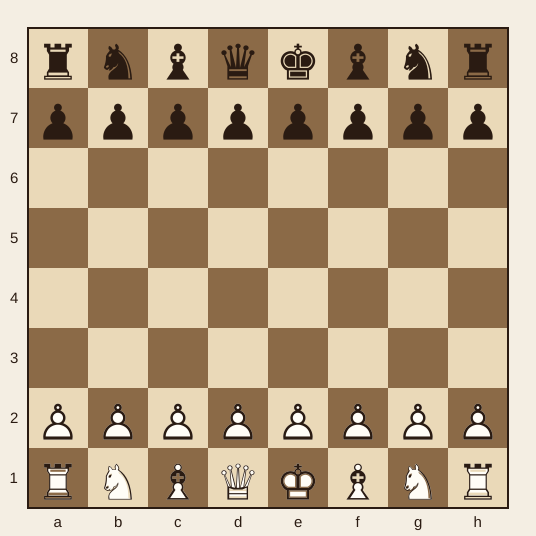
The short answer: what "labeled" means on this sheet
A labeled chess starting position board shows the empty grid with file letters a through h across the bottom, rank numbers 1 through 8 up the left side, and the name of each piece printed on its home square. Sixty-four squares. Thirty-two pieces. That's the whole idea.
Hand that sheet to a seven-year-old with a bag of chessmen and the setup problem mostly solves itself. No lecture about which side of the board is which. The paper does the talking.
The one rule that catches everybody is the queen. White queen on d1, black queen on d8, each one on her own color. A good labeled sheet prints that reminder directly on the square instead of hiding it in a legend at the bottom.
What the printed sheet should contain
The chess starting position board I'd hand a beginner carries the letters running left to right from White's side and the numbers climbing away from White, plus the piece name on all 32 occupied squares. Free printable files are linked on this page, so you don't have to build the thing yourself.
Look for four things before you commit paper. Coordinate labels on all four edges, because kids sit on the wrong side of the table constantly. Arrows or a note showing that pawns move toward the far rank. A queen-on-her-color reminder. And enough white space between squares that the piece names stay readable at arm's length.
If the sheet you find has the file letters on two edges only, print it anyway and write the missing ones in by hand. I've done that more than once with club handouts.
Paper size and how big the squares actually come out
Here's the arithmetic that surprises people. Eight squares at 2 inches each is a 16 inch wide board, and US Letter is 8.5 inches wide. It doesn't fit. Not even close.
Your options, in order of how often I'd pick them:
- US Letter (8.5 by 11 inches) at 1 inch squares. The board prints about 8 inches wide with room for margins. Fine for a diagram a parent points at, too small for a kid to set real pieces on top of.
- US Letter, tiled across four pages at 2 inch squares. Print in poster or tile mode, trim the edges, tape the seams. The result is 16 inches of board with a visible cross seam. Works, looks homemade.
- Tabloid (11 by 17 inches) at 2 inch squares. The board is 16 inches across, so with a half inch margin on each side it just fits in landscape. One sheet, no tape. This is what I'd do for a classroom.
- A4 (210 by 297 mm) at 25 mm squares. For anyone outside the US, 25 mm is roughly 1 inch, and the sheet behaves like Letter.
The chess board dimensions page has the wider version of this math if you're matching the sheet to a set you already own. For reference, US Chess guidance puts king height around 3.375 to 4.5 inches and squares at 2 to 2.5 inches, with the king's base running 75 to 80 percent of a square.
Scaling the print to 2 to 2.25 inch squares
Your print dialog will lie to you. "Fit to page" shrinks everything by a few percent to make room for margins, and a square you wanted at 2 inches lands at 1.85. Choose "Actual size" or set the scale to 100 percent, then measure.
Print one page. Measure one square with a ruler. Then adjust with this formula: target size divided by measured size, times 100. A square that prints at 1.75 inches when you want 2 inches needs a scale of 2 divided by 1.75, which is 114 percent.
Yes, this is fussy. Do it once and every reprint for the rest of the school year is correct. I'd rather you print one sheet at the right size than five at the wrong one, and I say that as someone who has wasted alot of cardstock.
The starting position, square by square
If the sheet gets lost or the printer dies, this table rebuilds it. White's pieces sit on ranks 1 and 2, Black's mirror them on ranks 7 and 8.
| Piece | Count per side | White starts on | Black starts on |
|---|---|---|---|
| Rook | 2 | a1 and h1 | a8 and h8 |
| Knight | 2 | b1 and g1 | b8 and g8 |
| Bishop | 2 | c1 and f1 | c8 and f8 |
| Queen | 1 | d1 | d8 |
| King | 1 | e1 | e8 |
| Pawn | 8 | a2 through h2 | a7 through h7 |
And by rank, which is how most beginners actually build a board:
| Rank | What sits there |
|---|---|
| 1 | White's back rank: rook, knight, bishop, queen, king, bishop, knight, rook from a to h |
| 2 | White's eight pawns |
| 3 and 4 | Empty |
| 5 and 6 | Empty |
| 7 | Black's eight pawns |
| 8 | Black's back rank, same order, mirrored |
Two things trip people up constantly. The king stands on e1, not d1, so the queen goes on the square that matches her color. And the board is set with a light square in each player's right hand corner, which puts a white square at h1.
The chess board number of files and ranks breakdown covers why the letters and numbers run the direction they do, and it's worth five minutes if the coordinates still feel arbitrary.
Laminating, and what it costs
A plain paper sheet lasts about a week in a kid's backpack. Laminated, it lasts a season of club nights.
3 mil pouches are fine for a sheet that lives in a folder; 5 mil survives a classroom of thirty. A 25-pack of letter-size 3 mil pouches runs roughly $8 to $12, and self-sealing laminating sheets cost more per page but need no machine. Tabloid pouches jump to about $15 to $25 for a 25-pack, so price the pouch before you commit to the big sheet.
The tradeoff is glare. A glossy 5 mil pouch under gym fluorescents throws a hot spot that can wash out the light squares, and if your labeled sheet has pale gray empty squares, they'll vanish. Matte pouches cost a dollar or two more per pack and fix it.
Using the sheet for the first two weeks
Week one, don't play chess. Set up the board from the sheet, knock it down, set it up again. Time it. Most kids get under 90 seconds by the fourth try, and that speed is the point.
Week two, cover the sheet and let them build from memory, then uncover it for the check. Point at a random square and ask what belongs there. It takes two minutes and it builds the board map that everything else hangs on.
And then put the sheet away. A printable is training wheels, not a permanent fixture at the table. It won't teach a kid the weight of a piece or the sound of a knight landing. Only a real board does that.
When you're ready to move up, the guide on how to set up a chess board walks through the same position on a real set, and how to read a chess board handles the coordinates from the player's seat instead of the page.
Mistakes that waste paper
Printing in grayscale when the sheet relies on light and dark squares to teach the queen rule. Trimming the margins with scissors and slicing off the h file. Taping a tiled board with the pages in the wrong order so the a file ends up next to the d file, which I have watched a grown adult do.
And the big one: printing at "fit to page" and then wondering why the 2.25 inch squares measured 1.9. Check the scale first, measure second, print the rest of the stack third.
Once the setup is automatic, the next step is actual moves. The learn chess section starts from the first pawn push, and if you're wondering whether this even counts as a board game alongside the checkers set in the closet, the answer is on the page about whether chess and checker boards are the same. Short version: same grid, different job.
A vinyl roll-up board with 2.25 inch squares runs $15 to $30 and rolls into a tube, which makes it the natural next purchase after the laminated sheet has done its work. Start with paper. Spend money when the kid asks to.
Questions people ask me
What does a labeled chess starting position board show?
It shows the 8 by 8 grid with file letters a through h across the bottom, rank numbers 1 through 8 up one side, and the name of each piece printed on its home square. The useful ones also print the queen rule right on d1 and d8. That single reminder prevents most setup arguments.
What size should I print the board so it matches my pieces?
Aim for squares between 2 and 2.25 inches, which means the board itself is 16 to 18 inches wide before margins. That doesn't fit on US Letter at full size, so you either scale down to about 1 inch squares or print across four tiled sheets and tape them. Tabloid paper handles 2 inch squares on a single sheet with tight margins.
Can I laminate the printed board and write on it?
Yes, and 3 mil pouches are plenty for a sheet that lives in a folder while 5 mil survives a classroom. Use a dry erase marker on the plastic and wipe it with a damp cloth. Matte pouches cost a little more but cut the glare from overhead lights.