How Does a Chess Board Look Like? Here's the Grid, Plus a Printable Copy
Sixty-four squares, eight files, eight ranks, and one corner rule that trips up half the beginners I've taught.
Free downloads
PDFs, 0.9 inch squares. Print at 100% (actual size), not “fit to page”.
- Blank board with coordinates: US Letter · A4
- Blank board, no coordinates: US Letter · A4
- Board with pieces in the starting position: US Letter · A4
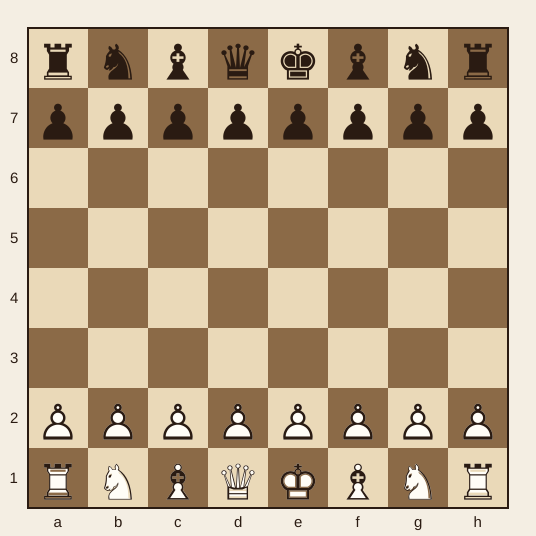
A chess board is 64 squares in an 8 by 8 grid
That's the whole answer. Eight rows of eight squares, light and dark alternating, 32 of each. A vinyl roll-up, a walnut tournament set, and a printed sheet all share the same pattern. Nothing about the colors changes the game.
The rule that matters is the corner. Each player needs a light square in the corner on their right: h1 for White, a8 for Black. Which makes a1 dark. Turn the board 90 degrees the wrong way and every diagram in every book reads backwards. I've watched beginners fight a lost position for an hour because nobody checked the corner at the start.
Want the counting rabbit hole? There's a full breakdown in how many squares on a chess board, including the 204 you get once you count every size of square, not just the small ones.
What to print: a labeled board and a blank one
Two files, two jobs. The labeled board prints a1 through h8 small in the corner of every square, which is what a new player needs for the first month. The blank one is for puzzles, wall charts, and knight's-tour drills.
The free printable files are linked on this page, in US Letter (8.5 by 11 inches) and A4 (210 by 297 mm).
One printer setting decides whether any of this works. Set scaling to "actual size," not "fit to page." Plenty of printers shave 3 to 5 percent off to tidy up their margins, and you find out when you measure a square and get 1.9 inches instead of 2.
Scaling the squares to 2 to 2.25 inches
Do the arithmetic before you hit print, because this is where paper boards go wrong.
Two-inch squares give you a 16-inch board. Squares at 2.25 inches give you 18 inches. Neither fits on Letter paper, and no margin setting saves you.
So you tile it. Four sheets, two across and two down, each sheet carrying a 4 by 4 block of squares. Four 2-inch squares span 8 inches, which squeezes inside Letter's printable width once your margins drop to a quarter inch. At 2.25 inches the block is 9 inches wide, too much for Letter; run those on 11 by 17 tabloid, or stay at 2 inches and accept a slightly smaller board.
The shortcut people try is scaling a one-page board down untill it fits. That lands you around 0.8 to 0.9 inch squares. Fine on a wall. Useless under a 3.75-inch club king, whose base will overhang the square on every side. If you want to check your numbers against real sets, chess board dimensions lays out the ratios.
US Chess guidance puts king height around 3.375 to 4.5 inches, squares at 2 to 2.5 inches, and the king's base at roughly 75 to 80 percent of a square. Measure the base of your tallest king and work backward from there. A 1.5-inch base wants 2-inch squares at minimum.
Files, ranks, and the 8 by 8 coordinate table
Files are lettered a to h, starting at White's left. Ranks are numbered 1 to 8, starting on White's side. Here's what sits on each file at the start of a game:
| File | White's back rank | Black's back rank |
|---|---|---|
| a | rook | rook |
| b | knight | knight |
| c | bishop | bishop |
| d | queen | queen |
| e | king | king |
| f | bishop | bishop |
| g | knight | knight |
| h | rook | rook |
The queens land on their own color. d1 is a light square, so the white queen goes there; d8 is dark, so the black queen goes there. If your queen is sitting on the wrong shade, the board is set up wrong. More on that in chess board number of files ranks.
The 32 pieces and their starting squares
Sixteen pieces a side, 32 on the board. Eight of them are pawns, all on the second rank.
| Piece | Per side | White starts | Black starts |
|---|---|---|---|
| King | 1 | e1 | e8 |
| Queen | 1 | d1 | d8 |
| Rook | 2 | a1, h1 | a8, h8 |
| Bishop | 2 | c1, f1 | c8, f8 |
| Knight | 2 | b1, g1 | b8, g8 |
| Pawn | 8 | rank 2 | rank 7 |
White always moves first, and the board is oriented so the letters read left to right in front of the player with the light pieces. For the piece-by-piece version with the reasoning behind each placement, how to set up a chess board covers it.
Laminating, taping, and mounting the sheets
A 3 mil pouch is enough for a board that rides in a backpack. Go to 5 mil if it lives in a classroom and gets handed around by nine-year-olds. Matte beats gloss under gym lighting, where a glossy surface turns the board into a mirror and the far rank disappears.
Trim the white margin off two edges of each sheet with a steel ruler and a fresh blade before you tape anything. Scissors give you a wavy edge, and the grid lines never meet. Tape on the back only. Tape on the front leaves a ridge that pawns catch on.
Then mount the finished board on an 18 by 18 inch piece of foam board from a craft store. It stops the seams from curling after a week in a hot car.
Here's my honest concession. A laminated sheet is not a wooden board. Pieces don't slide the same, the surface never sits perfectly flat on an uneven table, and there's no clack when you move a knight. For ten lessons with a seven-year-old, none of that matters. For a Saturday tournament, it does.
Using a printed board for teaching and drills
Paper does things a heavy set can't. You can write on it with a dry-erase marker: circle the pinned knight, shade the diagonal the bishop controls, number the eight squares a knight reaches from e4. Eight is the answer, and it surprises most beginners.
A printed board also travels. Folded once, it weighs nothing, so a kid can carry their own board to a lesson and set it up without help. I keep four laminated boards in the car for exactly this. Half the club nights I run start with a diagram on paper before anyone touches a piece. If a student can't find the square on a sheet, they won't find it on a $200 set either. The basics of scanning the grid are in how to read a chess board.
Once the coordinates stick, move on to the rules. There's a sensible order for that in learn chess, starting with how the pieces move and ending with a first game that doesn't collapse in six moves.
Three numbers to check before you buy a wooden board
King height, square size, king base diameter. Those three decide whether a set plays well, and every honest listing prints them. The fourth thing, piece weight in the hand, you can only judge by picking one up, which is why I'd rather buy a club set at a tournament than off a photo.
Measure your paper board against the same numbers. If your printable board has 2-inch squares and your kings are 3.75 inches with a 1.6-inch base, you're within spec and the set will feel right on it. If the base is 1.8 inches, bump the squares up. Same rule at a kitchen table or a tournament hall.
Questions people ask me
Does it matter which way the board is turned?
Yes. Each player needs a light square in the corner on their right, which makes h1 light for White and a1 dark. Turn it the other way and every diagram you read afterward feels shifted by one square.
What size should the squares be on a printable board?
Two to 2.25 inches if you plan to actually play on it with standard pieces. Anything under an inch turns the board into a diagram, and a 3.75-inch king will dwarf the squares.
Can I print a chess board on a single sheet of paper?
You can, but the squares come out around 0.8 inches, so it's a wall chart, not a playing surface. For real play, print four sheets in a 4 by 4 block layout and tape them into a 16-inch board.