Italian Game Chess Opening Board: A Printable That Fits Real Pieces
One sheet, one opening: print the Italian Game board, check your square size with a ruler, and teach the first three moves tonight.
Free downloads
PDFs, 0.9 inch squares. Print at 100% (actual size), not “fit to page”.
- Blank board with coordinates: US Letter · A4
- Blank board, no coordinates: US Letter · A4
- Board with pieces in the starting position: US Letter · A4
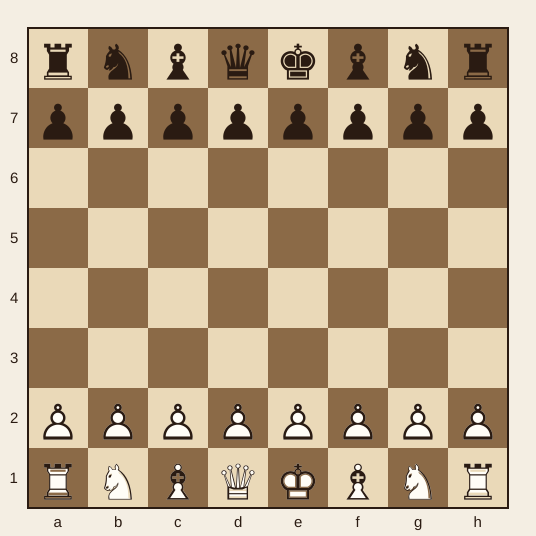
The short answer: print the sheet on US Letter (8.5 by 11 inches) or A4, pick 100 percent or "actual size" in the print dialog, and put a ruler on one square before you laminate anything. The single-page file gives you a labeled board plus the first three moves of the Italian Game. The tiled file spreads the same board over four pages so real pieces fit, and at 100 percent those squares measure 2 inches. The free printable files are linked on this page.
What the printable page holds
The reference sheet is one page: an 8 by 8 board with files a through h and ranks 1 through 8 on all four edges, and the Italian setup drawn in at the start. Labels on every side matter more than they sound, because a beginner who turns the paper around loses the a file in about four seconds. There's a move strip for 1.e4 e5 2.Nf3 Nc6 3.Bc4 and a short note on why the bishop belongs on c4. If the labels confuse your kid, the how to read a chess board guide walks through files and ranks with the same layout.
The tiled file is four quadrants, each 4 squares by 4 squares, with crop marks in the corners. That's 16 squares per page and 64 when assembled. Tape, don't glue. Tape lets you nudge a quadrant a quarter inch when it drifts, and it always drifts.
Printer settings that keep squares at 2 to 2.25 inches
Do the arithmetic before you press print. Eight squares at 2 inches is a 16 inch board; at 2.25 inches it's 18 inches, which is wider than any desktop sheet in your house. That's why the tiled file splits the board across four Letter pages and lands at 2 inch squares once assembled. Want the bigger size? Run a 3 by 3 page tile (six more tape lines) or take the file to a copy shop. US Chess guidance puts tournament squares at 2 to 2.5 inches, so either version plays fine with a standard club set. Choose "actual size," not "fit to page," because fit to page shaves a few percent and your 2 inch square quietly becomes 1.9. The chess board dimensions page has the full set of numbers if you want to compare against a board you already own.
Cardstock, lamination, and a board that survives a term
Print on 65 lb cardstock (about 176 gsm) if kids will handle it. Standard 20 lb copy paper is fine for one evening and ripples the first time a juice box lands on it. A 3 mil laminating pouch is enough for a flat sheet; 5 mil trims cleaner and stays flat when you pick it up by one corner. Leave a quarter inch of sealed border around every quadrant, since lamination peels first at a cut edge. Use dry erase markers on the laminated copy. Permanent marker on a laminated board is a mistake you make once.
The Italian Game in coordinates
The whole opening is three moves for White. Everything after that is a choice about how early you push d4 or tuck the king away. Long algebraic (from square, then to square) is easier for a new player than the shorthand, so the table gives both.
| Ply | Move (SAN) | Long form | Why it matters |
|---|---|---|---|
| 1 | 1. e4 | e2 to e4 | Takes the center and opens the f1 bishop's path |
| 2 | 1... e5 | e7 to e5 | Black answers in the center, the reply that keeps the Italian honest |
| 3 | 2. Nf3 | g1 to f3 | Attacks e5 and develops toward castling |
| 4 | 2... Nc6 | b8 to c6 | Defends e5 with a knight, not a pawn |
| 5 | 3. Bc4 | f1 to c4 | The Italian bishop, aimed at f7 |
| 6 | 3... Bc5 | f8 to c5 | Giuoco Piano, the quiet Italian |
| 7 | 3... Nf6 | g8 to f6 | Two Knights Defense, sharper and more tactical |
| 8 | 3... Be7 | f8 to e7 | Hungarian Defense, solid and a touch passive |
The point of 3.Bc4 is f7. That pawn is guarded by the king and nothing else on move one, which is why the Italian shows up in most beginner books. If your kid can point at f7 and say why it's soft, they've understood more than a memorized move list gives them. The learn chess section covers the rest of the piece values and basic plans.
Three ways to use the sheet this week
Start with the four-move line: 1.e4 e5 2.Nf3 Nc6 3.Bc4 Bc5 4.c3. Play it on the paper board, then set up the same position on the real board and compare the feel (the chess starting position board guide shows the finished layout). Ten minutes, twice a week, beats a two hour session on Sunday.
For a classroom, print one sheet per pair of kids and skip the tiled version entirely. The single-page diagram is enough to copy the setup onto real boards, and the how to set up a chess board guide handles the "which king goes where" question that comes up every time. Count the pieces before the bell: 32 total, 16 per side, one queen each on her own color.
Then let the kid play Black and choose among 3...Bc5, 3...Nf6 and 3...Be7. The first is calm, the second gets sharp fast, the third is solid and slightly cramped. Ask which one feels safer and why. That question does more for their chess than another twenty minutes of drills.
Matching the paper board to the pieces you already own
The working rule is a king base around 75 to 80 percent of the square. On a 2 inch square, that allows a king base up to 1.6 inches, which is roughly a 3.75 inch king. Measure the base of your tallest king with a ruler before you cut anything. At 1.8 inches, knights will knock into pawns all night and nobody will know why the position looks messy. A 2.25 inch square buys you real room, and that's the main reason to bother with the larger print and the extra tape.
Where a paper board falls short
The sheet slides on a smooth table, and a bumped elbow moves the whole board. It won't survive a club season, and the quadrants leave a seam running through the d and e files. I'd still print it. For a first month of lessons, a free board you can scribble arrows on beats a nice set sitting in a closet. When the kid starts asking for a proper board, that's your signal, and the how to make chess board guide is where I'd start if you want wood or vinyl. Until then, paper does the job.
Questions people ask me
What size should the squares be on a printable chess board?
US Chess puts tournament squares at 2 to 2.5 inches, and 2 to 2.25 inches suits most home sets. Measure one square with a ruler after printing, because fit to page shrinks the file without warning. If your king base is wider than the square, the pieces will crowd all game.
Can I print the Italian Game board on A4 paper?
Yes. The tiled file prints on A4 at 100 percent and gives you the same 2 inch squares. A4 is 8.27 by 11.69 inches, so check the print preview margins before you commit, then trim the crop marks and tape the quadrants.
What is the Italian Game in one sentence?
It is 1.e4 e5 2.Nf3 Nc6 3.Bc4, with White's bishop aiming at f7. Black's three common replies are 3...Bc5, 3...Nf6, and 3...Be7. The opening suits beginners because the plan is easy to see on a printed board.