Chess Pieces Drawings: Free Printable Sheets, Right Sizes, and How to Use Them
What's in the free pack, which paper to use, and how to scale the drawings so pieces sit right on a 2 to 2.25 inch board.
Free downloads
PDFs, 0.9 inch squares. Print at 100% (actual size), not “fit to page”.
- Blank board with coordinates: US Letter · A4
- Blank board, no coordinates: US Letter · A4
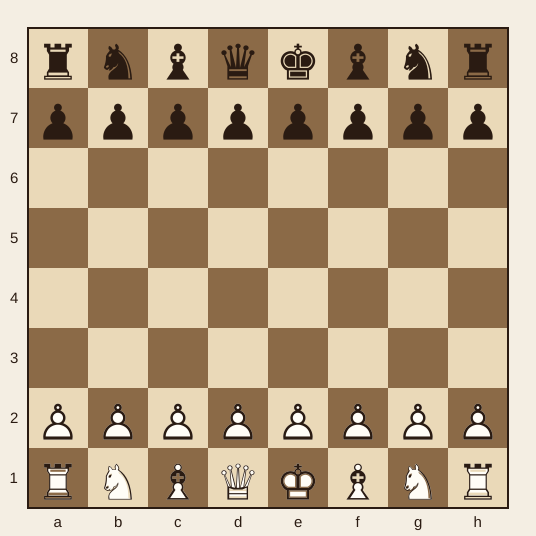
- Board with pieces in the starting position: US Letter · A4
Short answer: the free printable files linked on this page are line drawings of all six chess pieces, laid out to print on ordinary US Letter or A4 paper, and they scale cleanly to a board with 2 to 2.25 inch squares. Print the reference sheet at 100%, then bump the scale up if you want cut out pieces for a paper set. Plain 24 lb (90 gsm) paper handles tracing fine. Step up to 65 lb cardstock for anything a kid will pick up.
What's on each sheet and where the files sit
The main sheet carries the six piece outlines at roughly 3.5 to 4 inches tall, with a labeled strip underneath so a new player can match name to shape. A second version drops the labels for quizzes. That's 16 pieces per side when you count the full army: 8 pawns, 2 rooks, 2 knights, 2 bishops, 1 queen, 1 king. Thirty two shapes on a board, and most beginners can name maybe four of them on day one.
Every file is linked directly on this page, no email form, no account. If you want the wider set of grids, score sheets and diagrams that go with these, the chess printables library has the rest of it.
Printer settings that keep the pieces in proportion
Set the print dialog to actual size, not "fit to page." That one checkbox can shrink your sheet by 4 to 6 percent, which is enough to throw off the square matching later. Letter paper gives you 8.5 by 11 inches, A4 gives 210 by 297 mm, and most home printers reserve a quarter inch margin on each side. Print single sided. There's no reason to duplex a sheet a kid will cut up.
Black and white is fine. I'd argue it's better for the first pass, because shading hides bad proportions. Color the pieces after you've checked the outlines read correctly at arm's length.
Scaling the drawings to a 2 to 2.25 inch square
US Chess guidance puts the king at 3.375 to 4.5 inches tall, squares at 2 to 2.5 inches, and the king's base at about 75 to 80 percent of a square. That last number is the one people forget. A tall king on a skinny base looks wrong on a board and tips over during a blitz game.
Here's the math with a 2.25 inch square:
| Square size | King base (75 to 80%) | King height to aim for |
|---|---|---|
| 2.0 in | 1.50 to 1.60 in | 3.375 to 4.0 in |
| 2.25 in | 1.69 to 1.80 in | 3.75 to 4.5 in |
| 2.5 in | 1.88 to 2.00 in | 4.0 to 4.5 in |
Measure the king base on your 100% print with a ruler. Say it comes out at 1.5 inches and you want 1.8. Divide 1.8 by 1.5, get 1.2, and type 120% into the scale box. Print one test page before you commit to thirty two.
If you'd rather draw the pieces at size than scale a printout, this walkthrough on chess pieces drawing covers proportion from the base up.
The six pieces, their counts, and where they start
Use this alongside the sheets when you're teaching the setup. White starts on ranks 1 and 2, Black mirrors on 7 and 8.
| Piece | Per side | White start | Black start | Move in one line |
|---|---|---|---|---|
| Rook | 2 | a1, h1 | a8, h8 | Any distance, straight lines |
| Knight | 2 | b1, g1 | b8, g8 | L shape, jumps over pieces |
| Bishop | 2 | c1, f1 | c8, f8 | Any distance, diagonals |
| Queen | 1 | d1 | d8 | Rook plus bishop |
| King | 1 | e1 | e8 | One square, any direction |
| Pawn | 8 | a2 to h2 | a7 to h7 | One forward, two on the first move |
The queen on her own color is the line I use with kids. White queen on d1, a light square. Black queen on d8, a dark square. It sticks after two tries.
Laminating the sheets so a class can use them twice in a day
A 3 mil pouch is enough for a sheet that gets handled twice a week. Go to 5 mil for club nights, where the same sheet gets picked up by thirty different hands. Trim to about an eighth of an inch of sealed border and round the corners with a punch, because square laminate corners are surprisingly sharp. Then hand out dry erase markers. Kids can label the pieces, wipe, and start again. A damp cloth takes off the residue.
An 8.5 by 11 inch pouch is the standard size and costs pennies each in a box of 100. A4 pouches exist too, so check which one your paper actualy is before ordering.
Cutting a paper set that stands up and plays
Printed drawings make a real, playable set if the pieces stand. Three steps. Glue the cutout to thin cereal box card. Leave a quarter inch tab at the bottom of each piece, fold it back at a right angle. Tape a penny behind the base, which gives you 2.5 grams of ballast so the piece doesn't faceplant when someone reaches across the board.
Budget 45 minutes for all 32 pieces with scissors and a glue stick. Less if you have a rotary trimmer. And do yourself a favor: build the eight pawns first, because that's where the tedium lives.
For boards and stands that pair with these, the diy chess pieces page goes further into card thickness and weighting.
Pencil choices for tracing and copying the outlines
A 2H for construction lines, HB for the final outline, 2B for the shadow side. That's the whole kit. Draw a half inch grid over the printed sheet with a ruler and copy square by square if you want to learn the shapes rather than trace them. It's the old method and it works.
The collection of drawing chess pieces drawings has more on cross hatching and where the light should fall. I'll be honest about a limit here: tracing will teach you the silhouette, but it won't teach you why the knight's neck is that thick. That comes from drawing the same piece eleven times badly.
What to check before you buy a real set to match the drawings
Once the drawings stop being enough, match the hardware to the paper. A standard club set runs a 3.75 inch king on a 2.25 inch square, with 34 pieces (the extra pair are queens for promotion). Look for a stated base diameter and a stated weight per piece, because a lightweight king rattles around and a heavy one knocks the board. Both are miserable in different ways. The listing should give you the base diameter in inches; if it doesn't, ask.
One concession: none of this replaces a real tournament set. Printed drawings teach names, setup and movement. They don't teach the feel of picking up a piece and committing to a move, and that hesitation is half of what chess is.
If you'd rather make the pieces than print them, carving chess pieces is the natural next step from a good line drawing. A front and side view, dimensioned, is what you need.