Drawing Chess Pieces Drawings: Printable Sheets for Kids, Teachers, and New Players
A practical print guide for drawing chess pieces drawings, with paper sizes, square checks, lamination, and piece starting squares.
Free downloads
PDFs, 0.9 inch squares. Print at 100% (actual size), not “fit to page”.
- Blank board with coordinates: US Letter · A4
- Blank board, no coordinates: US Letter · A4
- Board with pieces in the starting position: US Letter · A4
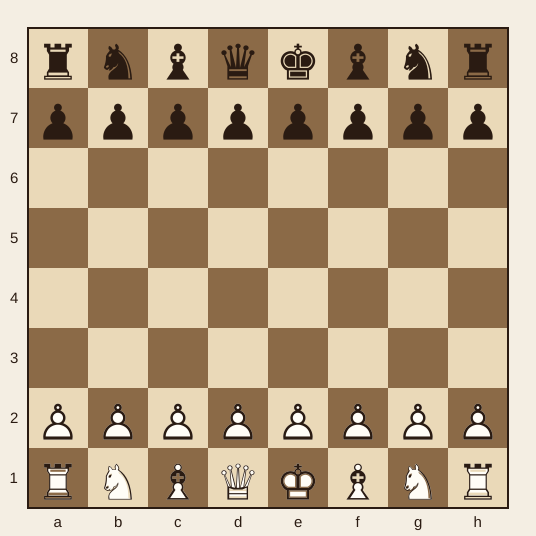
What the drawing pages include and what to print first
Print the drawing chess pieces drawings sheets on US Letter at 100 percent, not fit to page, then measure the grid square. If a square lands between 2 and 2.25 inches, you're set. Laminate one copy for dry erase and keep a paper copy for tracing. The free printable files are linked on the page in the chess printables set.
Each sheet gives one large piece outline, a faint square grid, and a small start-square label. The set covers 6 piece types and 32 starting squares, so a child can draw the whole army across 4 to 6 short sessions.
Paper size, print scale, and the 2 to 2.25 inch square check
US Letter is the default. A4 works if you print at 100 percent and check the grid with a ruler, since fit-to-page can turn a 2.25 inch square into a 2 inch square. Print the printable chess board at the same scale if you want the finished drawings to sit on a board.
Measure the square, not the piece. A 2 inch square should read 2 inches on the ruler. And a 2.25 inch square should read 2.25 inches. If the square reads 1.8 inches, raise the print scale in 5 percent steps untill the square hits the target.
How a parent or teacher runs a 15 minute drawing session
Start with the pawn and the rook. Straight lines and one round ball are kinder than a horse head, and 10 minutes on one piece is enough for most 7-year-olds. Stop at 20 minutes even if the knight looks like a dog.
But the blank grid won't teach perspective by itself, and that's fine. I'd rather see a kid draw 8 crooked pawns than copy one perfect rook from a screen. The third try usually finds the base width, and the first two tries teach the hand something.
Starting squares and drawing cues for the six pieces
Use the table as a label sheet, not a test. The chess pieces drawing guide covers the shape order, and the counts below keep a full set straight: 8 pawns, 2 rooks, 2 knights, 2 bishops, 1 queen, 1 king per side.
| Piece | White start | Black start | Drawing cue |
|---|---|---|---|
| King | e1 | e8 | Cross on top, base about 75 to 80 percent of a 2 inch square |
| Queen | d1 | d8 | Crown points, widest base after the king |
| Rook | a1, h1 | a8, h8 | Crenellations, 3 notches |
| Bishop | c1, f1 | c8, f8 | Slanted miter, 1 cut |
| Knight | b1, g1 | b8, g8 | Horse head, 2 ear shapes |
| Pawn | a2 to h2 | a7 to h7 | Round ball, 1 narrow stem |
If a child mixes up b1 and g1, write the letter on the sheet, not on the table. Two minutes of pointing at the queenside rook fixes more than a 5 minute lecture. The coordinates are labels, not decoration.
Lamination, dry erase markers, and classroom copies
Laminate the sheets with a 3 mil to 5 mil pouch if they will travel to a club night. Dry erase markers wipe off, and a 20 lb paper copy under the pouch keeps the grid from sliding. I'd laminate 4 copies before I laminate 20.
For a classroom center, print 12 copies on 20 lb paper and laminate 4 of them. The plain copies go home, and the laminated 4 stay in the math bin with 4 dry erase markers. If the class wants to build pieces after drawing them, how to make chess pieces has the cardboard and clay routes.
Fit-to-page errors and when to skip the poster print
The most common print error I see is a fit-to-page setting that shrinks the grid by 10 percent. A 2.25 inch square becomes 2.02 inches, which still looks fine on screen and feels wrong on the board. Print one test page before you run 30 copies.
I'd skip blown-up poster prints for a first lesson. A 2 inch square is the right target for small hands, and a 24 by 36 inch poster turns one rook into a 3 foot project that runs past a club night. Before drawing the knight, look at 4 photos in chess board pictures to see how the base sits inside the square.
Questions people ask me
What paper size should I use for drawing chess pieces drawings?
US Letter is the default, and A4 works when you print at 100 percent. Avoid fit to page, because a 2.25 inch square can shrink to 1.8 inches without a warning.
How do I scale the pieces to a 2 inch square?
Measure the printed square, not the piece. If the square reads 2 inches to 2.25 inches, leave the scale alone; if it reads 1.8 inches, bump the scale up until the square hits the target.
Can I laminate the drawing sheets?
Yes. A 3 mil to 5 mil pouch plus dry erase markers makes the sheets reusable for a club night or a classroom center.