Chess Pieces Meaning: What the 32 Pieces Stand For
Six piece types, 32 total, and a family tree that runs back to a 6th century Indian army. Here's what each one means and does.
Chess has 32 pieces, 16 per side, and just six kinds among them. Each one stands for a figure in an old Indian army: foot soldiers in front, cavalry and chariots on the flanks, an advisor and a king behind them.
That's the short answer to what the chess pieces mean, and it's the one I give when a kid at the club asks. What follows is the longer version. It explains why a bishop looks like a hat, why the rook is a tower when the word means chariot, and why the queen got promoted sometime in the 1400s.
Six kinds of pieces, and the figure each one stands for
| Piece | Count per side | Original figure | How it moves |
|---|---|---|---|
| Pawn | 8 | Foot soldier | One square forward, two on its first move, captures diagonally forward |
| Knight | 2 | Mounted cavalry | Jumps two squares one way and one square across |
| Bishop | 2 | War elephant | Slides any distance diagonally |
| Rook | 2 | Chariot | Slides any distance in a straight line |
| Queen | 1 | The king's advisor, the vizier | Slides any distance in any direction |
| King | 1 | The king himself | One square in any direction |
Eight pawns, two knights, two bishops, two rooks, one queen, one king. Sixteen pieces a side, lined up the same way every single game, which is why setup stops being a puzzle after about the third try. If you want the full inventory with names and counts, there's a separate page on how many pieces are in chess.
A few of those roles show up in the rules themselves. Pawns are the only pieces that can't move backward, which is exactly what you'd expect from infantry. Knights are the only ones that jump over anything, because that's what horses do. Bishops stay on one color for the whole game, since the two of them start on different colors and never meet. And the queen does everything the rook and bishop do, which is why losing her feels like losing a hand.
Where the names came from, and why English went its own way
Chess started in India around the 6th century as chaturanga, and the name meant four divisions: infantry, cavalry, elephants, chariots. The Persians picked it up as shatranj, kept the shapes and shifted the words. "Rukh" meant chariot in Persian. English players looked at the piece, saw a tower, kept the sound and changed the picture. That's the whole story of why the word and the shape don't match; if you want the long version, here's what a rook is.
The bishop is the other odd one. Most languages still call it an elephant: Russian slon, Spanish alfil, from the Arabic al-fil. English clerics got their hands on the game in the medieval period and the piece picked up a mitre, which is what that slit in the top is meant to be. The Germans call it Läufer, runner. The French call it fou, jester. Same piece, four completely diffrent pictures in the head.
Point values, and what they say about each piece's job
| Piece | Value in pawns | Job |
|---|---|---|
| Pawn | 1 | Hold ground, open lines |
| Knight | 3 | Short-range attack, awkward forks |
| Bishop | 3 | Long diagonals, especially in pairs |
| Rook | 5 | Open files, the seventh rank |
| Queen | 9 | Attack anywhere, but don't trade her for less |
| King | Not rated | Survive, then switch on in the endgame |
Those numbers are the ones you'll hear at every club night. Three pawns for a knight is a real trade, five pawns for a rook is a real trade, and a queen is worth roughly a rook plus a bishop. I'll concede the values are crude. A bishop on an open diagonal beats a knight on the rim most days of the week, and nobody has ever put a number on a rook that reaches the seventh rank. But as a first map of what each piece is for, the table holds up; the fuller breakdown lives on the chess piece values page.
The king is the one piece whose meaning the rules enforce
Every other piece gets its meaning from history. The king gets his from the rulebook. He moves one square at a time, he can never be captured, and when he can't escape check the game is over no matter how much material sits on the board.
That changes the shape of everything. I've watched a player up a queen lose a five-minute game because his king got boxed in and none of that material could defend the square next to it, and he sat there for a full minute afterward working out where it went wrong. Half of what looks like an attack at club level is really a king hunt. Read up on the king in chess before you play many games and the pattern starts showing up early.
Telling the pieces apart in your hand
US Chess guidance puts tournament king height between 3.375 and 4.5 inches, with squares from 2 to 2.5 inches and a king base around 75 to 80 percent of the square. A standard tournament set runs a 3.75 inch king on 2.25 inch squares, which is the setup most club players have used a thousand times.
Shape does the rest of the work.
| Piece | What to look for |
|---|---|
| King | Tallest piece, cross or crown on top |
| Queen | Second tallest, coronet with points |
| Bishop | Slit in the top, round head |
| Knight | Horse head, no symmetry at all |
| Rook | Flat top with crenellations, like a castle wall |
| Pawn | Smallest, plain ball on a short body |
One warning from club tables: cheap sets sometimes put the king and queen within a quarter inch of each other, and under bad light that's a problem. Check the two tallest pieces side by side before you buy.
If you need a set to learn on
Knowing what the pieces mean is one thing. Remembering how each one moves on move four of a real game is another, and these sets are aimed at that second problem.

Spin Master Games Cardinal Classics Chess Teacher
- Includes: Chessboard, 32 Chess Pieces, Instructions
The listing says every piece carries its name, its direction of travel and how many squares it can go, which is a decent crutch for a total beginner, so I'd buy it for a family with one kid learning the game.

A folding board with standard flat-bottomed plastic pieces and a price that suggests a grocery store shelf, so I'd skip it for a club player and consider it for a classroom or a gift for a 6-year-old.
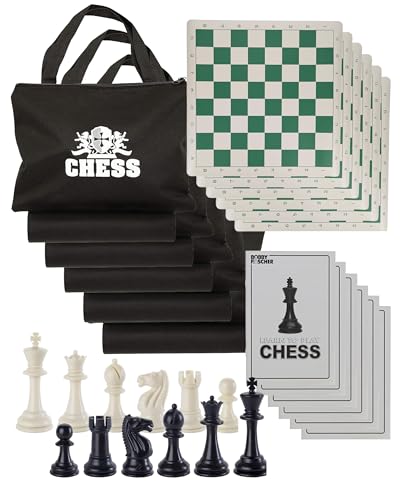
The listing says 34 pieces including two extra queens, a 3.75 inch king, 2.25 inch squares and a roll-up board built to FIDE and USCF proportions, and that's the one I'd buy for someone who plans to keep playing.
Last thing. Set the board up from a diagram rather than memory, and follow a guide on how to put chess pieces on the board so the back row lands right the first time. Then say each piece's name and move out loud as you place it: pawn goes one forward, knight jumps, bishop goes diagonal. Ten minutes of that beats an hour of reading.
Questions people ask me
What do chess pieces represent in real life?
An Indian army from around the 6th century. Pawns are infantry, knights are cavalry, bishops started as war elephants, rooks started as chariots, and the queen began as the king's advisor. The king is the only piece that still means exactly what the name says.
Which chess piece is the most powerful?
The queen, by a wide margin. She moves like a rook and a bishop combined and is usually counted as worth about nine pawns, against five for a rook and three for a knight or bishop. The king matters more, but he moves one square at a time.
Why is the rook called a rook?
From the Persian word rukh, which meant chariot. English players kept the name and swapped the chariot for a tower, so the word and the shape no longer match. German calls it Turm and French calls it tour, both meaning tower.