Chess Pieces Ranked: 1 to 9, and Why the King Sits Out
The classic 1/3/3/5/9 list, plus the spots where it lies to beginners.
Ranked by raw value, the chess pieces go pawn (1 point), knight (3), bishop (3), rook (5), queen (9), and king (no number at all, because losing him ends the game). Six ranks, 32 pieces, 64 squares, and that short list settles most of the arguments at a club table.
I've taught this count to adults on Tuesday nights and to eight-year-olds at the library, and it takes about ten minutes before somebody starts using it out loud. "Rook for bishop, I'm up two." Good. That's the habit worth building.
The ranking, piece by piece
| Piece | Value | Per side | What earns it that number |
|---|---|---|---|
| Pawn | 1 | 8 | Almost nothing on move 1, plenty by move 40 |
| Knight | 3 | 2 | Forks two pieces at once from the center |
| Bishop | 3 | 2 | Owns a long diagonal once the pawns move |
| Rook | 5 | 2 | Open file, seventh rank, hits from far away |
| Queen | 9 | 1 | Rook and bishop reach, at the same time |
| King | unranked | 1 | Can't be traded, so a number means nothing |
Add up one side and you get 39 points: eight pawns, two knights, two bishops, two rooks, one queen. The table is really a trade calculator. Bishop for knight is even. Rook for bishop hands over two points for nothing. Queen for two rooks is 9 against 10, which is why every coach in the room yells "take both." If you want the longer version of the arithmetic, the numbers live on my chess piece values page.
Why the king sits outside the list
Beginners ask what the king is worth, and the honest answer is that the question doesn't work. He can't be captured, only checkmated, so he never appears on the trading block. Coaches sometimes talk about a king being worth roughly four pawns in the endgame, meaning his ability to walk up the board and attack, but that's a feel, not something you compute.
What matters is where he stands. Castling kingside puts him two squares over behind three pawns, which is the safest real estate on the board for the first 20 moves. Leaving him in the center at move 15 is how a huge share of games under 1200 get decided, and not in the defender's favor. There's more on that in my piece on the king in chess.
Bishop and knight, the 3 against 3 argument
This is the one rank that genuinely splits people. Most charts give both 3, a few older books nudge the bishop to 3.25, and a pair of bishops is usually counted as an extra half pawn on top of the 6. Position decides the rest. Open board with pawns on both wings, the bishop wins. Locked pawn chains down the middle, the knight wins.
I'll take a knight over a bishop in a blocked position every time, and I've dropped more than one slow game to that preference. If you want to dig into the diagonal piece properly, my notes on the bishop chess piece cover the good and bad squares.
Where the pawn stops being worth 1
The old line is that a pawn on the seventh rank is worth a rook, and it holds up more often than you'd think. A white pawn sitting on a7 with a rook behind it creates about 5 or 6 points of practical trouble, not 1. Passed pawns, connected pawns, and pawns that fix enemy pieces all climb above their sticker price.
Doubled pawns go the other way. Two pawns stacked on one file still count 2 on paper, but the front one blocks the back one all game, and club players will happily hand over a bishop to create that stack. Eight pawns is alot of small decisions.
What the count leaves out
Coordination, tempo, and king safety don't appear anywhere in a 1 to 9 list. Two rooks doubled on an open file can beat a queen in plenty of positions, even though 10 against 9 looks close. A knight stuck on the rim is a 3 that plays like a 2. Yes, I know two rooks outrank a queen on the chart, and in a 3-minute blitz game I'd still rather hold the queen.
The list also assumes you know how many pieces you're working with in the first place. If the board in front of you has 30 pieces instead of 32, that's a problem before any trade happens, and my page on how many pieces in chess covers what should be in the box.
If you need a set to learn on
For a kid who has never moved a piece, the Spin Master Cardinal Classics Chess Teacher prints the piece name and the directions it travels directly on the plastic, which beats me drawing arrows on a napkin.

Spin Master Games Cardinal Classics Chess Teacher
- Includes: Chessboard, 32 Chess Pieces, Instructions
For a plain, cheap set that folds in half and lives on a shelf, the Point Games HI-Q set uses standard flat-bottomed plastic pieces on a cardboard board, and the listing says ages 6 and up.

For a first serious set, the WE Games Value Tournament comes with 34 pieces (two extra queens), a 3.75-inch king on 2.25-inch squares, and a 19.75-inch roll-up board, which lands right inside US Chess guidance of a 3.375 to 4.5 inch king and 2 to 2.5 inch squares.
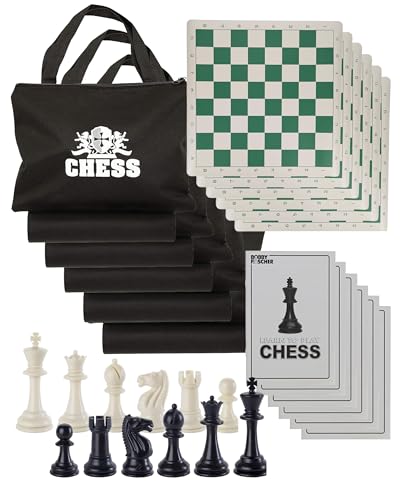
Next step: set the 32 pieces up tonight and play one game where you say the value out loud after every single capture. Do that for a week and the ranking stops being a chart and starts being a reflex. Then spend an evening on the basics at learn chess, because the point count only pays off once you know where the pieces belong.
Questions people ask me
What is the weakest chess piece?
The pawn, at 1 point. It's the only piece that can't move backward, and each side starts with eight of them blocking the back rank. A pawn that reaches the far side of the board promotes, so it stops being the weakest piece at exactly the wrong moment for your opponent.
Which chess piece is the most powerful?
The queen, at 9 points. She combines rook and bishop movement, so she can cross the board on a rank, a file, or a diagonal in a single move. That reach is also why beginners lose her early, since she's easy to chase with a knight or a pawn.
Is a knight better than a bishop?
On paper they're both 3 points, and the argument never ends. Knights do better in closed positions where pawns block the diagonals, since they jump over everything. Bishops prefer open boards and long diagonals, and a pair of bishops is usually counted as worth about half a pawn more than 6.