Queen Chess: How She Moves, What She's Worth, and When to Trade Her
Where she stands, why she costs 9 points, and the two-queen situation that surprises every beginner.
The queen moves any number of empty squares in a straight line: along her rank, along her file, and along both diagonals, 8 directions in total. From the middle of an empty board she covers 27 squares, more than any other piece. She's worth 9 points, and every game starts with exactly one queen per side.
That's the short answer. The rest is what I end up explaining at club night with a 3.75 inch king rolling around the table: where she belongs during setup, why 9 points changes your trade math, and what to do when a pawn turns into a second queen.
Eight directions, and the squares she covers
Think of the queen as a rook and a bishop sharing one body. Same straight lines, same stopping rules. She can't jump anything and she can't bend, which is why she feels unstoppable on an open board and cramped on a closed one.
From d4 on an empty board: 7 squares along the rank, 7 up the file, 7 on the a1-h8 diagonal, 6 on the other one. Total 27. From a1 it drops to 21, because one of her diagonals runs straight off the board. That gap matters. A centralized queen is a monster; a queen on the rim is a rook with expensive taste.
| Direction from the queen | Squares from d4 | Squares from a1 |
|---|---|---|
| Along the rank | 7 | 7 |
| Along the file | 7 | 7 |
| Long diagonal | 7 | 7 |
| Short diagonal | 6 | 0 |
| Total | 27 | 21 |
The L shape is the knight's, and only the knight's. Eight directions, none of them bending. If you want the long version, I've already written about whether a queen can move in an L shape, and the answer doesn't change with distance or with how much you want it to.
Where she stands, and the queen-on-her-color rule
White queen on d1, black queen on d8. d1 is a light square, d8 is dark, which is where the old saying comes from: the queen sits on her own color. Swap her with the king and you'll be untangling it in your head for the whole game.
The back rank runs, a to h: rook, knight, bishop, queen, king, bishop, knight, rook. Two rooks, two knights, two bishops, one queen, one king, eight pawns. That's 16 pieces a side and 32 on the board at move one. If you're still sorting out the lineup, my page on chess pieces has the starting square for all six types.
Nine points, and what that buys in a trade
Standard values: pawn 1, knight 3, bishop 3, rook 5, queen 9. The king gets no number, because you lose the game instead of trading him.
So a queen against two rooks (10 points) is a bad trade on paper. Queen against a rook and a bishop (8) is a good one. Queen against three minor pieces (9) reads level, though in a real game three coordinated pieces usually beat one queen, because she runs out of safe squares before they do. Here's my concession to the arithmetic: I'll gladly hand over my queen for two rooks in an endgame, and I'll refuse the same trade at move 12 with both kings still sitting in the middle. Position beats the chart. The chart just tells you what you're giving up, and my chess piece values breakdown covers the full scale if you want the reasoning.
One rule of thumb worth carrying: if you're ahead in material, trade queens. If you're behind, keep her on.
Two queens, and why sets ship a spare
A pawn that reaches the eighth rank promotes, and nearly everyone picks a queen. That's why a standard set of 32 pieces often ships with two spares, and why tournament sets list 34 pieces, with the extra queens bagged separately.
The rules don't cap you. Two queens is legal. Three is legal. So is a board with nine queens on it, assuming you somehow got nine pawns through. What you can't do is promote a pawn to a king, or leave the pawn parked on the eighth rank and pretend it's a rook.
If a second queen shows up in your club game, count material before you panic. For the full starting count on each side, see how many pieces in chess.
Queen habits that cost club players games
Four things, all fixable:
- Developing her on move 2 or 3. She gets bumped by a knight, then a pawn, then another pawn, and you spend five moves retreating. Knights and bishops first. Castle. Then find her a file.
- Hunting wing pawns. A queen raiding b2 or grabbing g7 while your king sits in the center wins a pawn and loses the game, usually inside 20 moves.
- Accepting 8 for 9. A rook and bishop for a queen is not close. It's one point, and one point decides a lot of endgames.
- Using her as a bodyguard. A queen defending three pieces isn't attacking anything. She wants a file with a target on it, or an eye on f7 and g7.
If you're rebuilding from scratch, my learn chess guide walks the opening moves in a sensible order, queen included.
Board sizes that keep the queen readable
On a physical board, the queen is the second tallest piece. That holds for any Staunton set worth owning, and it's how you spot her across a crowded table.
US Chess sizing guidance: king height 3.375 to 4.5 inches, squares 2 to 2.5 inches, king base about 75 to 80 percent of a square. Anything in that window plays fine.
| Measurement | Usual range |
|---|---|
| King height | 3.375 to 4.5 in |
| Square size | 2 to 2.5 in |
| King base | 75 to 80 percent of a square |
| Squares on the board | 64 |
If a listing won't print king height and square size, it's hiding the two numbers that matter. My page on the king in chess covers the proportions in more detail.
If you need a set to learn on
Three sets worth a look, each with a specific job:

Spin Master Games Cardinal Classics Chess Teacher
- Includes: Chessboard, 32 Chess Pieces, Instructions
The Cardinal Classics Chess Teacher prints the piece name plus the direction and number of spaces each piece can move, which is about as close to a queen cheat sheet as molded plastic gets.

The HI-Q Classic is a folding board with standard flat-bottomed plastic pieces for ages 6 and up, and there's nothing on it that'll confuse a kid working out what the queen does.
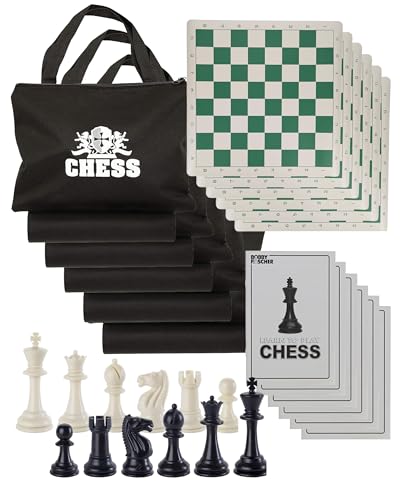
The WE Games Value Tournament set is the one I'd point a serious beginner at: 34 pieces with two spare queens, a 3.75 inch king, 2.25 inch squares on a 19.75 inch roll-up board, and a bag that swallows the lot.
Next step: set the board up tonight and play one game where your queen doesn't move before move six. Count how many times you wanted to move her earlier. That number is your habit, and it's the fastest thing in your game to fix.
Questions people ask me
How many queens are on a chess board?
Two at the start, one white on d1 and one black on d8. Pawns can promote, so a player can legally end up with two, three, or more queens in the same game. Sets often ship a spare queen for exactly that reason.
Can a queen move in an L shape?
No. She moves any number of empty squares along a rank, a file, or a diagonal, and she can't jump over anything. The L belongs to the knight alone, and a queen can never copy it.
Is the queen the most valuable piece?
By points, yes: 9 against 5 for a rook and 3 for a bishop or knight. The king still matters more because losing him ends the game, but he has no trade value and can't be captured.