The Queen in Chess: How She Moves, What She's Worth, and How to Stop Losing Her
One piece, eight directions, nine points: the queen explained the way a club player would explain her over a board.
The queen in chess is the strongest piece on the board. She moves any distance in a straight line, along a rank, a file or a diagonal, and she's worth 9 points, which is more than a rook and a bishop combined. One piece, eight directions. Nothing else in the box does that, and nothing else gets traded so reluctantly on a Tuesday night at the club.
Where the queen stands before the first move
Two things to burn in: White's queen starts on d1, Black's on d8, and she always starts on her own color. Light square for White, dark square for Black. The file letter and the color rule do the same job, so if you blank on one the other catches you.
| Piece | White square | Square color | Black square | Square color |
|---|---|---|---|---|
| Queen | d1 | light | d8 | dark |
| King | e1 | dark | e8 | light |
Count the files from White's left: a, b, c, d. Queen on the fourth, king on the fifth, and Black mirrors it exactly. That pairing is the fastest way to check a board somebody else set up. The king in chess sits right next to her, and if the two of them are on the wrong squares, everything downstream looks off to anyone who plays.
Thirty-two pieces at the start, sixteen a side, exactly one queen each. She's outnumbered by pawns eight to one.
How she moves, counted square by square
Pick her up, slide her in a straight line, put her down. Ranks, files, diagonals, any distance, no turning corners mid-move. She can't jump, which is the part beginners forget: a knight hops over the pawn wall in front of him, the queen has to go around or wait her turn.
The number that surprises people is how much board she covers from a standing start. On an empty board:
| Queen's square | Squares she attacks |
|---|---|
| a1 (corner) | 21 |
| d1 (her starting square) | 21 |
| d4 (center) | 27 |
The corner and her starting square happen to produce the same count, for diffrent reasons, and both trail the center badly. Park her on d4 and she touches 27 of the 63 other squares. That's the whole argument for centralizing her in one table.
And no, she can't move in an L shape. That's the knight's job alone, a question I get from students often enough that I wrote the long version at can queen move in L shape, including the one legal case where it looks like she did.
The 9 points, and what that number actually buys
Point values are a shopping list, not scripture. Still, the list is worth memorizing because it's how every club player decides whether to make a trade:
| Piece | Points |
|---|---|
| Pawn | 1 |
| Knight | 3 |
| Bishop | 3 |
| Rook | 5 |
| Queen | 9 |
Nine is shorthand for "don't give her up for anything less than a rook and a piece, and even then think about it." Here's my concession, though: I'd rather have two rooks (10 points between them) than a lone queen in most endings where pawns sit on both wings. The queen is worth 9 on paper, and two rooks coordinate better than she does. There's more on how those numbers get argued over at chess piece values.
The quick arithmetic that saves beginners: queen for rook plus bishop is 9 for 8, close enough to play. Queen for rook alone is a disaster you'll feel for thirty moves.
Four queen mistakes I see at every club night
Bringing her out on move two. 1.e4 e5 2.Qh5 is legal and it wins a few games against people who don't look up. Against anyone who does, 2...Nc6 3.Bc4 g6 kicks her around the board while they develop four pieces for free.
Grabbing the b7 pawn. Qxb7 looks like a free pawn because it usually is, until ...Qb6 or ...Nc6 arrives and the queen has to retreat with her tail between her legs. Count the defenders before you count the pawn.
Using her as a bodyguard. She's a 9-point babysitter parked in front of her own king. Meanwhile the rook on a1 has done nothing for twenty moves.
Trading her for two minor pieces without counting. Bishop plus knight is 6 against 9, and you'd better get a pawn and a strong square out of the deal or you've just donated a queen.
One more: knowing which piece is which under pressure. If you can't tell a queen from a king at a glance across a crowded table, the piece identification rundown at chess pieces is ten minutes well spent.
What the queen looks like, and how tall she is
In a Staunton set the queen is the second tallest piece, topped with a coronet of points rather than the king's cross. Her base is often the widest in the box, which is why she feels heavier in the hand than you expect.
| Spec | What the listing says |
|---|---|
| King height | 3.75 in |
| Square size | 2.25 in |
| Board size | 19.75 in |
| Piece count | 34 (32 plus 2 extra queens) |
Queen height isn't listed, and I won't invent one. In a set built around a 3.75-inch king she typically lands somewhere near 2.9 to 3.1 inches, but check the listing if it matters to you. For scale, US Chess guidance puts tournament kings between 3.375 and 4.5 inches, squares between 2 and 2.5 inches, and the king's base at roughly 75 to 80 percent of a square.
Those 34 pieces matter more than they sound. Two extra queens exist so a pawn can promote and you can keep playing without hunting under the table. The full breakdown of a standard army is at how many pieces in chess.

Spin Master Games Cardinal Classics Chess Teacher
- Includes: Chessboard, 32 Chess Pieces, Instructions
The Cardinal Classics Chess Teacher prints the piece name and the direction and number of squares on each piece, which is the closest thing to training wheels I've seen on a chess set.

The HI-Q classic set is a folding cardboard board with flat-bottomed plastic Staunton-style pieces, plain and cheap and fine for a first year of club-style play.
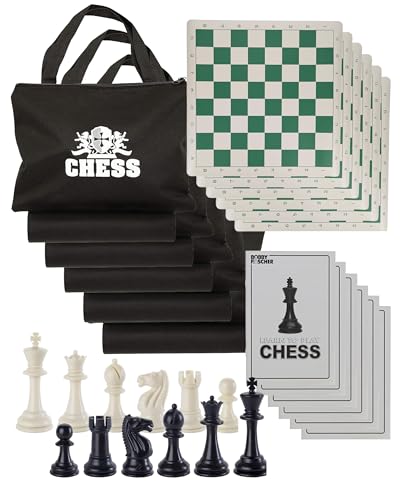
The WE Games value tournament set gives you a 3.75-inch king, 2.25-inch squares, a roll-up board and two extra queens, which is the setup I'd point a serious beginner toward.
Set a lone queen on d4 tonight and count the squares she touches out loud, then move her to d1 and count again. Twenty-seven, then twenty-one. Ten minutes of counting will teach you more about her than an hour of reading.
Questions people ask me
Can you have two queens in chess?
Yes. A pawn that reaches the far rank can promote to a queen, and tournament sets often include two extra queens for exactly that reason (34 pieces instead of 32). Nine queens is the theoretical maximum for one side: the starting queen plus eight promotions.
Which square does the queen start on?
d1 for White and d8 for Black. The rule that saves you is simpler than the file letter: the queen sits on her own color, light square for White and dark square for Black. The king takes the other one.
Is the queen stronger than the king?
She's worth more, 9 points against the king's untradeable value, but the king can't be captured and she can. Losing the queen usually loses the game, which is why beginners are told to move her carefully and keep the king tucked away.