What Is a Rook in Chess? The Tower That Owns Open Files
The tower piece, its 5-point value, the corner squares it starts on, and the castling move it shares with the king.
A rook is one of the six types of chess piece, and it's the tower-shaped piece worth about 5 points that moves any number of empty squares in a straight line, sideways or up and down the board. Each player starts with 2 rooks, one in each back corner: a1 and h1 for White, a8 and h8 for Black. That's the short answer. The longer answer is why the piece wins so many club games and why beginners keep leaving it asleep in the corner for 30 moves.
How a rook moves: any distance, one straight line
Rooks travel along ranks and files, never diagonals, and they stop only when they reach a piece or the edge of the board. A rook on e1 with an empty file ahead of it reaches e8 in a single move. That's 7 squares in one turn, and no bishop on the board can match the range.
And a rook can't jump. Not over a friend, not over an enemy. If your own pawn sits on e4, the rook behind it on e1 is going nowhere untill that pawn advances or gets traded. That's why rooks feel clumsy in the opening. Honestly, they are clumsy in the opening. In my experience, a rook that comes out early just gets chased back down the board by a knight.
The notation letter is R, so Rxe7 means a rook captures on e7, and Rad1 means the rook from the a-file goes to d1. If the letters still look like noise, my rundown of chess pieces covers all six symbols and what each one looks like on a real set.
| Rook question | Answer | | Which way does it move? | Ranks and files only, never diagonally | | How far? | Any number of empty squares | | Can it jump? | No, never | | How does it capture? | By landing on the enemy piece | | Notation letter | R | | Starting squares | a1, h1, a8, h8 |
Where the rooks start, and why the corners work
Set up all 32 pieces and each side gets 2 rooks, one parked in each corner of its back rank. From White's left, the back rank runs rook, knight, bishop, queen, king, bishop, knight, rook. Queen on her own color, so the white queen sits on d1 and the black queen on d8.
A corner is a strange home for a piece that wants open space. But it keeps the two rooks out of each other's way and lets them swing along the first rank once the minor pieces clear out. Rooks belong on the outside edges of the board and in the middle of the action, just not at the same time.
If you're teaching a kid, have them place the rooks last. They're the easiest pieces to pick out of a pile, and the corners are the easiest squares to remember. My walkthrough of how to put chess pieces has the full setup order if the back rank still trips you up.
What a rook is worth, piece by piece
The standard count gives a rook 5 points, behind only the queen.
| Piece | Value | Rook comparison | | Pawn | 1 | A rook is worth about 5 pawns | | Knight | 3 | Rook plus a pawn is usually better than two knights | | Bishop | 3 | Bishops beat rooks only when the board is closed | | Rook | 5 | Two of them roughly equal a queen | | Queen | 9 | A queen beats two rooks that are stuck defending each other | | King | Not counted | Lose it and the game ends |
Two rooks (10) beat a queen (9) in most open positions, and I'd take that trade every time as long as my rooks have files to work on.
But 5 is a rule of thumb, not physics. On a jammed board with every file blocked, a rook can play like a 3. Give it one open file and it plays like a 6. That's the honest version, and it's the reason coaches nag you about trading into open positions. The numbers behind that argument are in my piece on chess piece values.
Castling: the one move the rook and king share
Castling is the only move in chess that shifts two pieces in one turn. The king slides 2 squares toward a rook, and the rook hops over to the square the king crossed.
Kingside, that means king e1 to g1 and rook h1 to f1. Queenside, king e1 to c1 and rook a1 to d1. Black does the same thing on the 8th rank.
The conditions are where beginners get caught out: neither piece has moved yet, every square between them is empty, the king isn't in check, and the king doesn't pass through or land on a square an enemy piece attacks. The rook can be under attack during all of this. The rook can pass through an attacked square. Only the king is fussy. For the king half of that deal, see king in chess.
Open files, the seventh rank, and the two-rook ladder
A rook on e7 on an otherwise empty board touches 14 squares, 7 along the rank and 7 along the file. That reach is why the seventh rank is such an unpleasant place to meet one. A rook planted there attacks pawns that haven't moved yet and pins the enemy king to its back rank.
Open files matter more than anything else for these pieces. Scan all 8 files after every trade; a file with no pawns on it is a highway, and doubled rooks on that highway end a lot of club games. I underrated that idea for years and spent whole evenings with both rooks on a1 and h1 doing nothing.
Then there's the ladder mate, the first checkmate I teach anybody. Two rooks, one on the seventh rank and one on the sixth, and you walk the enemy king to the edge one rank at a time. No bishop, no knight, no cleverness. It works from almost any position where the king is cut off, which is exactly why it's the first thing I show a kid who has just learned the moves. From there a proper learn chess plan makes more sense than memorizing openings you don't understand yet.
If you need a set to learn on
I haven't unboxed any of these three. I'm going by the listings and by what owners keep mentioning in reviews.

Spin Master Games Cardinal Classics Chess Teacher
- Includes: Chessboard, 32 Chess Pieces, Instructions
The Cardinal Classics Chess Teacher prints the direction and number of squares on each piece, which is the crutch a beginner needs for the first month and doesn't need after that.

HI-Q's standard plastic set with a folding cardboard board is the cheap one to leave in a classroom, a car trunk, or a grandparents' house.
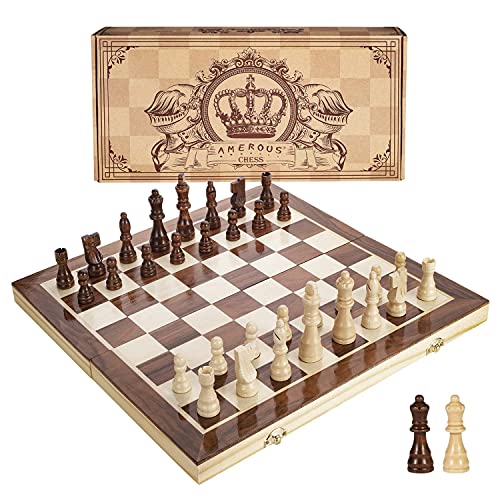
The AMEROUS 15 inch magnetic wooden board folds up with slots for the pieces and ships with 2 extra queens, so it's the one I'd drop in a club bag.
Set up the starting position tonight, clear everything off the board except the two kings and one rook, and learn the king and rook checkmate. Ten minutes a night for a week and a lone king will never scare you again.
Questions people ask me
Can a rook jump over other pieces?
No. A rook slides any number of empty squares but stops at the first piece it meets, friend or enemy. If a pawn blocks the file, that rook waits until the pawn moves or gets traded off.
How many rooks are on a chessboard?
Four at the start. Each side gets 2, one in each back corner: a1 and h1 for White, a8 and h8 for Black. A pawn can promote to a rook as well, so a finished game can have more than four on the board.
Is a rook worth more than a bishop?
Yes, on the standard count. A rook is 5 points and a bishop or knight is 3. The gap shrinks in closed positions where the rook has no open file to work with, which is why coaches tell you to open lines before you trade into a rook endgame.