3D Printed Chess Board: What to Print, What to Scale, What to Skip
Two routes to 64 squares: the free printable files you can tape together tonight, and the tile math behind a plastic board.
Free downloads
PDFs, 0.9 inch squares. Print at 100% (actual size), not “fit to page”.
- Blank board with coordinates: US Letter · A4
- Blank board, no coordinates: US Letter · A4
- Board with pieces in the starting position: US Letter · A4
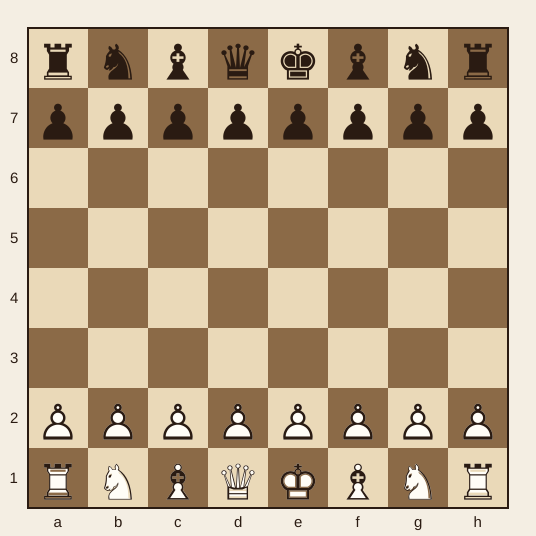
A 3D printed chess board is a set of STL files you slice for a filament printer, and most designs break into four or more tiles because an 18 inch board won't fit a 220 x 220 mm bed. That's the plastic route. The free printable files linked on this page are the paper route: same 64 squares, same coordinates, no hardware required.
I'm blunt about the split because I've watched people start a long print and quit at tile two. Paper gets a board on the table tonight. Filament gets you something you can hand down, if you finish it.
What the free printable files include
The free printable files linked on this page are the printable chess board set, laid out for Letter paper at 8.5 by 11 inches. On A4, print at 100 percent and trim the overhang rather than letting the driver shrink the sheet to fit. You want a plain grid for play, a labeled grid with files and ranks for teaching, and a sheet of flat pieces if the house set has gone missing under a couch.
Print settings matter more than paper stock
Set the dialog to Actual Size, or 100 percent. "Fit to page" shrinks a Letter sheet by 4 to 6 percent on most drivers, and that's the difference between a 2 inch square and a 1.9 inch square, which is the difference between a pawn that sits on its square and a pawn that overhangs it.
Measure the first square with a steel ruler before you print the remaining three sheets. If the number is wrong, fix the scale in the dialog, not with a knife.
Square size: aim for 2 to 2.25 inches
US Chess guidance puts tournament squares at 2 to 2.25 inches, with kings from 3.375 to 4.5 inches tall and a king base around 75 to 80 percent of the square. You don't need tournament numbers for a kitchen table game. You do need pieces that fit. A pawn with a 1.25 inch base on a 1.5 inch square looks like a crowd on a bus.
So print big enough to move the pieces you own, and don't agonize past that.
The four sheet layout for a 16 inch board
At 2 inch squares the board is 16 inches across, so it comes out as four sheets of 8 by 8 inches. Rank 8 sits at the top, the way White sees it.
| Sheet | Squares | Coordinates | Printed grid |
|---|---|---|---|
| 1 | 16 | a8 to d5 | 8 x 8 in. |
| 2 | 16 | e8 to h5 | 8 x 8 in. |
| 3 | 16 | a4 to d1 | 8 x 8 in. |
| 4 | 16 | e4 to h1 | 8 x 8 in. |
An 8 inch grid on Letter leaves about a quarter inch of margin on each side, and plenty of inkjets can't reach that far in. Two fixes. Print at 96 percent and accept 1.92 inch squares, or move to 11 by 17 tabloid, landscape, where half the board fits on one sheet at 2 inch squares (16 by 8 inches of grid, two sheets total). Tabloid is my pick for a classroom board that gets picked up and moved.
Laminating and taping so it survives a school bag
Use 3 mil pouches for a board that lives on a table, 5 mil if it travels. A 100 pack of 3 mil letter pouches runs under $20, which is cheaper than reprinting the set every month. Choose matte film if the room has overhead fluorescents, since gloss throws a glare straight across the dark squares and kids end up tilting their heads.
Join the sheets from the back with clear packing tape, hinge style, so the board folds along the seam instead of tearing. And tape the corners down on the table with painter's tape if you're teaching a group. Boards slide.
Printing the board in PLA instead
If you own an FDM printer, the usual recipe is a 0.4 mm nozzle, 0.2 mm layer height, and 1.75 mm PLA, which runs $18 to $25 for a 1 kg spool. Board designs tend to interlock with dovetails or hold 6 x 2 mm magnets in pockets, so they fold up for a bag. Bed size decides the tile count: a 220 x 220 mm bed swallows a 4 by 4 square tile at 2.25 inch squares with room for a brim, so four tiles plus seam tuning.
You'll spend more time sanding seams than printing squares. That's the part nobody mentions in the listing photos.
The 3D printed chess pieces are where the hobby actualy gets fun, since a knight is a real modeling problem and a square is not.
And here's my honest read on the result. A printed board is light and hollow, and setting a piece down on it makes a plastic clack that carries across a quiet room. A $25 roll-up vinyl board with printed squares plays better chess and weighs less in a bag. I'd print one because I like making things, not because it beats vinyl. If you want to see what the good ones look like before you commit a weekend, browse the best 3D printed chess sets and steal their finish choices.
Getting the pieces on the right squares
White queen on d1, black queen on d8, white king on e1, and the light square goes in each player's right-hand corner. Queen on her own color, in other words. Tape a small labeled strip along the near edge if beginners keep asking which side the king starts on, then take it off once they stop. There's a fuller walkthrough in the chess board setting guide, including how to orient the board so both players read the same coordinates.
Drawing your own grid if nothing fits your table
Sometimes the table is 14 inches wide and no print layout works. Then draw it. Eight squares at 2 inches is a 16 inch grid, so reduce to 1.75 inch squares for a 14 inch board, and keep the border at a half inch so pieces don't hang off the edge. A t-square, a fine Sharpie, and 20 minutes gets it done. Steps are here: how to make a chess board.
One last thing. Print the labeled version and the plain version both. The labels teach coordinates; the plain grid lets a nervous beginner forget about notation and just play.
Questions people ask me
Can you 3D print a chess board?
Yes, but almost nobody prints one in a single piece. A board with 2.25 inch squares is 18 inches across, and a typical FDM bed is 220 mm, so designs come as four or more interlocking tiles. Budget the seam cleanup as part of the project.
How do I print a chess board at the right size?
Set your print dialog to Actual Size rather than Fit to Page, then measure one square with a steel ruler. For tournament-style play, aim for squares between 2 and 2.25 inches. If the first sheet comes out small, change the scale percentage and reprint before you laminate anything.
Is a 3D printed chess board as good as a real one?
Not for tournament use, no. Printed plastic boards are light and hollow, they clack under the pieces, and seams between tiles can trip a sliding bishop. For club play I'd take a vinyl roll-up; for a first board at home, printed or paper works fine.