Chess Board Outline Printables: Free Grids and Piece Shapes to Print
A chess board outline is 64 empty squares and a sheet of piece shapes. One page of paper covers a whole classroom.
Free downloads
PDFs, 0.9 inch squares. Print at 100% (actual size), not “fit to page”.
- Blank board with coordinates: US Letter · A4
- Blank board, no coordinates: US Letter · A4
- Board with pieces in the starting position: US Letter · A4
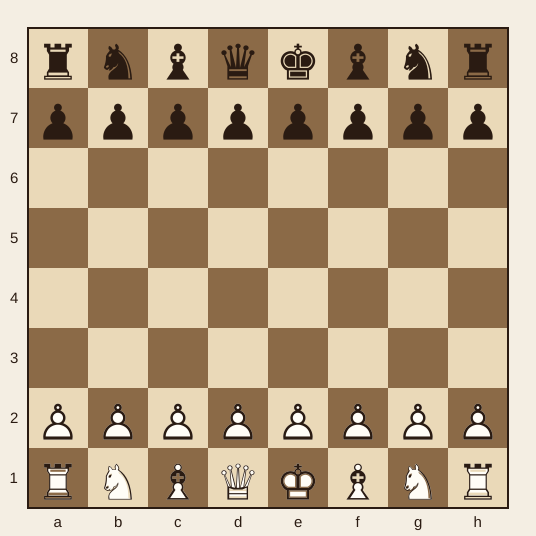
A chess board outline is 64 empty squares and nothing else
A chess board outline is a grid of 64 squares, 8 by 8, printed with no pieces drawn inside. That's the whole idea. The free printable files are linked on this page, and they cover three things: a plain grid, a grid with letters and numbers down the sides, and a sheet of piece outlines sized to sit on the squares.
I've run club nights where the boards ran short and we fell back on paper. It works. A laminated sheet and a handful of plastic pieces gets a beginner through an evening of chess without anyone complaining.
Here's my one honest caveat: paper will not survive a season of Tuesday nights. Corners fur up, creases show up along the folds, and someone always spills something. Print a stack, expect to reprint, and don't get attached.
Paper size, margins, and why a full board won't fit on one sheet
Do the arithmetic before you hit print. Eight squares at 2.25 inches is 18 inches of board. Letter paper is 8.5 by 11 inches. A4 is 210 by 297 millimeters. Neither one holds an 18 inch grid, and no printer setting changes that.
What fits: subtract half-inch margins from letter paper and you have 7.5 inches of usable width. Divide by 8 and you get squares around 0.94 inch. Small, but readable. If you want a true 2 to 2.25 inch square, plan on a tiled print across four sheets, or print the printable chess board version that's already laid out for tiling.
Two printer settings matter more than anything else in that dialog. Set scaling to "actual size" or a custom percentage, not "fit to page." And turn borderless printing off, because borderless quietly rescales the image to hide the white edge.
Scaling the outline until squares measure 2 to 2.25 inches
Print one copy at 100 percent first. Measure a single square with a ruler, then do the math: target size divided by measured size, times 100. That's the number you type into the custom scale box. Nothing else.
| Measured square on the printout | Enter this scale for a 2.25 inch square |
|---|---|
| 2.5 in | 90% |
| 2.25 in | 100% |
| 2.0 in | 112% |
| 1.8 in | 125% |
| 1.5 in | 150% |
| 0.94 in | 240% |
Anything past about 200 percent is easier to tile than to scale, because most home printers clip the edges when the custom scale climbs. Measure again after the second print. Printers drift a percent or two, and a board that's off by a sixteenth of an inch per square is off by half an inch across the rank.
Taping four sheets into one 18 inch board
Print the grid in quarters, trim the white margins off two edges of each sheet, and butt the squares together rather than overlapping them. Tape across the seams on the back first, then run a strip down the front. Matte tape, not shiny, or the glare under a ceiling light will drive you up a wall.
An 18 inch board with a half-inch coordinate border needs 19 inches of surface. A 20 by 30 inch piece of foam board handles it with room to spare, and it stays flat across a table.
Laminating, and which marker to hand a kid
A 3 mil pouch is the cheap option and it's fine for a single student at a kitchen table. Go to 5 mil for a classroom set, because 3 mil corners curl after a few weeks of being stacked and shoved in a cupboard.
Laminated boards take dry erase marker, which is the point. Students circle squares, draw arrows for a knight's path, cross out bad moves. Use dry erase only. Wet erase and permanent markers ghost the surface, and I've watched a teacher ruin six boards that way in one afternoon. Test one corner with a scrap piece first.
The piece outlines sheet, and sizing shapes to the squares
The piece sheet is where most printables fall apart. A king outline sized for a 3.4 inch tournament piece looks wrong on 0.94 inch squares, so pick one scale and stick with it. If you're matching a real club set, king height around 3.375 to 4.5 inches puts the base at roughly 75 to 80 percent of a square. On a 2.25 inch square, that's a base near 1.7 inches.
The chess pieces drawing guide covers the actual shapes, including the knight, which is the one everybody mangles. Profiles matter more than detail at this size. A pawn is a circle on a foot with a collar. Get the silhouette right and nobody notices the rest.
If you want photographs to check your shapes against, the chess board pictures collection shows real boards from above, which is the angle you're drawing.
Coordinates, piece counts, and what goes where
The files with letters and numbers use standard algebraic labels: files a through h left to right from White's side, ranks 1 through 8 from the bottom. a1 is a dark square. That single fact trips up more beginners than any opening.
| Piece | Per side | Total on the board |
|---|---|---|
| King | 1 | 2 |
| Queen | 1 | 2 |
| Rook | 2 | 4 |
| Bishop | 2 | 4 |
| Knight | 2 | 4 |
| Pawn | 8 | 16 |
| Total | 16 | 32 |
That's 32 outlines to cut if you're making a full set of paper pieces. Queens go on their own color, d1 for White and d8 for Black. The chess board setting guide has the full starting layout if you want a diagram to hand out alongside the empty grid.
Drills that work on a laminated outline
Three uses justify the printer ink. First, setup races: hand out a board and pieces, time the kids to a correct starting position, and watch how fast they learn that the queen sits on her own color. Second, notation quizzes: call out a square, have them circle it. Third, knight's tours, where a student draws a path covering all 64 squares.
For older students, print two outlines and use one as the "answer key" board. Call out moves in algebraic notation and have them play both sides on paper. It's slow, and it's the fastest way I know to fix a kid who can't find c4 under time pressure.
Printing errors that waste a ream of paper
Draft quality is a false economy here, since pale gray grid lines are hard to see across a table. Standard or high quality, black lines, plain paper. Skip the photo paper.
The bigger mistake is laminating before you measure. Once a sheet is sealed in plastic, a quarter-inch error is permanent. Measure, tape, then laminate. And if you're printing the piece outlines on the same run, check they're on a seperate page and at the same scale as the board.
More grids, score sheets, and notation paper live in the chess printables collection if you want a full packet for a classroom.
From paper outline to a board you keep
A good outline doubles as a template. Tape it to a piece of 3/4 inch plywood, center punch the corners of the 64 squares, and you have your cutting and painting layout without measuring a single square by hand. The diy chess board walkthrough covers that jump from paper to wood.
Until then, print the plain grid, print the coordinate version, print the piece shapes. Twenty minutes at the kitchen table and you've got enough boards for a small tournament.
Questions people ask me
What size should a printable chess board outline be?
Aim for squares between 2 and 2.25 inches, which is the range US Chess gives for tournament play. That makes the full grid 16 to 18 inches across, so a full-size board has to be printed across four sheets and taped. A single-sheet version lands around 0.9 inch squares and is fine for notation practice.
Can I print a chess board outline on one sheet of paper?
Yes, and most people should start there. A letter sheet with half-inch margins leaves about 7.5 inches of printable width, so each of the 8 squares comes out near 0.94 inch. That's too small for real pieces but perfect for drills, quizzes, and teaching the grid.
How do I resize an outline to match pieces I already own?
Measure one square on the printout with a ruler, then divide your target size by that measurement and multiply by 100. A 2 inch square scaled to 2.25 inches needs 112 percent. Turn off fit to page in the print dialog and enter the number yourself.