A Paper Chess Board You Can Print Tonight, at the Right Square Size
What to print, what scale to use, and how to turn four sheets of paper into a board that sits flat under real pieces.
Free downloads
PDFs, 0.9 inch squares. Print at 100% (actual size), not “fit to page”.
- Blank board with coordinates: US Letter · A4
- Blank board, no coordinates: US Letter · A4
- Board with pieces in the starting position: US Letter · A4
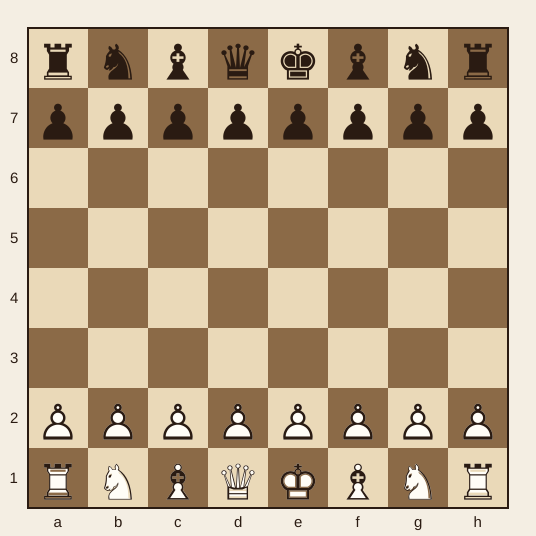
Print the board at 100% scale, not "fit to page," on US Letter or A4, then measure one square with a ruler before you tape anything. If real club pieces are going on it, aim for squares of 2 to 2.25 inches, which is what US Chess guidance lines up with for kings between 3.375 and 4.5 inches tall. One sheet of Letter paper won't get you there. It gives you roughly 1 inch squares, which is fine for a kid's first game and cramped for anything else.
So plan on two jobs: a quick single-sheet board for tonight, and a taped multi-sheet board for anything serious. The free printable files are linked on this page, and both versions are included.
What the free printable files contain
The set covers a blank 8x8 grid, a labeled version with a1 to h8 printed inside the squares, and a four-page tile designed to butt together into a 16 x 16 inch board. Print the labeled one if anyone at the table is still learning coordinates, because hunting for c4 out loud is half the point. The wider collection of chess printables also has scoresheets and diagram pages if you're building a folder for a class.
Print settings that keep the squares square
Set scaling to 100% or Actual Size, turn off Fit to Page, and leave the margins on default rather than borderless. Print the first page alone, then measure the full width of the board: eight 1 inch squares should measure 8 inches exactly, not 7.75. I've seen printers quietly knock 4% off a page to satisfy their own margins, and the only way you catch it is a ruler on paper. Grayscale is plenty for a board, and it saves the color cartridge for the pieces.
Reaching a 2 to 2.25 inch square on home paper
Here's the arithmetic that decides everything: eight squares at 2.25 inches is 18 inches of board, and Letter paper is 8.5 by 11. You can't print that in one pass, so you tile it. Trim the margins off the joining edges only, line the grid lines up under a lamp, and tape the back first. If you'd rather build the whole thing from scratch with a ruler and a pen, the walkthrough on how to make a chess board covers the layout math.
| Paper and layout | Squares per sheet | Finished board | Square size |
|---|---|---|---|
| Letter, single sheet | 8 x 8 | about 8.5 x 8.5 in | about 1 in |
| A4, single sheet | 8 x 8 | about 7.9 x 7.9 in | about 1 in |
| Letter, 4-sheet tile | 4 x 4 | 16 x 16 in | 2 in |
| Letter or A4, 9-sheet tile | 3 x 3 | 18 x 18 in | 2.25 in |
| Tabloid 11x17, 2-sheet | 4 x 8 | 16 x 16 in | 2 in |
Taping, covering, and keeping it flat
Paper curls. It always curls, and a board that rocks under a knight is worse than no board. Tape every seam on the back with clear packing tape, then cover each sheet with clear shelf liner or a 3 mil laminating pouch before assembly so the front wipes clean. A strip of non-slip shelf liner under the finished board stops the whole thing creeping across a table during a blitz game. If you want a printed grid to practice on before you commit to a full board, the chess board outline page gives you an empty one.
Coordinates and starting pieces to check your print
Once the ink is dry, read the labels out loud against this table. Getting the colors flipped is the most common printing mistake, and it makes the board useless for anyone counting files. The test is simple: a1 is dark, and a square is dark when the file number plus the rank number comes out even (a is 1, h is 8).
| Square | Color | White piece at the start |
|---|---|---|
| a1 | dark | rook |
| b1 | light | knight |
| c1 | dark | bishop |
| d1 | light | queen |
| e1 | dark | king |
| f1 | light | bishop |
| g1 | dark | knight |
| h1 | light | rook |
Count 32 pieces total, 16 per side: 8 pawns, 2 rooks, 2 knights, 2 bishops, 1 queen, 1 king. The white queen starts on a light square, which is the detail people forget when they're setting up in a hurry, and the full setup walkthrough lives on the chess board setting page.
A paper board for a class of 24 kids
Four sheets per board times 24 boards is 96 sheets, so one 500-sheet ream covers a whole classroom set with room for misprints. Print single-sided in grayscale, stack the four quadrants per child, and let them tape their own, which takes about five minutes each and teaches them where the dark corner goes. Folded paper boards also survive backpacks better than a rigid one. If the pieces keep wandering off, printable chess pieces drawing sheets give every kid a spare set to color.
When paper stops being the right tool
I'll be blunt: a taped paper board slides, dents, and never quite lies flat again after a week in a tote bag. If you're playing weekly, a vinyl roll-up mat or a wooden board earns its place, and paper becomes the spare you keep in the car for the park. But for a rainy Sunday, a classroom, or a hotel room with a travel set, printed paper at the correct square size does the job for the cost of a few sheets. Just print at 100%, measure before you tape, and don't skip the non-slip liner.
Questions people ask me
What size should a printable chess board be?
An 8x8 grid with squares between 2 and 2.25 inches suits standard pieces, since US Chess guidance puts kings at 3.375 to 4.5 inches tall and squares at 2 to 2.5 inches. A single sheet of Letter paper usually maxes out near 1 inch squares. Full size means tiling four or nine sheets together.
How do I print a chess board so the squares come out square?
Set page scaling to 100% or Actual Size and switch off any Fit to Page option, then print one page and measure a square with a ruler. Many printers quietly shrink a page to fit their margins, and you won't notice until the pieces look crowded. If the measurement is off, fix the setting before you print the rest.
Do I need to laminate a paper chess board?
Not required, but a 3 mil laminating pouch or a layer of clear shelf liner turns a floppy sheet into something that survives a club night. Laminate or cover each sheet before you tape the tile together. Laminated paper slides on a bare table, so put a strip of non-slip shelf liner underneath.